
Middle America (964 – 1107 CE): Goldworking …
Years: 964 - 1107
Middle America (964 – 1107 CE): Goldworking Chiefdoms, Toltec Horizons, and Maritime Cities of the Itzá
Geographic and Environmental Context
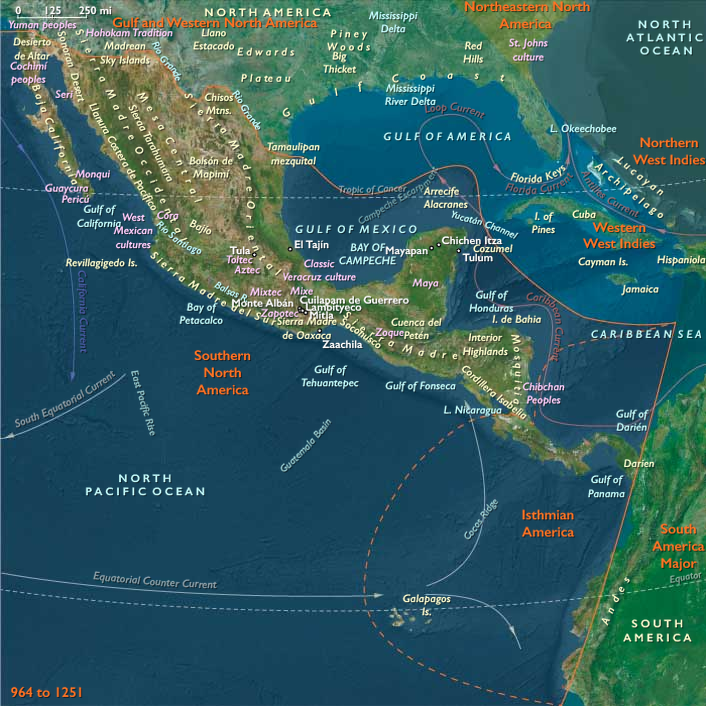
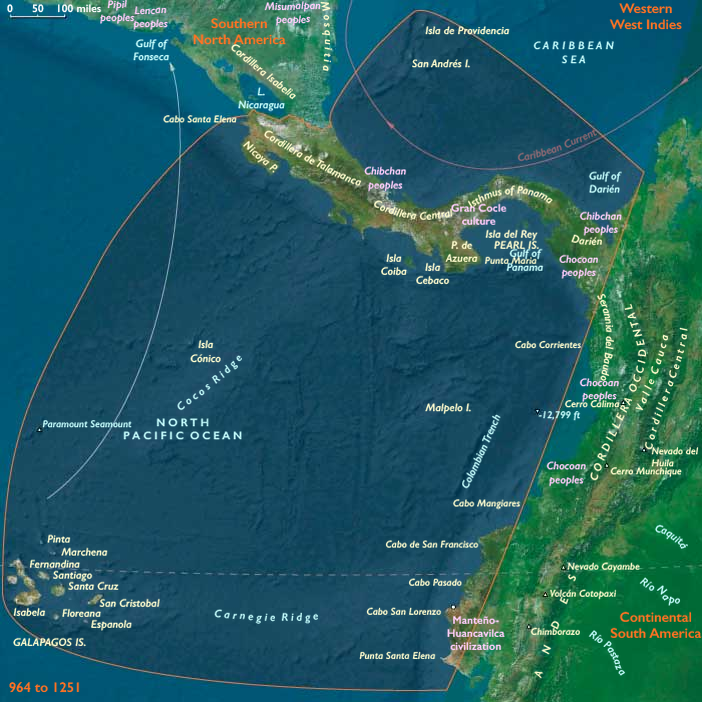
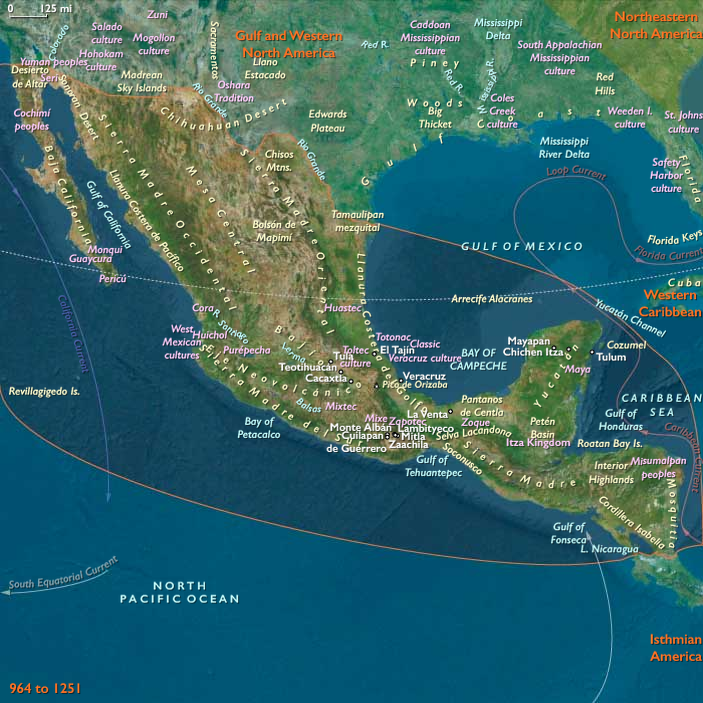
Middle America during the Lower High Medieval Age bridged the tropical isthmus and the Mesoamerican highlands, encompassing Mexico, Guatemala, Belize, Honduras, El Salvador, Nicaragua, Costa Rica, Panama, and the adjacent coasts of Colombia and Ecuador, along with the uninhabited Galápagos and San Andrés islands.
It was a region of volcanic highlands, fertile valleys, and dual coasts, divided by forested mountains but united by trade—linking Tula and Chichén Itzá in the north with the goldworking chiefdoms of Costa Rica and Panama in the south.
Canal-like portages across the Isthmus of Panama allowed goods, ideas, and people to move rapidly between the Pacific and Caribbean, making Middle America one of the most interconnected regions of the pre-Columbian world.
Climate and Environmental Shifts
The Medieval Warm Period (c. 950–1250) brought generally stable warmth and regular monsoon rains.
-
Mexican highlands and Yucatán north enjoyed reliable maize harvests.
-
Pacific Soconusco coast and Belize–Bay of Honduras lagoons maintained year-round cacao and salt production.
-
Costa Rica–Panama valleys alternated between dry-season maize and wet-season manioc and cacao.
-
ENSO cycles produced occasional droughts, but regional diversity of crops and coastlines buffered disruption.
-
Pacific upwellings supported rich fisheries, while Caribbean mangroves yielded abundant shellfish.
Societies and Political Developments
Central Mexican and Yucatán Realms
The Toltec capital of Tula (Tollan) rose around 980 CE as a militarized and mercantile hub of the Valley of Mexico.
-
Toltec artisans standardized bronze, obsidian, and ceramic production; its Atlantean columns symbolized a new warrior–sun ideology.
-
Highland–Gulf routes distributed metal ornaments, turquoise, and cacao north and east.
In the Yucatán, Chichén Itzá flourished as a maritime thalassocracy, projecting power from its walled city and coastal ports like Isla Cerritos. -
Its temples and ballcourts, adorned with serpents and Kukulcan imagery, became centers of diplomacy and ritual trade linking the Caribbean to the Mexican plateau.
To the south, the Mixtec hill states of Oaxaca, such as Tilantongo, and the Zapotec ceremonial center of Mitlarefined dynastic statecraft recorded in painted codices, marrying artistry with politics.
Highland and Coastal Peripheries
In Guatemala and western Honduras, fortified hilltop towns controlled obsidian passes and river valleys; inter-lineage warfare alternated with trade alliances.
The Belize–Bay of Honduras coast maintained lagoon towns and ports (e.g., Lamanai), serving as entrepôts for cacao and cotton textiles.
Along the Pacific slope—from Soconusco to Nicaragua—fertile volcanic plains supported cacao plantations and coastal markets connecting Mexico to the Isthmus.
Isthmian Chiefdoms and Canal Routes
Further south, the chiefdoms of Costa Rica and Panama reached their apogee.
-
Caciques ruled villages built around plazas, earthen mounds, and ballcourts.
-
The Diquís culture continued producing monumental stone spheres, symbols of cosmic order and lineage prestige.
-
Skilled goldsmiths perfected lost-wax casting, creating intricate tumbaga (gold–copper) pectorals and pendants depicting jaguars, crocodiles, and birds of prey.
In the Darién and Capes of Ecuador, Cueva and ancestral Emberá–Wounaan groups practiced mixed horticulture and fishing, bridging Andean and Isthmian networks.
The Galápagos and San Andrés archipelago remained uninhabited but ecologically familiar to voyagers who occasionally sighted their shores.
Economy and Trade
Middle America’s prosperity lay in its dual networks of land and sea.
-
Agriculture: maize, beans, squash, and chile in uplands; manioc, cacao, and pejibaye (peach palm) in humid lowlands.
-
Metals and luxury goods: gold and tumbaga from Costa Rica and Panama; obsidian from Pachuca and El Chayal; jade from the Motagua Valley; turquoise from northern Mexico.
-
Cacao and salt circulated as currency and tribute; cotton textiles and jade ornaments functioned as prestige items.
-
Trade corridors:
-
Tollan–Yucatán–Gulf circuits blended highland craft goods with Caribbean shells and salt.
-
Isthmian portages funneled shells, gold, and ceramics between coasts.
-
Canoe fleets moved Spondylus shells, cacao, and gold from Ecuador–Colombia to Nicaragua–Honduras, linking South and Mesoamerica.
-
These arteries made Middle America the commercial hinge between the continents, sustaining cultural and economic integration across thousands of kilometers.
Subsistence and Technology
-
Irrigation and terracing: Toltec and Mixtec systems optimized rainfall in highlands; Isthmian chiefdoms used raised beds and canal gardens in lowlands.
-
Metallurgy: lost-wax casting and alloying of gold, copper, and silver; ornaments used as tribute and ritual offerings.
-
Architecture: columned temples and walled precincts at Tula and Chichén; mounds and ballcourts in Costa Rica and Panama; open plazas for markets and ceremonies.
-
Navigation: dugout canoes on both coasts; Toltec and Itzá maritime routes connected the Yucatán with Panama and Ecuador.
-
Ceramics: polychrome pottery of Nicoya and Gran Coclé reflected cross-cultural aesthetics between Mesoamerica and the Isthmus.
Belief and Symbolism
Religion unified the region’s diversity through ancestor worship, cosmological dualities, and ballcourt ritual.
-
Toltec and Itzá theology fused the sun–war god (Quetzalcoatl–Kukulcan) with notions of cyclical creation.
-
Mixtec codices immortalized lineage founders and divine marriages as cosmic dramas.
-
Isthmian gold and stone art depicted hybrid beings—jaguar-men, crocodile–eagles—symbolizing shamanic transformation.
-
Ballcourts, present from Tula to Diquís, reenacted the balance of life and death, politics and the cosmos.
-
Ancestor burials, accompanied by gold pectorals and jade ornaments, expressed kin-based authority; stone spheres embodied harmony and world order.
Movement and Interaction Corridors
-
Overland highways: Tula to Oaxaca and Soconusco; Mixtec roads over the Sierra Madre to Pacific cacao ports.
-
Maritime routes: Chichén Itzá’s ports (Isla Cerritos) to Belize and Honduras; canoe trade from Panama to Nicaragua and onward to Mexico.
-
Isthmian portages: Chagres, Bayano, and Reventazón rivers served as proto-canal routes linking Pacific and Caribbean economies.
-
Capes of Ecuador and Darién tied the Isthmus into Andean trade, passing gold and Spondylus shells northward.
Adaptation and Resilience
-
Ecological diversity—from highland terraces to rainforest gardens—insured against climatic stress.
-
Dual-coast economies used Pacific fisheries and Caribbean trade to offset agricultural shortfalls.
-
Political plurality maintained resilience: multiple city-states and chiefdoms prevented single-point collapse.
-
Artisanal prestige economies—centered on gold, jade, and cacao—stabilized alliances through ritual and exchange rather than coercion.
Long-Term Significance
By 1107 CE, Middle America had become a continental crossroads of power and artistry:
-
Toltec Tollan and Chichén Itzá anchored the northern highlands and maritime Yucatán as twin centers of innovation and trade.
-
Mixtec and Zapotec hill states codified dynastic histories and expanded sacred architecture.
-
Costa Rica–Panama chiefdoms reached the zenith of goldworking sophistication, linking the Isthmus with both the Andes and Mesoamerica.
-
Canoe and portage routes unified the Caribbean and Pacific for the first time, prefiguring the region’s enduring role as a global transit zone.
This age defined Middle America as a land of metal, maize, and myth—where jade, gold, and cacao flowed together through networks of pilgrimage, trade, and ritual that bound the American continents into one dynamic cultural sphere.

Isthmian America (with civilization) ©2024-25 Electric Prism, Inc. All rights reserved.
Groups
Topics
Commodoties
- Fish and game
- Gem materials
- Colorants
- Grains and produce
- Textiles
- Fibers
- Ceramics
- Strategic metals
- Salt
- Stimulants
Subjects
Regions
Subregions
Years: 964 - 1107
Isthmian America (with civilization) ©2024-25 Electric Prism, Inc. All rights reserved.
Groups
Topics
Commodoties
- Fish and game
- Gem materials
- Colorants
- Grains and produce
- Textiles
- Fibers
- Ceramics
- Strategic metals
- Salt
- Stimulants
Subjects
Regions
Subregions