
Southern North America (49,293 – 28,578 BCE): …
Years: 49293BCE - 28578BCE
Southern North America (49,293 – 28,578 BCE): Upper Pleistocene I — Lowland Corridors, Plateau Refugia, and Coastal Steppes
Geographic & Environmental Context
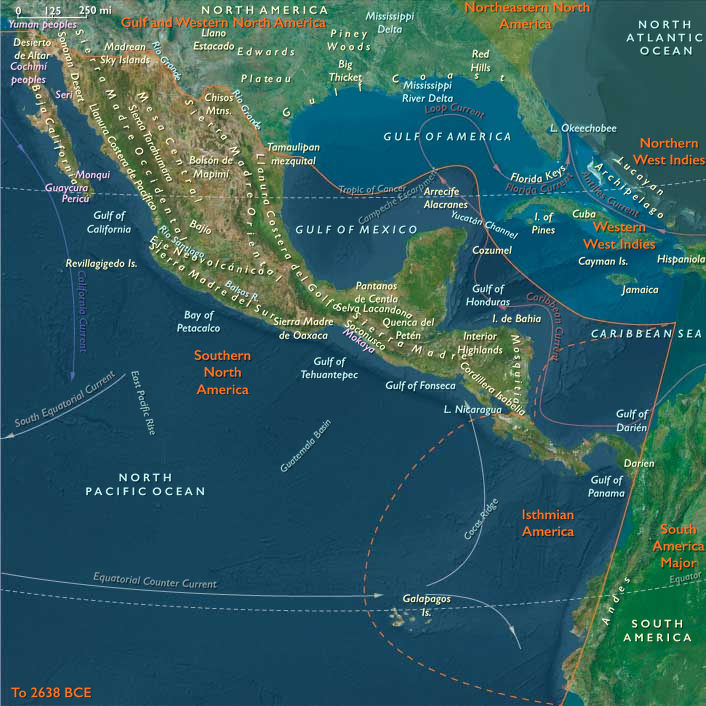
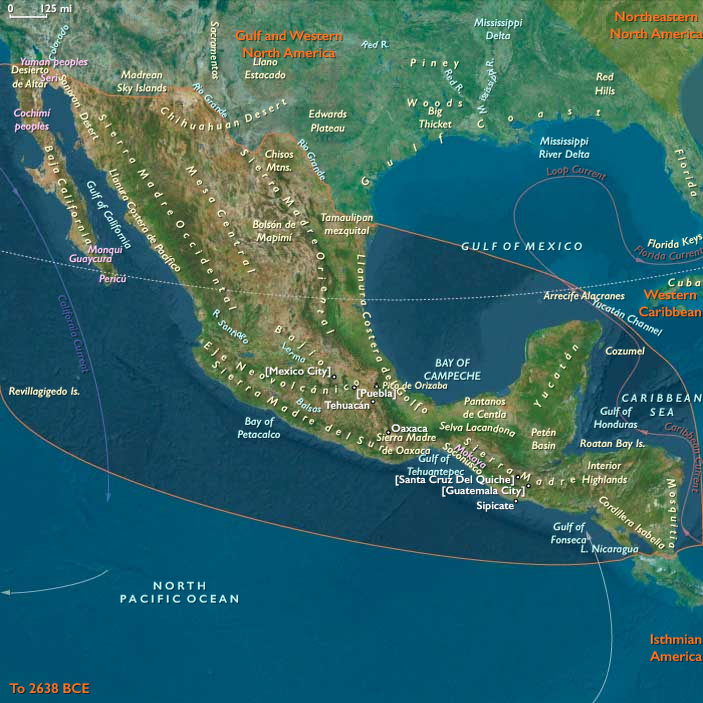
Southern North America spans the modern Mexico–Central America transition, including the Mexican Plateau, Gulf and Pacific lowlands, and the Central American volcanic front north of Costa Rica.
It embraces:
-
The Mexican Plateau (Basin of Mexico, Puebla–Tlaxcala, Zacatecas)
-
The Gulf lowlands (Tamaulipas–Veracruz–Tabasco)
-
The Pacific slope (Balsas and Soconusco valleys, Chiapas highlands, Tehuantepec Isthmus)
-
The Yucatán Peninsula and its northern carbonate shelf
Sea level stood roughly 100 m lower, expanding both Gulf and Pacific coastal plains. The Yucatán karst exposed vast dry basins dotted with cenotes; the Basin of Mexico held cool upland lakes; the Tehuantepec Isthmus served as a biogeographic hinge between the two oceans.
Climate & Environmental Shifts
-
Global cooling during the Last Glacial Maximum produced stronger seasonality and drier interiors, while storm intensity rose along both coasts.
-
Northern trade winds strengthened; monsoonal rains weakened.
-
The Mexican Plateau became semi-arid grassland; Gulf lowlands retained gallery forest refugia along rivers; Pacific slopes alternated between thorn scrub and riparian woodland.
-
In the Yucatán, rainfall declined and aquifers fell, exposing deeper cenotes but preserving groundwater access for future foragers.
Subsistence & Settlement
Definitive human presence before 30 ka BP is debated. If early occupants existed, they would have:
-
Favored springs, cenotes, and coastal wetlands as perennial refugia.
-
Hunted camelids, horses, bison, deer, and peccary on the Mexican Plateau and Balsas grasslands.
-
Harvested shellfish, fish, and turtles along widened Gulf and Pacific shelves.
-
Gathered palms, tubers, and cactus fruits in semi-arid zones and riparian belts.
Camps were likely ephemeral, situated on lake terraces, dune ridges, or rock shelters near reliable water.
Technology & Material Culture
-
Late Middle / Early Upper Paleolithic flake-blade industries in local chert, obsidian, and basalt.
-
Expedient core tools, backed flakes, and occasional bifacial points; heavy reliance on organic implements—digging sticks, nets, and carrying bags—now lost to preservation.
-
Pigments and ornaments (ochre, marine shell) probable in later phases by analogy to adjacent regions.
Movement & Interaction Corridors
-
Pacific coastal shelf provided a potential “kelp-edge” route southward into the Isthmian world.
-
Gulf strandlines and river deltas (Pánuco–Papaloapan–Grijalva–Usumacinta) served as east-coast arteries linking inland plateaus to mangrove margins.
-
Interior passes through Oaxaca and Chiapas connected the Plateau with Pacific and Caribbean slopes, anticipating later Mesoamerican exchange geography.
-
The Yucatán–Petén corridor remained a porous bridge between northern and equatorial biotas.
Cultural & Symbolic Expressions
If present, symbolic behavior paralleled broader Upper Pleistocene traditions:
-
Ochre for body or tool treatment, shell ornaments, and hearth structuring in caves or rock overhangs.
-
Recurrent camp refurbishing and stone caching imply cognitive mapping of place—early expressions of landscape memory.
Environmental Adaptation & Resilience
Adaptive success depended on water-tethered mobility:
-
Refugia anchoring—cenotes, lagoons, riverine forests—offset the risk of drought.
-
Dual coast–interior scheduling allowed seasonal access to fish, shellfish, and migratory game.
-
Diverse ecozones (arid plateau, humid gulf, marine shelf) provided fallback options during climate swings.
Transition
By 28,578 BCE, Southern North America had become a patchwork of viable refugia linked by coastlines and valleys that would guide later migrations southward.
As deglaciation advanced, rising seas would flood the exposed shelves and restore monsoonal rainfall, binding the Mexican isthmus and Isthmian corridor into a continuous tropical–subtropical world—the stage for the fully peopled Middle America of the next epoch.
Groups
Commodoties
Subjects
Regions
Subregions
Related Events
Showing 10 events out of 69706 total
Years: 49293BCE - 28578BCE
Groups
Commodoties
Subjects
Regions
Subregions