
Isthmian America (49,293 to 28,578 BCE) U …
Years: 49293BCE - 28578BCE
Isthmian America (49,293 to 28,578 BCE) Upper Pleistocene I — Shelf Lowstands, Rainforest Refugia, and Kelp-Edge Seas
Geographic & Environmental Context
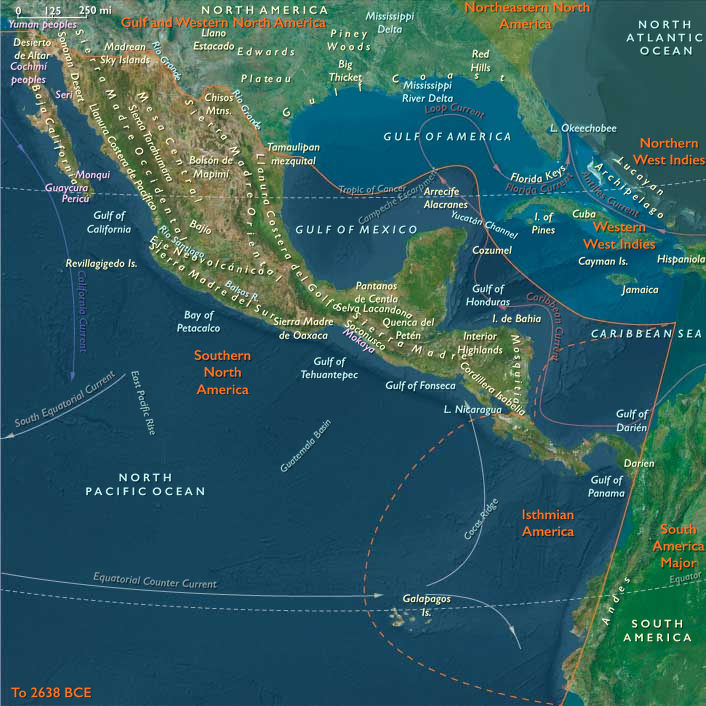
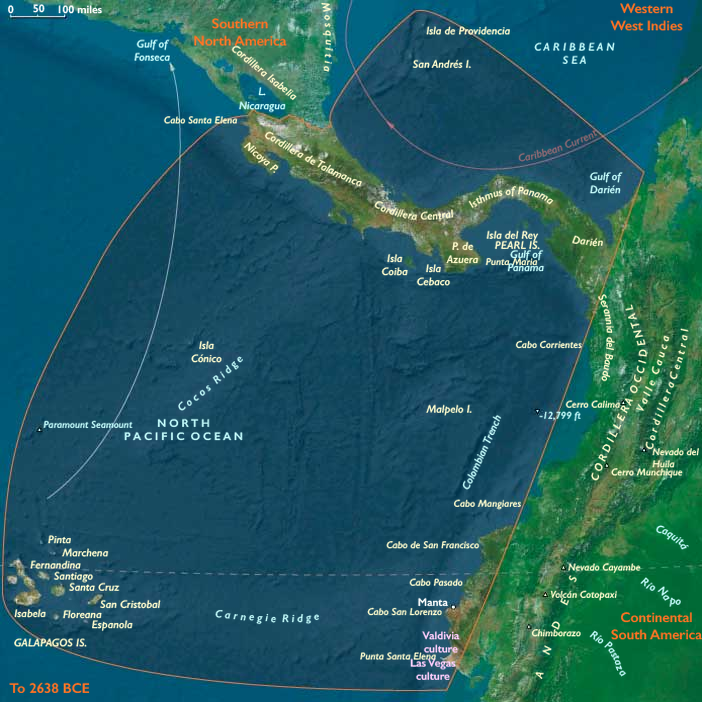
Isthmian America includes Costa Rica, Panama, Darién (Panama–Colombia), San Andrés Archipelago, Galápagos Islands, and the Ecuadorian Capelands (Cabos Manglares, San Francisco, Pasado, San Lorenzo, Punta Santa Elena; Manta; western Esmeraldas, Manabí, Guayas, Santa Elena).
Anchors: Panama isthmus and Azuero; Darién–Chocó rainforests; Costa Rica Central Valley and Nicoya; San Andrés banks; Galápagos volcanic outliers; Manta–Santa Elena capes and lagoons.
-
Sea level ~100 m lower exposed Pacific & Caribbean benches; Azuero/Nicoya capes extended; Manta–Santa Elena had broader strand-plains; Galápagos remained far-oceanic.
-
Darién–Chocó held humid forest refugia; Central American volcanic spine cooler/drier.
Climate & Environmental Shifts
-
LGM: cooler, drier; monsoon weakened; upwelling strengthened along Humboldt contact; Caribbean trade winds intensified.
Subsistence & Settlement
-
No secure evidence for people this early is expected in this corridor; any presence would hug refugia (Darién springs, Azuero coves), exploiting shellfish, reef fish, deer, peccary.
Technology & Material Culture
-
Flake–core industries if present; expedient shell tools; organic nets/baskets (poorly preserved).
Movement & Interaction Corridors
-
Pacific kelp-edge & Caribbean strandlines offered rich “highways” if used episodically; gap crossings shortest near Darién.
Cultural & Symbolic Expressions — Inferred only (ochre, shell beads) by analogy to nearby regions.
Environmental Adaptation & Resilience
-
Refugial tethering (springs & coves) + mixed coast/inland foraging buffered LGM stress.
Transition
-
Deglaciation will flood benches, build lagoons, and stabilize rainforest corridors for sustained occupation.
Groups
Commodoties
Subjects
Regions
Subregions
Years: 49293BCE - 28578BCE
Groups
Commodoties
Subjects
Regions
Subregions