
Isthmian America (1552–1563 CE): Wealth, Piracy, and …
Years: 1552 - 1563
Isthmian America (1552–1563 CE): Wealth, Piracy, and the Fortification of the Isthmus
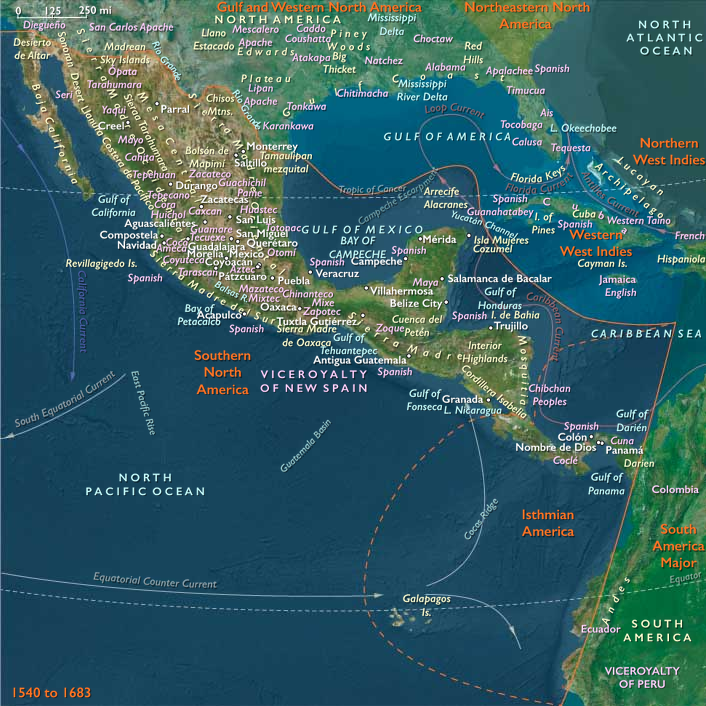
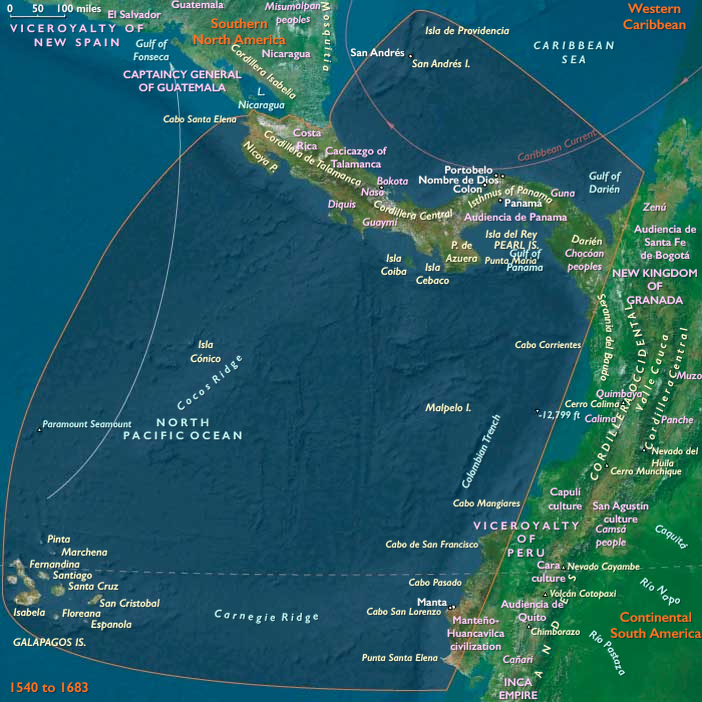
By the mid-sixteenth century, the trans-isthmian route between Nombre de Dios on the Caribbean and Panama City on the Pacific has become one of the Spanish Empire’s most valuable arteries, carrying immense treasure from Peru toward Spain. The enormous wealth passing along the Camino Real makes the region increasingly attractive to pirates and privateers, particularly English and French corsairs who target Spanish possessions and treasure fleets.
In 1554, a dramatic pirate raid underscores the vulnerability of the Spanish trans-isthmian route. French pirate François Le Clerc, also known as "Jambe de Bois" (Pegleg), leads a devastating attack on Nombre de Dios, plundering and partially destroying the town. This attack alarms the Spanish authorities, exposing the inadequacy of existing defenses and prompting urgent reinforcement.
In response, Spanish officials initiate a significant fortification project on the Caribbean coast, beginning construction of strengthened defenses at Nombre de Dios, and subsequently at nearby Portobelo, a more naturally defensible harbor. Portobelo's formidable fortifications are designed to secure the valuable treasure shipments, reflecting the heightened Spanish anxieties about piracy and foreign threats.
This era thus marks a pivotal shift as Spanish strategy moves from relying on secrecy and speed to embracing heavy fortifications and military preparedness to safeguard its critical interoceanic trade route.
People
Groups
Topics
Commodoties
Subjects
Regions
Subregions
Related Events
Filter results
Showing 10 events out of 36301 total
Muscovy continues to wage wars and to expand despite the domestic turmoil of Ivan's late period.
Ivan defeats and annexes the Kazan' Khanate on the middle Volga in 1552 and later the Astrakhan' Khanate, where the Volga meets the Caspian Sea.
These victories give Muscovy access to the entire Volga River and to Central Asia.
European Fashion Trends in the First Half of the 16th Century (1500–1550)
The early 16th century saw significant changes in European fashion, influenced by Late Gothic styles, Tudor aesthetics, and Renaissance opulence. Clothing became more structured and elaborate, with an increasing emphasis on geometric shapes, rich materials, and accessories.
Women’s Fashion: Hoods, Headdresses, and Expanding Skirts
-
The Transformation of the Hood (1500–1550)
- The simple hood worn by European women around 1500 evolved into a peaked shape, resembling the pointed arch of Gothic architecture or the Tudor arch.
- This style became characteristic of playing card queens, as seen in Tudor and Valois court portraits.
-
The Growth of Skirts and the Introduction of Hoops (1550s)
- By 1550, women’s robes expanded dramatically below the waistline, requiring support structures.
- Hoops made of wire or wicker, held together with ribbons and tapes, were introduced to create the wide, structured skirts that would evolve into the farthingale.
-
Alternative Headwear: Hats as a Fashion Choice (1540s)
- By the 1540s, hats became a fashionable alternative to hoods in England, reflecting a shift toward Renaissance styles.
Men’s Fashion: Broad Hats, Fur Caps, and Accessories
-
Broad Hats and Jewel-Trimmed Brims
- Men’s hats became wide-brimmed and richly decorated, sometimes trimmed with gems to reflect wealth and status.
-
Fur Caps for Cold Climates
- In colder regions, men wore close-fitting fur caps, providing both warmth and style.
-
Linen Coifs: A Common Undergarment
- Coifs (close-fitting linen caps) were worn under fur caps, hoods, or hats, functioning as a layer of protection and insulation.
Conclusion: The Transition to Renaissance Elegance
Fashion in the first half of the 16th century saw a shift from Late Gothic simplicity to Renaissance grandeur. Women’s growing skirts and peaked hoods mirrored architectural influences, while hats and decorative trims signaled a move toward elaborate court fashion. These trends set the stage for the extravagant styles of the later Renaissance and Elizabethan era.
The Arrival of the Norway Rat (Brown Rat) in Europe (1553) and Its Global Impact
The Norway Rat (Rattus norvegicus), also known as the Brown Rat, was first recorded in Europe in 1553. Although its name suggests a Norwegian origin, this is a misconception. The rat likely originated in eastern Asia, possibly northern China, and spread to Europe and beyond through trade and human migration.
Origins and Misnaming of the Norway Rat
- The name "Norway Rat" was given in 1769 by John Berkenhout in Outlines of the Natural History of Great Britain, mistakenly believing it arrived in England on Norwegian ships in 1728.
- However, at that time, no Brown Rats had yet reached Norway, and they more likely arrived from Denmark.
Comparison with the Black Rat (Rattus rattus)
- The Brown Rat is larger, more aggressive, and more adaptable than the Black Rat (or Roof Rat, Rattus rattus).
- While Black Rats were historically associated with the spread of bubonic plague, Brown Rats rarely, if ever, carried the disease.
- The Brown Rat’s dominance over the Black Rat in Europe began in the 18th century, as Brown Rats outcompeted Black Rats for resources.
Diseases Carried by Brown Rats
Although not a primary vector of bubonic plague, Brown Rats can transmit several diseases, including:
- Weil’s Disease (Leptospirosis)
- Cryptosporidiosis
- Viral Hemorrhagic Fever (VHF)
- Q Fever
- Hantavirus Pulmonary Syndrome
Their close association with human populations makes them a major concern for public health, especially in urban environments.
The Global Spread and Impact of the Brown Rat
- The Brown Rat is now found on every continent except Antarctica.
- Due to its incredible adaptability, it is considered one of the most successful mammals on the planet, alongside humans.
- It thrives in cities, sewers, and food storage areas, making it a permanent feature of human civilization.
The Brown Rat’s Role in Science and Domestication
- Selective breeding has led to two key developments:
- The Fancy Rat – A domesticated variety bred as a pet.
- The Laboratory Rat – Widely used in biological and medical research.
- Laboratory rats have been critical for scientific discoveries, including studies in genetics, psychology, and disease treatments.
Conclusion: The Brown Rat’s Unstoppable Expansion
First documented in Europe in 1553, the Brown Rat has become one of the most widespread and resilient mammals in the world. Its ability to adapt to urban environments, displace other rat species, and spread alongside human settlements makes it a defining species of human history, whether as a pest, pet, or scientific model organism.
East Europe (1552–1563 CE): Muscovite Consolidation and Expansion
Political and Military Developments
Consolidation after the Conquest of Kazan
Between 1552 and 1563 CE, Muscovy solidified control over newly acquired territories, notably following the conquest of Kazan in 1552. Under Ivan IV, Muscovy expanded further eastward, incorporating diverse ethnic regions such as the Bashkir territories, fostering new diplomatic and administrative challenges.
Integration and Management of the Bashkirs
The Bashkirs, a Turkic ethnic group residing primarily in the southern Ural region, increasingly came under Muscovite influence during this period. Integration involved complex diplomatic negotiations and occasional military confrontations, as Muscovy sought to stabilize its expanding eastern frontier.
Economic and Technological Developments
Enhanced Economic Integration
Muscovy continued economic expansion, capitalizing on resources from newly conquered territories such as Kazan. Improved integration of trade routes, particularly involving the Volga River and southern Ural regions, facilitated increased commerce and economic prosperity.
Military Infrastructure and Technological Advancements
Technological improvements persisted in military capabilities, including fortifications, siege warfare, and cavalry enhancements. These innovations significantly bolstered Muscovy's ability to defend and manage its expanding territory.
Cultural and Artistic Developments
Continued Cultural Patronage
Cultural activities flourished under Ivan IV’s continued patronage, notably in architecture, religious iconography, and literary production. The integration of diverse cultural influences from newly incorporated regions enriched the Muscovite cultural landscape.
Literary and Intellectual Productivity
Scholarly and chronicling activities remained robust, documenting the political, religious, and cultural developments during this expansive era, preserving historical memory and reinforcing regional identity.
Settlement Patterns and Urban Development
Urban Growth and Administrative Integration
Urban centers, especially Moscow, expanded significantly, supported by enhanced infrastructure and sophisticated urban planning. Newly integrated territories such as Kazan also saw urban development and infrastructural improvements.
Advanced Fortifications and Regional Security
The continued development of strategic fortifications safeguarded urban and frontier areas, providing stability and security amidst ongoing expansion and integration of diverse ethnic territories.
Social and Religious Developments
Social Integration of New Territories
Social structures effectively integrated new ethnic groups, including the Bashkirs, into Muscovite administration and society. This integration supported regional stability and administrative cohesion.
Orthodox Church’s Expanding Influence
The Orthodox Church expanded its role, incorporating newly acquired territories into its administrative and religious jurisdiction, significantly shaping societal norms and educational practices, reinforcing cultural unity.
Long-Term Consequences and Historical Significance
The period from 1552 to 1563 CE represented significant Muscovite territorial consolidation, integration of diverse ethnic groups, and strategic diplomatic maneuvering, shaping the trajectory of the Russian state's future unity, administrative complexity, and cultural diversity.
...Russian expansion to the northwest toward the Baltic Sea proves to be much more difficult.
In 1558 Ivan invades Livonia, eventually embroiling him in a twenty-five-year war against Poland, Lithuania, Sweden, and Denmark.
Despite occasional successes, Ivan's army is pushed back, and Muscovy fails to secure a coveted position on the Baltic Sea.
The war drains Muscovy.
Some historians believe that Ivan initiates the opricnina to mobilize resources for the war and to quell opposition to it.
Regardless of the reason, Ivan's domestic and foreign policies have a devastating effect on Muscovy, and they lead to a period of social struggle and civil war, the so-called Time of Troubles (Smutnoye vremya, 1598-1613).
Ivan IV had become grand prince of Muscovy in 1533 at the age of three.
Various factions of the boyars compete for control of the regency until Ivan assumes the throne in 1547.
Reflecting Muscovy's new imperial claims, Ivan's coronation as tsar is an elaborate ritual modeled after those of the emperors in Constantinople.
With the continuing assistance of a group of boyars, Ivan begins his reign with a series of useful reforms.
In the 1550s, he promulgates a new law code, revamps the military, and reorganizes local government.
These reforms undoubtedly are intended to strengthen the state in the face of continuous warfare.
Northeast Europe (1552–1563 CE): Emerging Rivalries, Religious Conflicts, and Strategic Realignments
Between 1552 and 1563 CE, Northeast Europe witnessed intensifying geopolitical tensions, driven by religious divisions, emerging rivalries, and shifting diplomatic alliances. The period marked increased Russian assertiveness under Ivan IV, heightened regional instability in Livonia, and further political consolidation across Scandinavia and the secular Duchy of Prussia, significantly reshaping territorial alignments and cultural identities.
Livonian Confederation under Mounting Pressure
The Livonian Confederation, centered around prosperous Riga, increasingly faced severe geopolitical pressures. Internal divisions, declining military capacity, and religious tensions weakened its political cohesion. Simultaneously, external threats intensified, particularly from an increasingly aggressive Grand Duchy of Muscovy, laying groundwork for the devastating conflicts of the upcoming Livonian War (1558–1583).
Outbreak of the Livonian War
In 1558, Ivan IV (the Terrible) of Muscovy launched a major invasion of Livonia, marking the start of the prolonged and destructive Livonian War. Ivan’s ambitions aimed at securing Baltic access and regional dominance, dramatically altering Northeast Europe's geopolitical landscape. Livonian defenses swiftly collapsed, triggering interventions by neighboring powers including the Polish–Lithuanian Union, Sweden, and Denmark–Norway, each competing for influence in the collapsing Confederation.
Strengthening of the Duchy of Prussia
The secularized Duchy of Prussia, ruled by Duke Albert of Brandenburg-Ansbach, consolidated Protestant governance, administrative efficiency, and regional autonomy under Polish overlordship. Königsberg and other Prussian cities saw sustained economic resilience despite regional conflicts. The Duchy emerged as a stable territorial entity amid growing regional turmoil, positioning itself strategically within shifting alliances.
Consolidation and Expansion of Independent Sweden
Under the reign of Gustav I Vasa until his death in 1560, and thereafter under his son Eric XIV, Sweden significantly strengthened its political cohesion, administrative reforms, and military capabilities. These efforts were extended notably into southern Finland, where fortified defenses and expanded governance deepened cultural and political integration, reinforcing Sweden's status as a major emerging regional power.
Danish-Norwegian Internal Stability and Diplomatic Strategies
Under Christian III and subsequently Frederick II, the Kingdom of Denmark–Norway successfully consolidated Lutheran reforms, reinforcing internal administrative stability and religious uniformity. Despite internal cohesion, external diplomatic maneuvers involved Denmark–Norway directly in Baltic rivalries, especially in contesting Muscovite advances, Swedish influence, and Livonian territories, shaping strategic diplomatic alignments throughout this period.
Economic Resilience and Urban Prosperity
Major urban centers such as Reval (Tallinn), Riga, Königsberg, and Visby continued experiencing economic resilience through maritime commerce, commercial networks, and stable urban governance. Even amid regional upheavals, these cities supported broader economic stability, significantly mitigating the disruptive impacts of geopolitical and military conflicts.
Cultural and Religious Transformations
Ecclesiastical institutions and religious identities continued experiencing profound transformations amid Lutheran consolidation and geopolitical instability. Protestant educational reforms significantly altered societal structures and cultural identities across Scandinavia and Prussia, while religious tensions in Livonia and the Baltic region contributed substantially to regional instability.
Strategic Diplomatic Realignments and Alliances
Diplomatic activity intensified considerably during this period, characterized by shifting alliances, strategic negotiations, and territorial contests amid escalating regional tensions. Conflicting interests among the Polish–Lithuanian Union, Sweden, Denmark–Norway, Muscovy, and the Duchy of Prussia drove complex diplomatic maneuvers, significantly reshaping regional geopolitics.
Legacy of the Era
The era from 1552 to 1563 CE profoundly influenced Northeast Europe’s historical trajectory through escalating geopolitical rivalries, deepened religious conflicts, and strategic territorial realignments. These developments established enduring territorial patterns, diplomatic relationships, and cultural identities, fundamentally shaping the region’s historical evolution in subsequent decades.
East Central Europe (1552–1563 CE): Peace of Augsburg, Religious Consolidation, and Ongoing Ottoman Threat
Between 1552 and 1563 CE, East Central Europe—encompassing Poland, Czechia, Slovakia, Hungary, and eastern Germany and Austria—experienced a significant stabilization of religious divisions, marked by the pivotal Peace of Augsburg (1555). This treaty formally recognized Lutheranism within the Holy Roman Empire, cementing confessional divides. Meanwhile, the continuing Ottoman threat shaped Habsburg defenses, especially along Hungary’s fragmented borders, prompting intensified fortification efforts. Poland-Lithuania remained relatively stable, enhancing its regional influence, while Bohemia and Saxony solidified their roles as major Protestant centers.
Political and Military Developments
Peace of Augsburg (1555): Cuius Regio, Eius Religio
-
The Peace of Augsburg, brokered by Emperor Ferdinand I, brought temporary resolution to religious conflict within the Empire, legally recognizing Lutheranism alongside Catholicism.
-
The principle of "cuius regio, eius religio" (whose realm, his religion) established the sovereign’s right to determine their territory's official religion. This further entrenched confessional divisions between Protestant and Catholic territories, notably between Lutheran Saxony, Mecklenburg, and Brandenburg, and Catholic Bavaria and Austria.
Habsburg Hungary and Ottoman Hostilities
-
Ottoman incursions continued into Hungary, prompting defensive campaigns led by Ferdinand I and his successor Maximilian II (1564–1576). Border fortresses such as Eger, Győr, and Komárom became pivotal in resisting Ottoman sieges.
-
Transylvania, under Ottoman suzerainty, consolidated its political autonomy under Prince John Sigismund Zápolya, serving as a balancing power between Habsburg and Ottoman interests.
Consolidation and Influence of Electoral Saxony
-
Under Elector Augustus of Saxony (r. 1553–1586), Electoral Saxony stabilized and prospered, becoming a focal point of Lutheran orthodoxy and education, thereby influencing religious and political dynamics throughout Protestant Europe.
Stability and Prosperity in Poland-Lithuania
-
Sigismund II Augustus (r. 1548–1572) governed Poland-Lithuania with relative stability and economic prosperity, strengthening royal administration and diplomatic influence.
Economic and Technological Developments
Economic Stabilization and Growth
-
Relative peace enabled economic stabilization and growth, particularly in Imperial Free Cities like Nuremberg, Augsburg, Regensburg, and Wrocław.
-
Trade networks linking Baltic, Central European, and Mediterranean markets flourished, boosting regional economies, especially those oriented toward agriculture, mining, and textiles.
Enhanced Military Fortifications
-
Persistent Ottoman threats necessitated technological improvements in fortress engineering, seen notably in Austria, Hungary, and Transylvania. These advancements strengthened regional defense capabilities.
Cultural and Artistic Developments
Lutheran Cultural Flourishing
-
Protestant territories, especially Electoral Saxony, Mecklenburg, and Brandenburg, saw vigorous cultural activity through enhanced support of Lutheran educational institutions, publishing houses, and theological scholarship.
Catholic Counter-Reformation Initiatives
-
Catholic territories—especially Austria, Bavaria, Salzburg, Passau, and Regensburg—increasingly embraced Counter-Reformation measures, supporting Jesuit education, Baroque artistic patronage, and reaffirming Catholic orthodoxy.
Polish-Lithuanian Renaissance
-
Under Sigismund II Augustus, Poland-Lithuania experienced notable cultural patronage, especially in humanistic scholarship, architecture, and Renaissance arts, enhancing its prestige and regional cultural significance.
Settlement and Urban Development
Reinforced Border Towns and Fortresses
-
Significant investments in urban fortifications along Hungarian, Austrian, and southern Polish frontiers reshaped settlement patterns, urban planning, and military infrastructure, notably in Eger, Vienna, Pressburg, and Graz.
Prosperity of Imperial Free Cities
-
Imperial Free Cities such as Nuremberg, Augsburg, and Regensburg continued flourishing economically and culturally, driven by vibrant trade, artisanal productivity, and growing political autonomy.
Social and Religious Developments
Entrenched Confessional Boundaries
-
The Peace of Augsburg deeply entrenched religious divisions within the Empire, prompting internal migrations as populations aligned more closely with their preferred confessions, thereby solidifying Lutheran and Catholic identities.
Rise of Jesuit Influence
-
Jesuit institutions expanded significantly in Catholic regions, especially in Austria, Bavaria, and Poland-Lithuania, fostering educational advancement and reinforcing Counter-Reformation efforts.
Long-Term Consequences and Historical Significance
The era 1552–1563 CE solidified East Central Europe's religious landscape through the Peace of Augsburg, permanently institutionalizing Lutheran-Catholic divisions within the Holy Roman Empire. Ongoing Ottoman threats reinforced Habsburg defensive fortifications, significantly shaping military architecture and urbanization. Electoral Saxony’s stability and Protestant influence deepened regional religious identity, while Poland-Lithuania continued thriving culturally and economically. Collectively, these developments defined East Central Europe's subsequent historical trajectory, embedding lasting religious and geopolitical patterns.
The Expansion of Sugar Production and the Rise of Iron-Casting Industries (Pre-1550)
The sugar industry in the New World, which saw the construction of approximately 3,000 small sugar mills before 1550, created an unprecedented demand for iron components, such as cast iron gears, levers, axles, and other mechanical implements. This demand fueled the growth of specialist trades in mold-making and iron-casting across Europe, marking an important stage in the technological and industrial development of early modern Europe.
The Role of Sugar Mills in Driving Iron Production
-
Growth of the Sugar Industry in the New World
- The Portuguese and Spanish introduced sugar plantations to the Caribbean, Brazil, and New Spain in the early 16th century.
- Sugar production was highly labor-intensive, requiring both large workforces (enslaved and free) and mechanized equipment.
- The massive increase in sugar mills meant that metal components were needed to process and refine the sugar cane efficiently.
-
Increased Demand for Iron-Casting and Mold-Making
- Sugar mills required cast iron parts for crushing rollers, gears, levers, and axles to process large quantities of sugarcane.
- This demand led to the development of new foundries in Europe, particularly in:
- Portugal and Spain (to supply their colonies).
- Flanders and northern Italy (centers of advanced metalwork).
- England and France, which began refining their ironworking techniques.
The Rise of Specialized Trades in Europe
- Mold-making and iron-casting became specialized industries due to the growing need for precision metal parts in sugar mills.
- Foundries experimented with new techniques in casting iron gears and components to increase durability and efficiency.
- The spread of sugar refining technology created lasting advances in metallurgy, which would later contribute to the Industrial Revolution.
Long-Term Impact on Technology and Industry
-
Advancements in Ironworking
- The demand for stronger, more durable iron components led to improvements in casting techniques, benefiting other industries like shipbuilding and mining.
-
Economic Growth in European Foundries
- The sugar industry created a transatlantic economy, linking colonial plantations to European manufacturers.
-
The Foundation for Later Industrialization
- The early iron-casting methods developed for sugar mills laid the groundwork for the mechanization of other industries in the 17th and 18th centuries.
Conclusion: Sugar and the Technological Transformation of Europe
The explosive growth of sugar production in the New World before 1550 not only reshaped colonial economies but also stimulated technological advances in Europe. The demand for cast iron machinery for sugar mills spurred the development of specialist trades in metallurgy, mold-making, and iron-casting, helping to modernize European industry and paving the way for future technological progress.
The Middle East: 1552–1563 CE
Military and Geopolitical Developments
Ottoman-Safavid Treaty of Amasya
The protracted struggle between the Ottoman Empire and the Safavid Dynasty reaches a temporary settlement with the Treaty of Amasya in 1555. Signed by Sultan Suleiman the Magnificent and Shah Tahmasp I, this pivotal agreement sets relatively stable borders, giving eastern Anatolia, Baghdad, and Mesopotamia to the Ottomans, while granting Azerbaijan and most of the Caucasus to the Safavids. This treaty, though uneasy, will remain in effect for two decades, providing both empires a period of much-needed respite.
Ottoman Naval Campaigns
Under the command of the famed admiral Piyale Pasha, Ottoman naval forces extend their Mediterranean reach significantly, notably capturing the strategic island of Djerba near Tunisia in 1560. This victory reinforces Ottoman maritime dominance in the Mediterranean and shores up their defensive perimeter against increasing European naval incursions, particularly by Spain and its allies.
Economic and Administrative Progress
Trade Expansion and Economic Prosperity
The relative peace afforded by the Treaty of Amasya encourages renewed economic growth, particularly benefiting Ottoman commercial hubs such as Aleppo and Damascus. Aleppo solidifies its role as the region’s preeminent trade nexus, bridging Eastern markets with European merchants, particularly the Venetians and French. Enhanced trade routes stimulate urban prosperity despite ongoing rural economic stagnation.
Ottoman Administrative Refinements
The Ottomans, building upon earlier reforms, further standardize the Kanun laws and taxation systems under Suleiman's capable grand viziers, enhancing administrative efficiency throughout the provinces. Local governance structures benefit from clearer mandates, enabling improved agricultural productivity and trade security.
Religious and Cultural Consolidation
Shi'a Consolidation in Safavid Iran
Under Shah Tahmasp I, Shi'a Islam becomes deeply entrenched across Safavid Iran, reinforced through rigorous religious policies and educational reforms. The shah actively promotes religious schools and seminaries in Qazvin and other cities, cultivating an educated clergy whose influence permeates Persian society, solidifying Shi'ism's central role in Iranian identity.
Artistic Patronage and Cultural Exchange
Both the Ottoman and Safavid courts remain active centers of artistic patronage. In Istanbul, Suleiman’s architectural program continues with the further construction of monumental public works, overseen by chief architect Sinan. In Iran, Shah Tahmasp maintains a vibrant artistic court at Qazvin, fostering a significant tradition of illuminated manuscripts and Persian miniatures, exemplified by the celebrated Shahnameh of Shah Tahmasp.
Legacy of the Era
This era's key developments—most notably the Treaty of Amasya—temporarily stabilize the volatile Ottoman-Safavid frontier, permitting a brief economic and cultural flowering. Ottoman maritime dominance expands, and Safavid religious and cultural policies deeply embed Shi'ism in Iranian life, leaving lasting impressions that will shape Middle Eastern dynamics for generations to come.
Years: 1552 - 1563
People
Groups
Topics
Commodoties
Subjects
Regions
Subregions