
Isthmian America (1396–1539 CE): Crossroads of Continents …
Years: 1396 - 1539
Isthmian America (1396–1539 CE): Crossroads of Continents and Spanish Intrusion
Geographic & Environmental Context
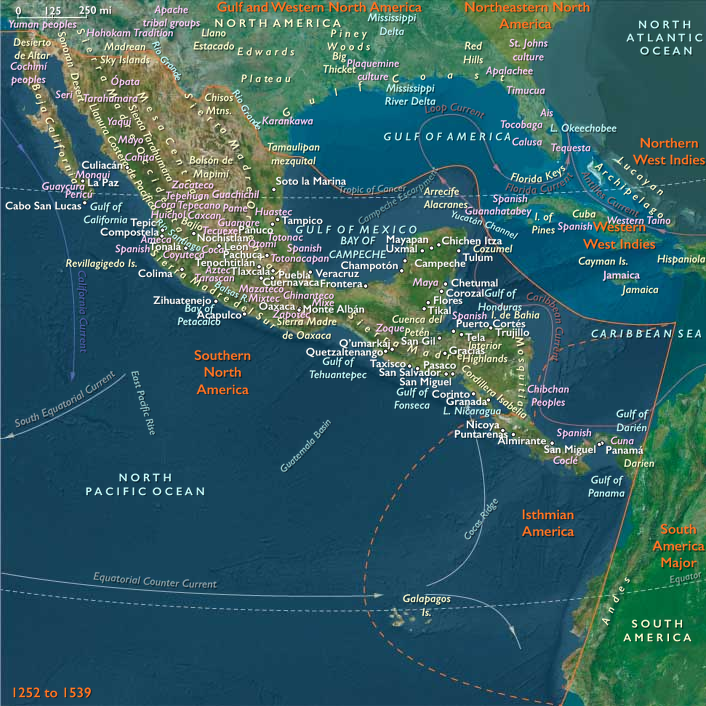
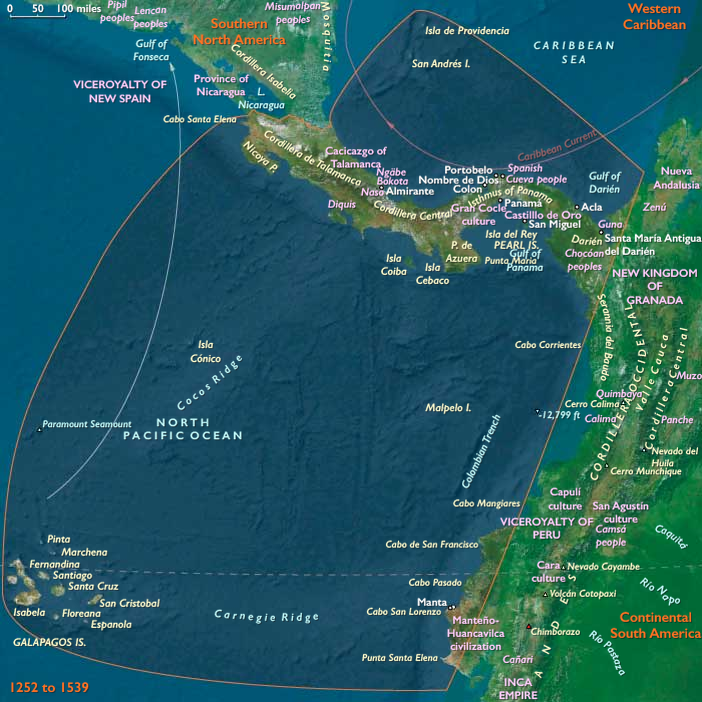
The subregion of Isthmian America includes Costa Rica, Panama, the Galápagos Islands, the San Andrés Archipelago, and the northeastern edge of South America (the Darién of Colombia and the capes of Ecuador). Anchors included the Cordillera Central of Panama and Costa Rica, the Darién Gap, the coasts of the Gulf of Panama, and the Pacific outliers of the Galápagos. This narrow isthmus bound together Pacific and Caribbean, making it one of the most strategic corridors in the Americas.
Climate & Environmental Shifts
The Little Ice Age brought modest cooling but retained high rainfall across most of the isthmus. The Caribbean side experienced humid equatorial rains, while Pacific slopes endured a sharper dry season. The Galápagos were subject to El Niño cycles, alternately increasing rainfall and disrupting marine upwellings, affecting seabird and turtle populations. Hurricanes rarely reached the region, but torrential rains and flooding in the Darién constrained settlement.
Subsistence & Settlement
-
Panama and Costa Rica: Populated by Chibchan- and Cueva-speaking peoples who practiced maize, manioc, and cacao cultivation, combined with fishing, hunting, and foraging. Villages ranged from dispersed hamlets to larger chiefdom centers.
-
Darién: Supported riverine farming and fishing societies, with villages on raised platforms in flood-prone areas.
-
Capes of Ecuador: Hosted coastal farmers and fishers who traded cotton, salt, and shell ornaments.
-
Galápagos and San Andrés Archipelago: Uninhabited, though the Galápagos may have been visited intermittently by seafarers from Ecuador or northern Peru for turtles and fish.
Technology & Material Culture
Local crafts included polished stone axes, gold ornaments, and ceramics. Chibchan metallurgy blended hammered gold with copper alloys. Cacao served as both food and currency. Wooden dugout canoes carried people and goods between river mouths and along coasts. Shell beads, cotton cloth, and feather ornaments circulated through regional exchange.
Movement & Interaction Corridors
-
Canoes plied the Caribbean and Pacific coasts, linking river mouths and estuaries.
-
Trails across the Isthmus connected cacao-producing zones with salt flats, creating a vital overland passage between seas.
-
The Galápagos lay beyond normal voyaging networks but were ecologically connected by seabird migrations and turtle rookeries.
-
In 1510, Spaniards founded Santa María la Antigua del Darién, the first enduring European town on the mainland. From there, Vasco Núñez de Balboa crossed the Isthmus in 1513, becoming the first European to view the Pacific Ocean.
-
Expeditions under Francisco Pizarro and Diego de Almagro launched from Panama toward Peru in the 1520s and 1530s.
Cultural & Symbolic Expressions
Indigenous cosmologies emphasized ancestor veneration, shamanism, and sacred landscapes tied to rivers and mountains. Gold ornaments embodied prestige and ritual power. Spanish missionaries imposed crosses and chapels, though Indigenous rituals endured in villages and forests. Oral traditions preserved memory of migrations, river spirits, and ancestral origins.
Environmental Adaptation & Resilience
Communities adapted to flooding with stilt houses, diversified diets through riverine fishing and farming, and used cacao and trade networks to spread risk. In the Galápagos, seabirds and turtles exploited shifting upwellings and El Niño variability, sustaining unpeopled but vibrant ecosystems.
Transition
By 1539 CE, Isthmian America had become the launching point of Spanish conquest across the Andes and Pacific. Indigenous communities persisted in Costa Rica, Panama, and the Darién, though epidemics and violence had already begun devastating populations. The Galápagos remained uninhabited but entered Spanish charts. This narrow, strategic corridor—long an Indigenous crossroads—had become the hinge of Spain’s oceanic empire.
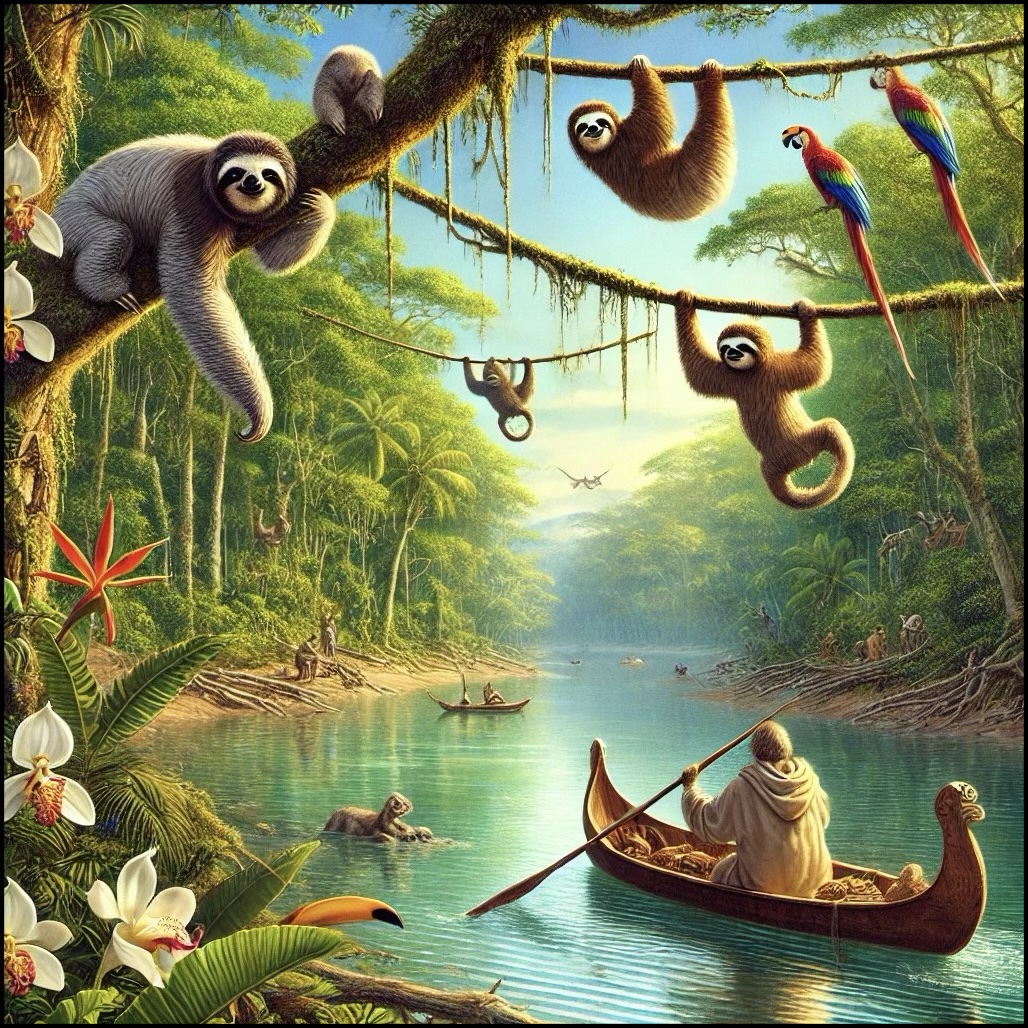
Isthmian America (with civilization) ©2024-25 Electric Prism, Inc. All rights reserved.
People
- Atahualpa
- Christopher Columbus
- Diego de Almagro
- Francisco Pizarro
- Pedro Arias Dávila
- Rodrigo de Bastidas
- Vasco Núñez de Balboa
Groups
- Naso people
- Guna
- Bokota people
- Ngäbe people
- Gran Coclé
- Manteño-Huancavilca culture
- Diquis culture
- Spanish Empire
- Spain, Habsburg Kingdom of
Topics
Commodoties
- Fish and game
- Gem materials
- Colorants
- Grains and produce
- Textiles
- Fibers
- Ceramics
- Strategic metals
- Slaves
Subjects
Regions
Subregions
Years: 1396 - 1539
Isthmian America (with civilization) ©2024-25 Electric Prism, Inc. All rights reserved.
People
- Atahualpa
- Christopher Columbus
- Diego de Almagro
- Francisco Pizarro
- Pedro Arias Dávila
- Rodrigo de Bastidas
- Vasco Núñez de Balboa
Groups
- Naso people
- Guna
- Bokota people
- Ngäbe people
- Gran Coclé
- Manteño-Huancavilca culture
- Diquis culture
- Spanish Empire
- Spain, Habsburg Kingdom of
Topics
Commodoties
- Fish and game
- Gem materials
- Colorants
- Grains and produce
- Textiles
- Fibers
- Ceramics
- Strategic metals
- Slaves
Subjects
Regions
Subregions