Israel wages a fierce border war with …
Years: 861BCE - 850BCE
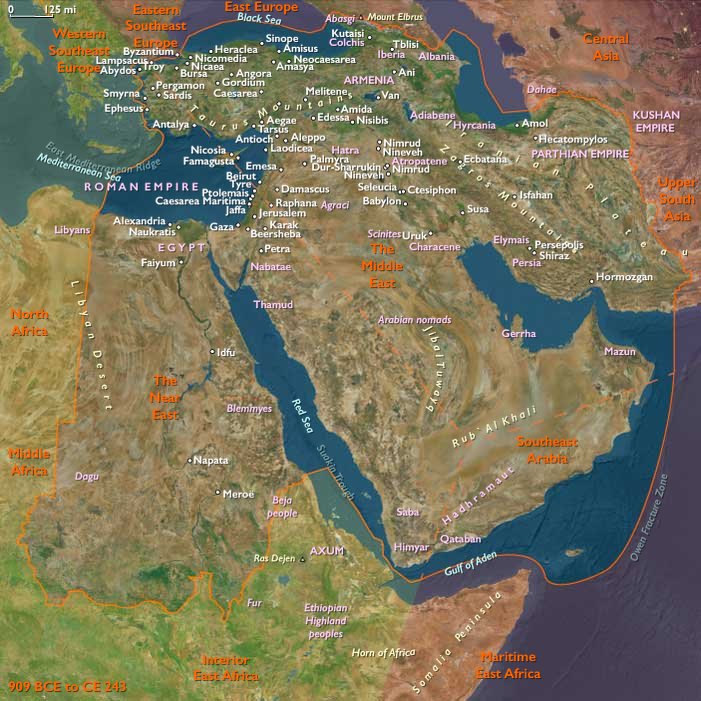
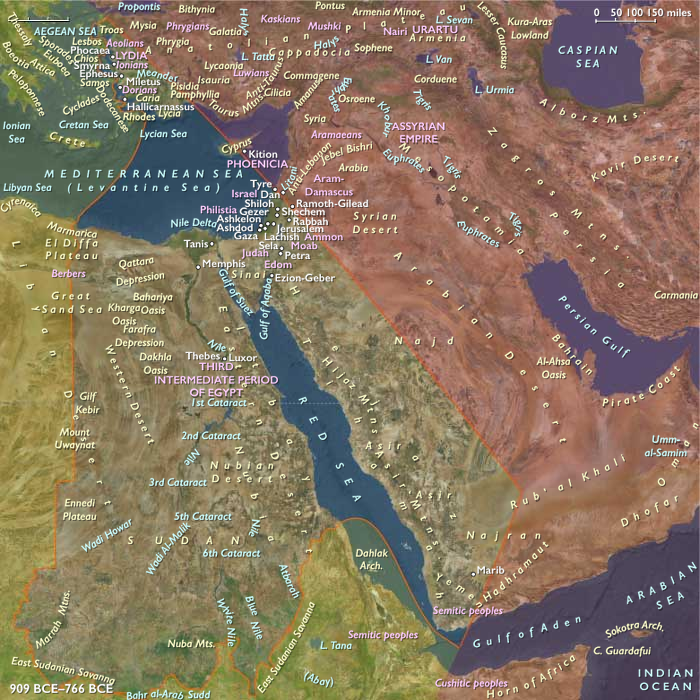
Israel wages a fierce border war with Syria throughout the reign of Ahab, in which Israel, in spite of occasional victories, proves the weaker, and in the meantime, the Moabite king Mesha successfully revolts and occupies the southern portions of the territory of Gad.
According to the Hebrew scriptures, Elisha, the prophet Elijah’s disciple and designated successor, becomes active in the northern kingdom from 850.
Locations
People
Groups
Topics
Commodoties
Subjects
Regions
Subregions
Related Events
Filter results
Showing 10 events out of 66595 total
The Middle East, 861 to 850 BCE: Emergence of Urartu and Iranian Peoples
During the era 861 to 850 BCE, significant political shifts occur in the northern and eastern regions surrounding Assyria, notably with the emergence of Urartu as a unified kingdom and the early consolidation of Iranian peoples on the Iranian Plateau.
The Rise of Urartu
Originally one of the fragmented states of Nairi, located in the Armenian Highlands around Lake Van, Urartu (also known as Uruartri) transitions into a cohesive kingdom under King Aramu (circa 860–843 BCE). Earlier Assyrian inscriptions from rulers such as Tukulti-Ninurta I, Tiglath-Pileser I, and Ashurnasirpal II repeatedly mention conflicts with the Nairi states. However, by this era, these disparate tribes and small kingdoms coalesce, transforming Urartu into a formidable rival to Assyrian dominance in the north. This consolidation signifies a critical turning point in the balance of power, presenting new challenges to Assyria’s northern frontier.
Neo-Assyrian Imperial Iconography
The Neo-Assyrian kings continue to solidify their image as formidable warriors and divinely favored rulers. Monumental sculptures featuring man-headed winged bulls, known as lamassu, increasingly dominate Assyrian art and architecture. These imposing figures serve both protective and propagandistic roles, symbolizing royal power and divine guardianship throughout the expanding Assyrian realm.
Arrival and Consolidation of Iranian Peoples
Around this period, the Iranian peoples—descendants of the ancient Indo-Iranians—further establish their presence on the Iranian plateau. Significant among these groups are the Old Persians, who by 850 BCE refer to themselves as the Parsa, occupying territory around Persis (modern-day Fars Province), bounded by the Tigris River to the west and the Persian Gulf to the south. Assyrian inscriptions from the ninth century BCE provide the earliest known written references to these peoples, naming them as Parsuash and Parsua.
These early Iranian communities, initially pastoral and nomadic, gradually settle and consolidate, laying the foundations for future empires. Their cultural identity revolves around a shared linguistic heritage and religious traditions centered on the worship of Ahura Mazda, a pivotal deity in their emerging religious framework.
Geopolitical Shifts
The concurrent rise of Urartu and the arrival and settlement of the Iranian peoples on Assyria’s northern and eastern frontiers mark the beginning of significant geopolitical changes. These developments signal an era of emerging regional powers that will profoundly influence the political and cultural landscape of the Middle East in the subsequent centuries.
Assyrian inscriptions of Shalmaneser I from about 1270 BCE first mention Uruartri as one of the states of Nairi—a loose confederation of small kingdoms and tribal states in Armenian Highland in the thirteenth to eleventh centuries BCE.
Uruartri itself is in the region around Lake Van.
The Nairi states have been repeatedly subjected to attacks by the Assyrians, especially under Tukulti-Ninurta I (circa 1240 BCE), Tiglath-Pileser I (circa 1100 BCE), Ashur-bel-kala (circa 1070 BCE), Adad-nirari II (circa 900), Tukulti-Ninurta II (circa 890), and Ashurnasirpal II (883-859 BCE).
Urartu reemerges in Assyrian inscriptions in the ninth century BCE as a powerful northern rival: the Nairi states and tribes become a unified kingdom under king Aramu (circa 860-843 BCE).
The neo-Assyrian kings depict themselves as warlike heroes in their sculpted portraiture.
Man-headed winged bulls dominate Assyrian art and architecture.
The origin of the ethnic Iranian peoples/Persian peoples are traced to the Ancient Iranian peoples, who were part of the ancient Indo-Iranians and themselves part of the greater Indo-European linguistic family.
The Ancient Iranian peoples had arrived in parts of the Iranian plateau circa 1000 BCE.
Important Iranic tribes such as Old Persians, Medes, Parthians, Bactrians, Scythians, and the Avesta people will use the name Arya (Iranian), which was a collective definition, denoting peoples who were aware of belonging to a generally common ethnic stock, speaking very closely related languages, and mainly sharing a religious tradition that centers on the worship of Ahura Mazda.
The Old Persians, who are one of these ethnic Iranian groups, were originally nomadic, pastoral people in the western Iranian plateau and by 850 BCE are calling themselves the Parsa and their constantly shifting territory Parsua for the most part localized around Persis (Pars), bounded on the west by the Tigris river and on the south by the Persian Gulf.
The first known written record of the term Persian is from Assyrian inscriptions of the ninth century BCE, which mention both Parsuash and Parsua.
The Near East (861–850 BCE): Moabite Revolt and Inter-Kingdom Conflicts
Mesha’s Revolt and the Moabite Stone
During this era, significant events unfold in Moab, notably the revolt led by King Mesha against Israelite dominance. King Omri's earlier conquest of Moab, now vividly chronicled on the famous Moabite Stone (also known as the Mesha Stele), represents one of the critical documents of this period. Discovered at Dhiban in 1868, this black basalt monument, now housed in the Louvre Museum, bears a thirty-four-line inscription written in a script closely related to ancient Hebrew.
Mesha attributes Israel's earlier dominance over Moab to the wrath of their god, Chemosh, and celebrates his successful rebellion and recapture of territories from Omri’s son, Ahab. This account provides the earliest certain extra-biblical references to the Israelite deity Yahweh, the "House of Omri," and possibly the "House of David," highlighting the historical importance and complexity of Moabite-Israelite relations.
Israel Under Ahab: Military Challenges and Prophetic Activity
Throughout King Ahab's reign, Israel endures intense and prolonged border conflicts with Aram (Syria), battles marked by fierce encounters but ultimately resulting in Israeli setbacks. These military struggles are compounded by Mesha’s successful revolt, causing the loss of southern territories in the region of Gad. Amid these geopolitical tensions, the prophet Elisha, disciple and successor to the prophet Elijah, emerges around 850 BCE, profoundly influencing religious and political life in the northern kingdom.
Ahab’s strategic alliances, notably with Jehoshaphat of Judah, see mixed results. Despite initial successes, his Levantine alliance fractures after confronting the growing Assyrian threat at Qarqar. Soon after this confrontation, Ahab meets his demise during a failed joint military attempt with Jehoshaphat to reclaim the strategically important city of Ramoth-Gilead from the Arameans. Mortally wounded by an arrow, Ahab’s death marks a turning point, reinforcing Syrian power and prompting further internal instability within Israel.
Judah’s Strength and Alliance with Israel
In Judah, King Jehoshaphat continues to strengthen his kingdom through administrative, religious, and military reforms, successfully centralizing power and reorganizing Judah’s army. His alliance with Ahab, despite ending tragically at Ramoth-Gilead, exemplifies a period of cooperation between the kingdoms of Judah and Israel, extending even into maritime trade partnerships. Jehoshaphat’s son and successor, Jehoram of Judah, is married to Athaliah, daughter of Ahab, reinforcing the political bonds between these neighboring kingdoms.
Under Jehoshaphat’s initiative, the strategically valuable port city of Ezion-Geber is rebuilt and fortified with substantial defenses, enhancing Judah’s economic potential through revived maritime trade.
Religious and Cultural Developments
The Philistine city-state of Ekron gains notoriety during this period for its association with the deity Baalzebub ("Baal of the Flies" or "Baal of the Abode"), reflecting the region's continued religious diversity and complexity. This association becomes particularly prominent during the reign of Ahaziah, Ahab’s successor in Israel, indicating ongoing cultural exchanges and religious interactions within the Near East.
Summary of the Era
The years 861–850 BCE are marked by significant political and military upheaval in the Near East. Mesha’s successful Moabite revolt, chronicled in the Moabite Stone, reshapes regional power dynamics. Israel, despite alliances and ambitious construction projects, suffers critical setbacks against Syria and Moab. Judah, under Jehoshaphat’s stable and reformist rule, navigates these turbulent times effectively, reinforcing its strength through strategic alliances and internal consolidation.

Omri's conquest of Moab is known from the Moabite Stone, a black basalt stone, 1.1 meters (forty-four inches) high, discovered at Dhiban in 1868 and now in the Louvre Museum in Paris.
The Moabite king Mesha erected this stela about forty years after the event in the city of Dibon (modern Dhiban, Jordan).
The stone's text of thirty-four lines, written in a Canaanite alphabet similar to contemporary Hebrew, is the only written document of any length that survives from Moab and the only royal stela known from Israel's neighbors.
In its inscription, Mesha, who flourished around 850, tells of Omri's reconquest of Moab and ascribes the renewed Israelite domination over Moab to the anger of Chemosh.
Mesha then describes his own successful rebellion against Israel, which probably occurs during the reign of Omri's successor, Ahab.
The Moabite Stone, whose story parallels, with some differences, an episode in the bible's Books of Kings (2 Kings 3:4-8), provides invaluable information on the Moabite language and the political relationship between Moab and Israel at one moment in the ninth century BCE.
It is the most extensive inscription ever recovered that refers to the kingdom of Israel (the "House of Omri"), it bears the earliest certain extra-biblical reference to the Israelite god Yahweh, and, if French scholar André Lemaire's reconstruction of a portion of line 31 is correct, the earliest mention of the "House of David" (i.e., the kingdom of Judah).
Thomas L. Thompson (The Bible in History), however, interprets the Mesha stele as suggesting that Omri is an eponym, or legendary founder of the kingdom rather than an historical person.
Most archaeologists reject this interpretation, seeing Omri as historical.
Assyrian kings frequently referred to Omri's successors as belonging to the "House of Omri" (Bit Hu-um-ri-a).
Jehoshaphat reorganizes Judah’s army and attempts to centralize political power through a series of religious and legal reforms.
He aids Ahab of Israel in his unsuccessful attempt to recapture Ramoth-gilead, joins Ahab’s succersor Ahaziah in extending maritime trade, helps Jehoram of Israel in his battle with Moab, and marries his son and successor, Jehoram of Judah, to Athaliah, a daughter of Ahab.
Jehoshaphat, Asa’s son and successor, is king of Judah during the reigns in Israel of Ahab, Ahaziah and Jehoram, with whom he maintains close political and economic alliances.
The destroyed settlement of Ezion-Geber is rebuilt, according to the Hebrew scriptures, at Jehoshaphat’s instigation and surrounded by a double mud-brick wall with a massive three-piered gateway.
Ahab’s Levantine alliance breaks up after repulsing the Assyrians at Qarqar, and Ahab soon afterwards meets his death fighting the Syrians in a vain attempt by Jehoshaphat to recover the city of Ramoth-Gilead from the Arameans.
Mortally wounded by an arrow, Ahab was propped up in his chariot facing his men but by evening, Ahab had died and the Aramaeans had won. (1 Kings 22:1-36)