
The Soviet Union is furious, believing it …
Years: 1973 - 1973
On October 24, the Soviet ambassador hands Kissinger a note from Brezhnev threatening that if the United States is not prepared to join in sending forces to impose the cease-fire, the Soviet Union will act alone.
The United States takes the threat very seriously and respond by ordering a grade-three nuclear alert, the first of its kind since President John F. Kennedy's order during the Cuban missile crisis of 1962.
The threat comes to naught, however, because a UN emergency force arrives in the battle zone to police the cease-fire.
Locations
People
Groups
- United States of America (US, USA) (Washington DC)
- Union of Soviet Socialist Republics (USSR), or Soviet Union
- Saudi Arabia, Kingdom of
- United Nations, The (U.N.)
- Syria, or Syrian Arab Republic
- Gaza Strip
- West Bank
- Israel
- Palestinians
- OPEC (Organization of the Petroleum Exporting Countries)
- Egypt, Arab Republic of
Topics
- Cold War
- Yom Kippur War, or Arab-Israeli War of 1973 (also “October War,” or War of the Ramadan)
- 1973 oil crisis
Commodoties
Subjects
Regions
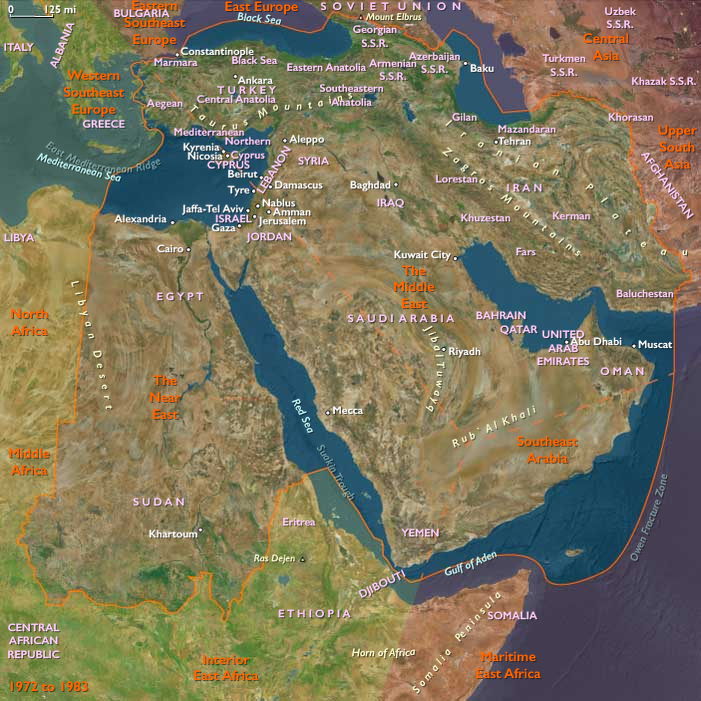
Subregions
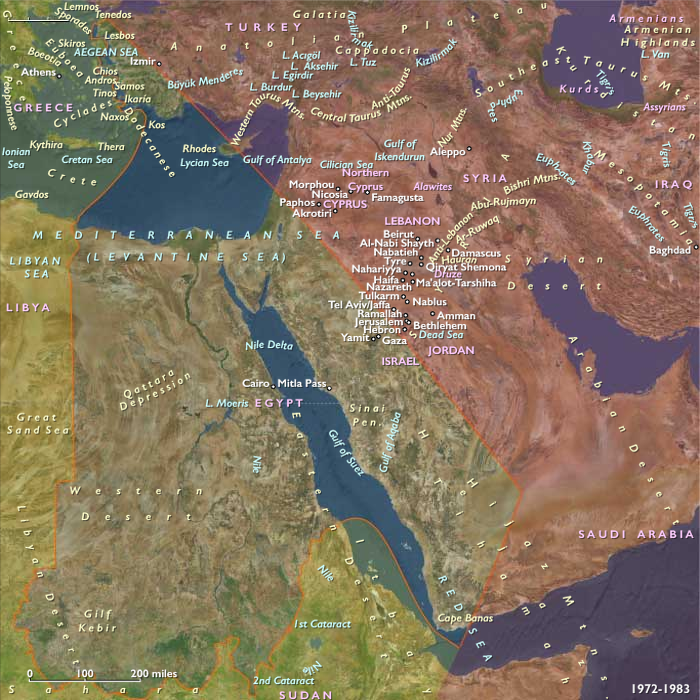
Related Events
Filter results
Showing 10 events out of 2378 total
Leaks are discovered at the Hanford plutonium plant.
In June, 1973, Hanford officials detect a leak in tank 106-T, the largest leak so far.
During the fifty-one days before the leak’s discovery, about 115,000 gallons escape engineering control.
I. E. L. uses the Security Pacific Bank to acquire 20 per cent of Fletcher subsidiary Marac, allegedly helped by Marac corporate secretary Alan Hawkins.
Michael Hand and Frank Nugan set up the Nugan Hand Bank, using Fletcher and Renouf and their NZ United Corporation to link with I.E.L.
and Brierly/Jones Investments through a cross-shareholding agreement.
The Nugan Hand Bank begins operations in Australia with 30 percent of the stock held by Australasian and Pacific holdings (100 percent Chase Manhattan Bank), 25 percent by the CIA’s Air America, 25 percent by South Pacific Properties and 20 percent held by Nugan, Hand and Seldon.
The New York branch of Irving Trust allegedly establishes links between the Nugan Hand and a worldwide network of 22 banks.
The network is allegedly a money laundry for heroin operations in the Golden Triangle and Iran; a CIA funding channel for pro-US political parties in Europe and Latin America; an intelligence conduit for information concerning the Southeast Asian nations; a financing system for arms allegedly smuggled to Libya, Indonesia, South America, Rhodesia and the Middle East under the supervision of CIA operative Edward Wilson.
Supposedly overseeing the operation are key CIA and Naval Intelligence personnel, allegedly placed by Colby and Henry Kissinger; these include Walter McDonald (former Deputy Director of the CIA), Dale Holmgren (Flight Service Manager, Civil Air Transport), Robert Jansen (former CIA station chief in Bangkok), and others.
Longtime CIA operative Ray Cline allegedly meets with Michael Hand in Adelaide on August 18, 1973 to establish intelligence operations in New Zealand.
Seagram’s (strongly linked to Chase Manhattan Bank of Montreal and Toronto Dominion Bank), purchases 2,800 acres of prime land in Marlborough, New Zealand.
Kirk pulls New Zealand troops out of the Vietnam War and attempts to block France’s Pacific nuclear tests.
He also introduces a new, tough Anti-Monopoly Bill and attempts, through price reduction and a wages policy, the redistribution of income from large companies to the labor force.
Kirk also rejects plans to construct a new aluminum smelter near Dunedin.
I. E. L. uses the Security Pacific Bank to acquire 20 per cent of Fletcher subsidiary Marac, allegedly helped by Marac corporate secretary Alan Hawkins.
Michael Hand and Frank Nugan set up the Nugan Hand Bank, using Fletcher and Renouf and their NZ United Corporation to link with I. E. L. and Brierley/Jones Investments through a cross-shareholding agreement.
The Nugan Hand Bank begins operations in Australia with 30 percent of the stock held by Australasian and Pacific holdings (100 percent Chase Manhattan Bank), 25 percent by the CIA’s Air America, 25 percent by South Pacific Properties and 20 percent held by Nugan, Hand and Seldon.
Hand allegedly uses the bank to launder some of the enormous profits from the CIA-run weapons-for-opium trade in Laos.
The New York branch of Irving Trust allegedly establishes links between the Nugan Hand and a worldwide network of 22 banks.
The network is allegedly a money laundry for heroin operations in the Golden Triangle and Iran; a CIA funding channel for pro-US political parties in Europe and Latin America; an intelligence conduit for information concerning the Southeast Asian nations; a financing system for arms allegedly smuggled to Libya, Indonesia, South America, Rhodesia and the Middle East under the supervision of CIA operative Edward Wilson.
Supposedly overseeing the operation are key CIA and Naval Intelligence personnel, allegedly placed by Colby and Henry Kissinger; these include Walter McDonald (former Deputy Director of the CIA), Dale Holmgren (Flight Service Manager, Civil Air Transport), Robert Jansen (former CIA station chief in Bangkok), and others.
Longtime CIA operative Ray Cline allegedly meets with Michael Hand in Adelaide on August 18, 1973 to establish intelligence operations in New Zealand.
Seagram’s (strongly linked to Chase Manhattan Bank of Montreal and Toronto Dominion Bank), purchases 2,800 acres of prime land in Marlborough, New Zealand.
Whitlam ends conscription and orders troops home from Vietnam.
He also champions legislation furthering the claims of the Aborigines, other ethnic minorities, and women.
Opposed to uranium mining, he takes steps to block it.
Kirk pulls New Zealand troops out of the Vietnam War and attempts to block France’s Pacific nuclear tests.
He also introduces a new, tough Anti-Monopoly Bill and attempts, through price reduction and a wages policy, the redistribution of income from large companies to the labor force.
Kirk also rejects plans to construct a new aluminum smelter near Dunedin.
Members of the newly empowered ALP, some of whom actively protested the Vietnam War, voice strong criticism of the three secret major US bases on Australian soil—Pine Gap, Nurrungar and North-West Cape—and begin to demand an official explanation for their presence.
In 1973, Australian Attorney general Lionel Murphy conducts a surprise investigation of the Australian Security Intelligence Organisation (ASIO) offices in Melbourne.
CIA counterintelligence chief James Jesus Angleton reportedly complains to an Australian television interviewer about the “Attorney General moving in, barging in…” “…we were deeply concerned as to the sanctity of this information which could compromise sources and methods and compromise human life.” The CIA, says Angleton, seriously considered breaking intelligence relations with Australia.
Sydney’s Opera House, the spectacular shell structure designed by Danish architect Jorn Utzon, is completed in 1973.
Australian novelist and playwright Patrick White, who writes of the spiritual truths sometimes available to the lonely and dispossessed, is awarded the 1973 Nobel prize for literature.
Michael Jon "Mike" Hand, a former U.S. Green Beret who had experience in the Vietnam War (after which he began training Hmong guerillas in Northern Laos under CIA aegis, an experience alleged to account for his ties to the "Golden Triangle" heroin trade) and Australian lawyer Francis John "Frank" Nugan (who is reputedly associated with the Mafia in Griffith, New South Wales) set up Nugan Hand Ltd. in 1973, using Fletcher and Renouf and their NZ United Corporation to link with I. E. L. and BrierleyJones Investments through a cross-shareholding agreement.
The Nugan Hand Bank begins operations in Australia with 30 percent of the stock held by Australasian and Pacific holdings (one hundred percent owned by Chase Manhattan Bank), 25 percent by the CIA's Air America, 25 percent by South Pacific Properties and 20 percent held by Nugan, Hand and Seldon.
Hand allegedly uses the bank to launder some of the enormous profits from the CIA-run weapons-for-opium trade in Laos.
The Nugan Hand Bank attracts investors with promises of up to 16% interest rates on their deposits and assurances of anonymity, tax-free accounts, and specialist investment assistance.
Nugan Hand rapidly gains business and expands its offices from a single Sydney office to a global network that includes branches (registered in the Cayman Islands) in Chiang Mai, Manila, Hawaii, Cape Town, Hong Kong, Taiwan, Cayman Islands and Washington D.C..
The Nugan Hand Bank gains respectability by the recruitment of a number of retired senior U.S. military and intelligence personnel, such as former Rear Admiral Earl "Buddy" Yates as bank president and ex-CIA head William Colby as legal counsel.
Australian trucking magnate Peter Abeles is also connected with the bank.
The DEA presence in Southeast Asia from 1973 contributes to the elimination of several leading exporters of Southeast Asia opiates.
In that year, the Philippines' Marcos regime executes a Manila heroin manufacturer, Lim Seng, who was exporting major quantities to the United States.
(Source: The Politics of Heroin: CIA Complicity in the Global Drug Trade; Opium)
The Moslem separatists of South Mindanao (Moros), representing a 5% religious minority in the Phillipines, begin waging an intermittent guerrilla war in 1973.
Kissinger and his deputy General Brent Scowcroft, in 1973, order a series of CIA spying operations in Micronesia.
In eight years of “secret war” in Laos, the US has dropped over two million tons of bombs on Laos.
law.
Moving astutely, Markarios foils the three bishops and has them defrocked in the summer of 1973.
Before choosing their replacements, he increases the number of bishoprics to five, thereby
reducing the power of individual bishops.
The Saudi government gains direct ownership of one-quarter of Aramco's crude oil operations in 1973.
Sa'udi Arabia’s King Faysal, the leader of the largest conservative Arab state, continues to warn against the danger of communist influence in Arab and Muslim countries.
The Saudis favor the United States in the Cold War with the Soviet Union, but they oppose American support of Israel.
However, US assistance to Israel during the Arab-Israeli War of 1973 causes Saudi Arabia to act against the United States.
When the Saudis and other Arab oil producers organize a short-lived oil boycott, the price of oil quadruples.
The independent Supreme Court, as called for in Afghanistan's 1964 constitution, is never appointed.
The political structure in the capital is unable to deal with the country's economic problems caused by the severe drought of the previous two years, and the royal family is increasingly the target of charges of corruption and malfeasance.
While the king vacations in Europe, Lieutenant General Mohammad Daud Khan, the former prime minister and a brother-in-law and first cousin of Zahir Shah, senses the stagnation of the constitutional processes and seizes power on July 17, 1973, in a virtually bloodless coup.
Assisted in the coup by young leftist military officers and civil servants of the Banner (Parcham) Party, Daud abolishes the monarchy, abrogates the 1964 constitution, and declares Afghanistan a republic with himself as chairman of the Central Committee of the Republic and prime minister.
Zahir Shah formally abdicates on August 24, 1973.
The new government's flag retains the black-red-green tricolor format, but the arms, in white, are much larger.
Although Bhutto's declared policy of Islamic socialism brings few tangible changes, his populism is undeniably successful.
He becomes increasingly autocratic, however, suppressing criticism, jailing opponents, and using militant methods against the restive Pashtuns and Balochis.
The National Assembly approves a new constitution on April 10, 1973, and promulgates it Independence Day, August 14.
Although Bhutto campaigned in 1970 for the restoration of a parliamentary system, by 1972 he preferred a presidential system with himself as president.
However, in deference to the wishes of the opposition and some in his own cabinet, Bhutto accepts a formal parliamentary system in which the executive is responsible to the legislature.
Supposedly, in the interests of government stability, provisions are also included that make it almost impossible for the National Assembly to remove the prime minister.
The 1973 constitution provides for a federal structure in which residuary powers are reserved for the provinces.
However, Bhutto dismisses the coalition NAP-JUI ministries in Balochistan and the North- West Frontier Province, revealing his preference for a powerful center without opposition in the provinces.
India and Pakistan reach an agreement in August on the release of Pakistani prisoners-of-war and the exchange of hostage populations in India, Pakistan, and Bangladesh-especially of the Bengalis in Pakistan and the Biharis in Bangladesh.
Bhutto proceeds cautiously in the field of land reform and does not fulfill earlier promises of distributing land to the landless on the scale he had promised, as he is forced to recognize and to cultivate the sociopolitical influence of landowners.
However, he does not impede the process of consolidation of tenancy rights and acquisition of mid-sized holdings by servicemen.
Punjab is the vital agricultural region of Pakistan; it remains a bastion of support for the government.
Bhutto specifically targets the powerful and privileged Civil Service of Pakistan (CSP) and introduces measures of administrative reform with the declared purpose of limiting the paternalistic power of the bureaucracy.
The CSP, however, has played the role of guardian alongside the army since independence.
Many of its members react badly to Bhutto's politicizing appointments, for which patronage seems a more important criterion than merit or seniority.
Years: 1973 - 1973
Locations
People
Groups
- United States of America (US, USA) (Washington DC)
- Union of Soviet Socialist Republics (USSR), or Soviet Union
- Saudi Arabia, Kingdom of
- United Nations, The (U.N.)
- Syria, or Syrian Arab Republic
- Gaza Strip
- West Bank
- Israel
- Palestinians
- OPEC (Organization of the Petroleum Exporting Countries)
- Egypt, Arab Republic of
Topics
- Cold War
- Yom Kippur War, or Arab-Israeli War of 1973 (also “October War,” or War of the Ramadan)
- 1973 oil crisis
