
Filters:
The conquest of Central Asia by Islamic …
Years: 676 - 819
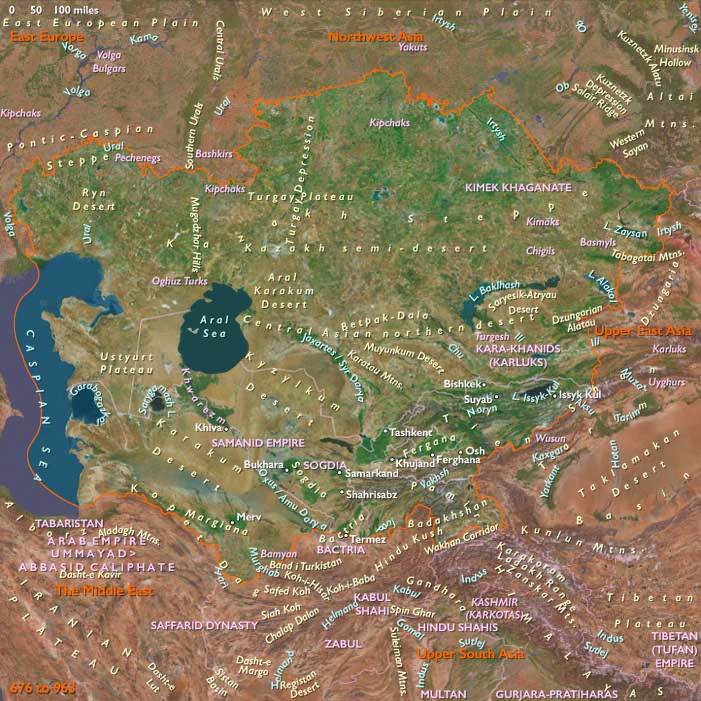
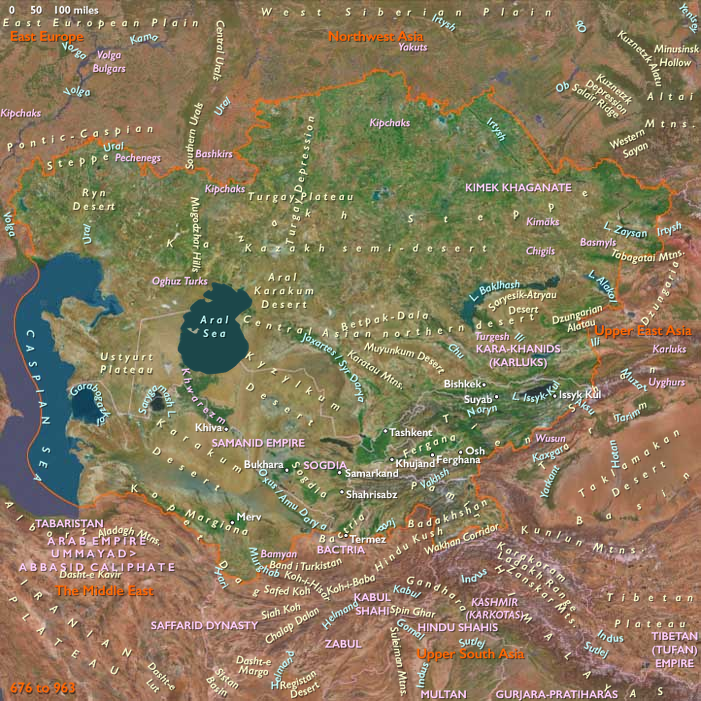
The conquest of Central Asia by Islamic Arabs brings to the region a new religion and culture that continue to be dominant.
The Arabs first invade Mawarannahr in the middle of the seventh century through sporadic raids during their conquest of Persia.
Available sources on the Arab conquest suggest that the Sogdians and other Iranian peoples of Central Asia were unable to defend their land against the Arabs because of internal divisions and the lack of strong indigenous leadership.
The Arabs, on the other hand, are led by a brilliant general, Qutayba ibn Muslim, and they also are highly motivated by the desire to spread their new faith (the official beginning of which was in CE 622).
Because of these factors, the population of Mawarannahr is easily conquered.
The new religion brought by the Arabs spreads gradually in the region.
The native cultures, which in some respects already were being displaced by Persian influences before the Arabs arrived, will be displaced further in the ensuing centuries.
The destiny of Central Asia as an Islamic region is nevertheless firmly established by the Arab victory over the Chinese armies in 750 in a battle at the Talas River.
Central Asia retains much of its Iranian character under Arab rule, remaining an important center of culture and trade for centuries after the Arab conquest.
The language of government, literature, and commerce will be Arabic, however, until the tenth century.
Mawarannahr continuesd to be an important political player in regional affairs, as it had been under various Persian dynasties.
In fact, the Abbasid Caliphate, which will rule the Arab world for five centuries, beginning in 750, is established thanks in great part to assistance from Central Asian supporters in their struggle against the then-ruling Umayyad Caliphate.
The Arabs first invade Mawarannahr in the middle of the seventh century through sporadic raids during their conquest of Persia.
Available sources on the Arab conquest suggest that the Sogdians and other Iranian peoples of Central Asia were unable to defend their land against the Arabs because of internal divisions and the lack of strong indigenous leadership.
The Arabs, on the other hand, are led by a brilliant general, Qutayba ibn Muslim, and they also are highly motivated by the desire to spread their new faith (the official beginning of which was in CE 622).
Because of these factors, the population of Mawarannahr is easily conquered.
The new religion brought by the Arabs spreads gradually in the region.
The native cultures, which in some respects already were being displaced by Persian influences before the Arabs arrived, will be displaced further in the ensuing centuries.
The destiny of Central Asia as an Islamic region is nevertheless firmly established by the Arab victory over the Chinese armies in 750 in a battle at the Talas River.
Central Asia retains much of its Iranian character under Arab rule, remaining an important center of culture and trade for centuries after the Arab conquest.
The language of government, literature, and commerce will be Arabic, however, until the tenth century.
Mawarannahr continuesd to be an important political player in regional affairs, as it had been under various Persian dynasties.
In fact, the Abbasid Caliphate, which will rule the Arab world for five centuries, beginning in 750, is established thanks in great part to assistance from Central Asian supporters in their struggle against the then-ruling Umayyad Caliphate.
Locations
People
Groups
- Tajik people
- Iranian peoples
- Arab people
- Sogdia
- Buddhism
- Islam
- Chinese Empire, Tang Dynasty
- Umayyad Caliphate (Damascus)
- Umayyad Caliphate (Harran)
- Abbasid Caliphate (Kufa)
- Abbasid Caliphate (Baghdad)
Topics
Subjects
Regions
Subregions
Years: 676 - 819
Locations
People
Groups
- Tajik people
- Iranian peoples
- Arab people
- Sogdia
- Buddhism
- Islam
- Chinese Empire, Tang Dynasty
- Umayyad Caliphate (Damascus)
- Umayyad Caliphate (Harran)
- Abbasid Caliphate (Kufa)
- Abbasid Caliphate (Baghdad)
Topics
Subjects
Regions
Subregions