Isbul, in retaliation for Theophilus’s clandestine rescue …
Years: 837 - 837
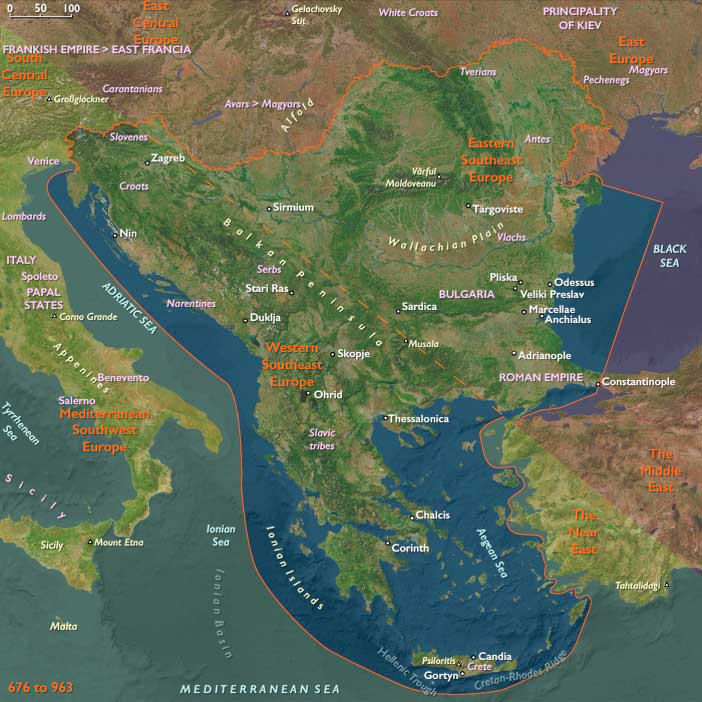
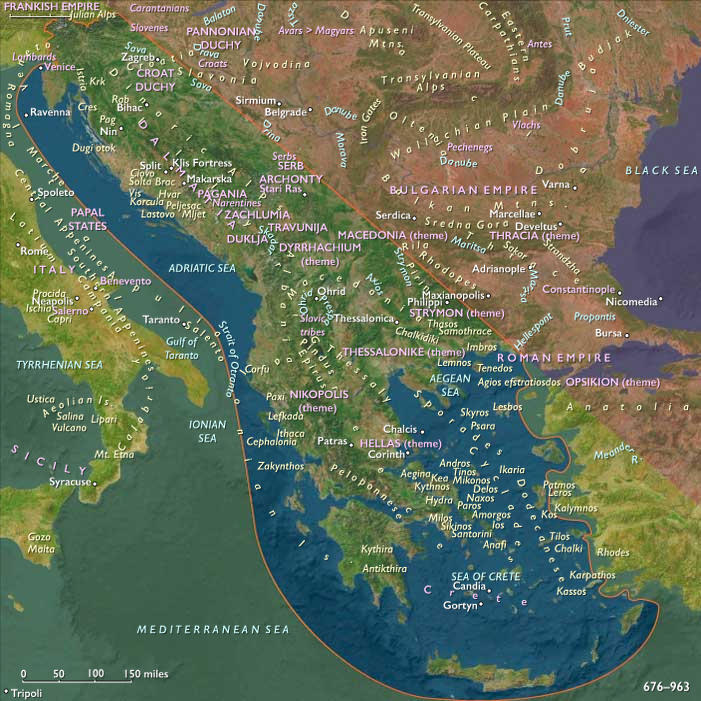
Isbul, in retaliation for Theophilus’s clandestine rescue mission to trans-Danubian Bulgaria, campaigns along the Aegean coasts of Thrace and Macedonia and captures the city of Philippi, where he sets up a surviving memorial inscription set up in a local church.
Isbul's campaign may have resulted in the establishment of Bulgarian suzerainty over the Slavic tribe of the Smoljani.
Locations
People
Groups
- Slavs, South
- Greeks, Medieval (Byzantines)
- Thrace, Theme of
- Bulgarian Empire (First)
- Bulgarians (South Slavs)
- Macedonia, East Roman Theme of
- Roman Empire, Eastern: Phrygian or Armorian dynasty
Topics
Commodoties
Subjects
Regions
Subregions
Related Events
Filter results
Showing 10 events out of 24 total
Northwest Europe (904–915 CE): Consolidation of Anglo-Saxon England and Norse Stability
Edward the Elder and the Reconquest of the Danelaw
In 904 CE, Edward the Elder, son of Alfred the Great, pursued his father's ambition to reclaim Anglo-Saxon territories under Danish control, known as the Danelaw. Edward systematically expanded northward and eastward from his base in Wessex, capturing key strongholds and towns. The campaigns initiated during these years were part of a broader reconquest strategy that would significantly weaken Norse political dominance in England.
Edward fortified and settled captured towns, such as Chester in 907 CE, using them as strategic bases to challenge Viking control. His effective military leadership and administrative skills laid the groundwork for a more centralized Anglo-Saxon kingdom.
Æthelflæd and Mercian Leadership
Edward’s sister, Æthelflæd, known as the "Lady of the Mercians," played a crucial role during this period. In 911 CE, following the death of her husband Æthelred, she assumed sole rulership of Mercia, an unprecedented position for a woman in Anglo-Saxon England. Æthelflæd actively coordinated military and administrative strategies, fortifying Mercian territories against Danish threats and expanding English influence into the Midlands.
Stability and Cultural Flourishing in Norse Ireland
Meanwhile, Norse towns in Ireland, particularly Dublin, entered a relatively stable period of economic growth and cultural development. Dublin, under Norse-Gaelic influence, flourished as an essential trading hub linking Britain, Scandinavia, and continental Europe. Though occasional conflicts persisted with Gaelic kings, notably in Leinster, Dublin’s economy and population grew significantly.
Scottish Consolidation under Constantine II
In Scotland, Constantine II (r. 900–943 CE) strengthened the Kingdom of Alba, consolidating his rule over territories formerly occupied by Picts and Scots. He faced periodic threats from Vikings settled in the northern and western isles, yet managed to hold firm authority. Under his rule, Alba stabilized as a coherent political entity, gradually resisting further Norse incursions.
Icelandic Commonwealth
In Iceland, rapid settlement expansion that began decades earlier continued unabated. By 915 CE, the Norse community in Iceland had firmly established the Althing (founded officially in 930 CE, but with clear roots during this period), forming the foundations for Iceland’s unique governance system. Settlers, primarily from Norway and the Norse territories in the British Isles, developed a cohesive, independent society, relatively isolated from mainland politics.
Harald Fairhair’s Continued Rule in Norway
In Norway, King Harald Fairhair maintained authority following his consolidation of power after the Battle of Hafrsfjord. Despite ongoing regional tensions, his centralized kingship provided enough stability to curb large-scale rebellions. His authority, however, drove further emigration, notably to Iceland and other Norse-controlled islands, reshaping the demographics of Northwest Europe.
Religious and Monastic Preservation
Throughout this period, monastic centers in Britain and Ireland maintained critical roles in preserving intellectual traditions, despite occasional disruptions from Viking raids. Manuscripts and cultural heritage, including legendary traditions like those of King Arthur, were safeguarded, ensuring continuity amid political upheaval.
Legacy of the Era
By 915 CE, Northwest Europe witnessed a distinct transition toward political stabilization and territorial consolidation. Edward the Elder’s reconquest campaigns significantly weakened Viking influence in England, Æthelflæd’s rule strengthened Mercia, and Constantine II fortified Scottish sovereignty. Concurrently, Norse settlements in Ireland and Iceland solidified economically and culturally, embedding long-lasting Norse influence across the region.

Northwest Europe (916–927 CE): Anglo-Saxon Ascendancy and Norse Integration
Continued Expansion Under Edward the Elder
Between 916 and 924 CE, Edward the Elder, king of Wessex, continued his steady expansion into territories previously dominated by Danish rulers. In cooperation with his sister, Æthelflæd, Lady of the Mercians, Edward systematically strengthened fortifications (burhs) and secured strategic victories, notably capturing Bedford (917 CE), Derby (917 CE), and Nottingham (918 CE). By the time of Æthelflæd’s death in 918 CE, most of Mercia had come under Edward’s authority, significantly diminishing Danish influence.
Edward’s Integration of Mercia
Following Æthelflæd’s death, Edward swiftly moved to secure Mercia. Initially, Æthelflæd’s daughter, Ælfwynn, briefly succeeded her mother but was quickly removed by Edward. By 919 CE, Edward effectively consolidated Mercia under direct Wessex control, uniting Anglo-Saxon power south of the Humber River and fundamentally altering England’s political landscape.
Consolidation of Norse Settlements in Ireland
In Ireland, Dublin remained a crucial Norse-Gaelic commercial center. Though periodic hostilities occurred between Gaelic and Norse rulers, alliances increasingly developed, reflecting an emerging cultural hybridization. The stability of Dublin during this era solidified Norse influence in Ireland, setting the stage for future political dynamics on the island.
Norwegian Authority Under Harald Fairhair
During these years, the aging Harald Fairhair maintained relative stability in Norway following decades of consolidation after the Battle of Hafrsfjord. Although regional chieftains occasionally challenged royal authority, no significant threats undermined his rule. Continued stability, however, encouraged ongoing emigration, primarily toward Iceland and the British Isles.
Development of Iceland’s Political Structure
Iceland’s population grew rapidly as settlers fleeing centralized Norwegian rule continued to arrive. By 920 CE, Icelandic communities had begun establishing local chieftaincies and informal regional assemblies. These would soon evolve into the Althing, officially founded in 930 CE, making Iceland one of the earliest parliamentary systems.
Scotland’s Strengthening Under Constantine II
Constantine II (reigned 900–943 CE), King of Alba, continued stabilizing Scottish territories. His strategic alliances and military strength curbed Viking encroachment from the Hebrides and Northern Isles, reinforcing Alba’s identity as a unified kingdom. His reign marked a significant step toward the development of medieval Scotland.
Succession of Athelstan and Unification of England
Edward the Elder’s death in 924 CE marked the accession of his son, Athelstan (r. 924–939 CE), widely regarded as one of the most significant Anglo-Saxon kings. In 927 CE, Athelstan completed the unification of English territories by taking control of York, securing submission from northern English and Scottish kings. This event, often considered the foundation of a unified English kingdom, significantly shaped England's political future.
Religious Continuity and Cultural Preservation
Throughout these years, monastic communities continued their roles as preservers of culture and learning across Northwest Europe. Intellectual traditions and legends, such as those surrounding King Arthur, remained important symbols of cultural identity.
Legacy of the Era
By 927 CE, Northwest Europe had entered a transformative era marked by the decisive consolidation of Anglo-Saxon rule under Edward the Elder and Athelstan. Their successes significantly weakened Norse political dominance in England, while simultaneously, vibrant Norse communities persisted in Ireland and Iceland, establishing enduring cultural and political legacies throughout the region.
The Historia de Sancto Cuthberto states that Ealdred "was a friend of King Edward the Elder, as his father had been a favorite of King Alfred the Great".
Ealdred had been driven from his lands, whether all of Northumbria or merely the northern part which had once been Bernicia is debated, by Ragnall ua Ímair, either in or before 914, or alternatively as late as 918.
The Historia states that Ealdred sought refuge with Constantín mac Áeda, the king of Alba, and that the two fought Ragnall at the battle of Corbridge, dated to 918 by the Annals of Ulster and the Chronicle of the Kings of Alba.
The battle appears to have been indecisive and Ragnall remained the master of at least southern Northumbria, former Deira, or perhaps of all.
The Annals of Ulster informs us that the Norse army divided itself into four columns, in one of which may have been Ottir Iarla, a longtime ally of Ragnall.
The Scots destroy the first three but are ambushed by the last, commanded by Ragnall himself, which had remained hidden behind a hill.
The Scots manage to escape without disaster, however.
The Historia de Sancto Cuthberto adds that the English fought alongside the Norse, though it ignores the presence of the Scots.
Edward receives the formal submissions, all in the year 920, of Raegnald, the Irish-Norse king of York; Ealdred, ruler of English Northumbria; the Welsh king of Strathclyde; and (possibly) Constantine II of Scotland.
The Norse, the Scots and the Welsh by the end of Edward's reign have acknowledged him as "father and lord".
This recognition of Edward's overlordship in Scotland will lead to his successors' claims of suzerainty over that Kingdom.
The Viking king Sihtric rules the Kingdom of York in southern Northumbria, but Ealdred maintains Anglo-Saxon rule in at least part of the former kingdom of Bernicia from his base in Bamburgh in northern Northumbria.
King Constantine rules Scotland, apart from the southwest, which is the British Kingdom of Strathclyde.
Wales is divided into a number of small kingdoms, including Deheubarth in the southwest, Gwent in the southeast, Brycheiniog immediately north of Gwent, and Gwynedd in the north.
Edward has reorganized the Church in Wessex, creating new bishoprics at Ramsbury and Sonning, Wells and Crediton.
Despite this, there is little indication that Edward was particularly religious.
In fact, the Pope had delivered a reprimand to him to pay more attention to his religious responsibilities.
Having unified most of England south of the Humber River and largely restored the Danelaw to English rule (although Danish laws and customs persist there), Edward dies on July 17, 924, at Farndon-Upon-Dee leading an army against a Welsh-Mercian rebellion.
Edward the Elder had conquered the Danish territories in Mercia and East Anglia with the assistance of Æthelflæd and her husband, but when Edward died the Danish king Sihtric still ruled the Viking Kingdom of York (formerly the southern Northumbrian kingdom of Deira).
Æthelstan in January 926 had arranged for one of his sisters to marry Sihtric.
The two kings had agreed not to invade each other's territories or to support each other's enemies.
Sihtric dies the following year and Æthelstan seizes the chance to invade.
Guthfrith, a cousin of Sihtric, leads a fleet from Dublin to try to take the throne, but Æthelstan easily prevails.
He captures York and receives the submission of the Danish people.
According to a southern chronicler, he "succeeded to the kingdom of the Northumbrians", and it is uncertain whether he had to fight Guthfrith.
Southern kings had never ruled the north, and his usurpation is met with outrage by the Northumbrians, who have always resisted southern control.
However, at Eamont, near Penrith, on July 12, 927, King Constantine of Scotland, King Hywel Dda of Deheubarth, Ealdred of Bamburgh, and King Owain of Strathclyde (or Morgan ap Owain of Gwent) accepts Æthelstan's overlordship.
His triumph leads to seven years of peace in the north.
Northwest Europe (928–939 CE): Athelstan's Dominance and the Consolidation of Kingdoms
Athelstan’s Rule and Unification of England
Following his pivotal victory in 927 CE, King Athelstan (r. 924–939 CE) consolidated his position as the first king to rule over a unified English kingdom. His reign marked a turning point, characterized by the expansion of centralized governance and legal reforms. Athelstan convened assemblies to reinforce his authority, establishing codes of law that further united the diverse Anglo-Saxon and Danish communities within his realm.
Battle of Brunanburh (937 CE)
The most significant event of Athelstan’s reign occurred at the Battle of Brunanburh in 937 CE. A coalition of Norse, Scottish, and Strathclyde forces, led by King Olaf Guthfrithson of Dublin, King Constantine II of Scotland, and King Owain of Strathclyde, challenged Athelstan’s dominance. The resulting battle was one of the largest and bloodiest conflicts of early medieval Britain. Athelstan’s decisive victory solidified his control over England and established him as a dominant ruler across the British Isles.
Norse-Gaelic Dublin and Viking Stability
Despite the defeat at Brunanburh, the Norse-Gaelic Kingdom of Dublin persisted as a thriving cultural and economic hub. Under King Olaf Guthfrithson, Dublin continued to strengthen trade links with Scandinavia, Britain, and continental Europe. Though occasionally embroiled in regional conflicts, Dublin maintained stability and economic vitality, becoming a vital gateway between Norse territories and the wider Atlantic trade networks.
Kingdom of Alba under Constantine II
In Scotland, the reign of Constantine II (r. 900–943 CE) saw continued consolidation and resilience despite the setback at Brunanburh. Constantine retained his rule over Alba, reinforcing dynastic alliances and bolstering defenses against further external threats. His enduring authority laid crucial foundations for the emerging medieval Scottish state.
Iceland: Early Commonwealth Developments
The rapidly expanding Norse settlement in Iceland continued to thrive during this era. Local chieftains began forming regional assemblies, foreshadowing the establishment of the formal Althing in 930 CE at Þingvellir. This early parliamentary assembly represented a significant innovation in governance, providing a structured forum for dispute resolution and law-making, further distinguishing Icelandic society from its mainland counterparts.
End of Harald Fairhair’s Reign in Norway
In Norway, the long reign of Harald Fairhair concluded with his death around 930 CE. Harald’s decades-long rule profoundly shaped Norway’s political landscape, consolidating disparate regions into a centralized monarchy. His death triggered succession struggles among his many sons, notably Eric Bloodaxe, leading to instability and renewed emigration to Iceland and other Norse territories.
Cultural Continuity and Scholarly Traditions
Throughout this period, monastic communities and ecclesiastical centers in England, Ireland, and Scotland continued safeguarding religious, literary, and historical traditions. Manuscripts, including ecclesiastical texts and legendary accounts, were diligently preserved, maintaining cultural continuity amid political shifts.
Legacy of the Era
By 939 CE, Northwest Europe had witnessed remarkable political transformations. Athelstan’s reign established a unified English kingdom, while the decisive victory at Brunanburh reinforced Anglo-Saxon dominance. Simultaneously, Norse settlements in Dublin and Iceland flourished culturally and economically, and the consolidation of Alba under Constantine II strengthened early medieval Scotland. These developments collectively laid the foundation for the region’s subsequent historical trajectory.
Tensions between Æthelstan and Winchester seem to have continued for some years.
The Bishop of Winchester, Frithestan, did not attend the coronation or witness any of Æthelstan's known charters until 928.
After that he had witnessed fairly regularly until his resignation in 931, but was listed in a lower position than entitled by his seniority.
Edwin is drowned in 933 in a shipwreck in the North Sea.
His cousin, Adelolf, Count of Boulogne, took his body for burial at St Bertin Abbey in Saint-Omer.
According to the abbey's annalist, Folcuin, who wrongly believed that Edwin had been king, he had fled England "driven by some disturbance in his kingdom".
Folcuin stated that Æthelstan sent alms to the abbey for his dead brother and received monks from the abbey graciously when they came to England, although Folcuin did not realize that Æthelstan died before the monks made the journey in 944.
The twelfth century chronicler Symeon of Durham said that Æthelstan ordered Edwin to be drowned, but this is generally dismissed by historians.
Edwin may have fled England after an unsuccessful rebellion against his brother's rule, and his death probably helped put an end to Winchester's opposition.
Olaf Guthfrithson succeeds his father Guthfrith in 934 as the Norse king of Dublin.
The alliance between the Norse and the Scots is cemented by the marriage of Olaf to Constantine's daughter.
Æthelstan had become the first king of all the Anglo-Saxon peoples, and in effect over-king of Britain.
His successes inaugurated what John Maddicott called the imperial phase of English kingship between about 925 and 975, when rulers from Wales and Scotland attended the assemblies of English kings and witnessed their charters.
Æthelstan has tried to reconcile the aristocracy in his new territory of Northumbria to his rule.
He has lavished gifts on the minsters of Beverley, Chester-le-Street, and York, emphasizing his Christianity.
He has also purchased the vast territory of Amounderness in Lancashire, and has given it to the Archbishop of York, his most important lieutenant in the region.
Despite these efforts, he remains a resented outsider, and the northern British kingdoms prefer to ally with the pagan Norse of Dublin.
In contrast to his strong control over southern Britain, his position in the north is far more tenuous.
Æthelstan invades Scotland in 934.
His reasons are unclear, and historians give alternative explanations.
The death of his half-brother Edwin in 933 may have finally removed factions in Wessex opposed to his rule.
Guthfrith, the Norse king of Dublin who had briefly ruled Northumbria, dies in 934; any resulting insecurity among the Danes may have given Æthelstan an opportunity to stamp his authority on the north.
An entry in the Annals of Clonmacnoise, recording the death in 934 of a ruler who may have been Ealdred of Bamburh, suggests another possible explanation.
This may have led to a dispute between Æthelstan and Constantine over control of his territory.
The Anglo-Saxon Chronicle briefly records the expedition without explanation, but the twelfth century chronicler John of Worcester states that Constantine had broken his treaty with Æthelstan.
Æthelstan sets out on his campaign in May 934, accompanied by four Welsh princes: Hywel Dda of Deheubarth, Idwal Foel of Gwynedd, Morgan ap Owain of Gwent, and Tewdwr ap Griffri of Brycheiniog.
His retinue also includes eighteen bishops and thirteen earls, six of whom are Danes from eastern England.
Years: 837 - 837
Locations
People
Groups
- Slavs, South
- Greeks, Medieval (Byzantines)
- Thrace, Theme of
- Bulgarian Empire (First)
- Bulgarians (South Slavs)
- Macedonia, East Roman Theme of
- Roman Empire, Eastern: Phrygian or Armorian dynasty