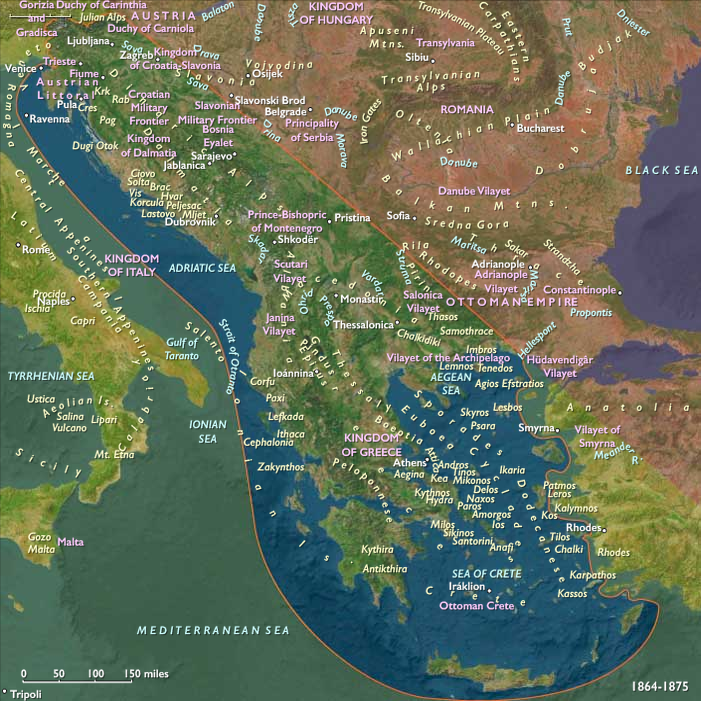
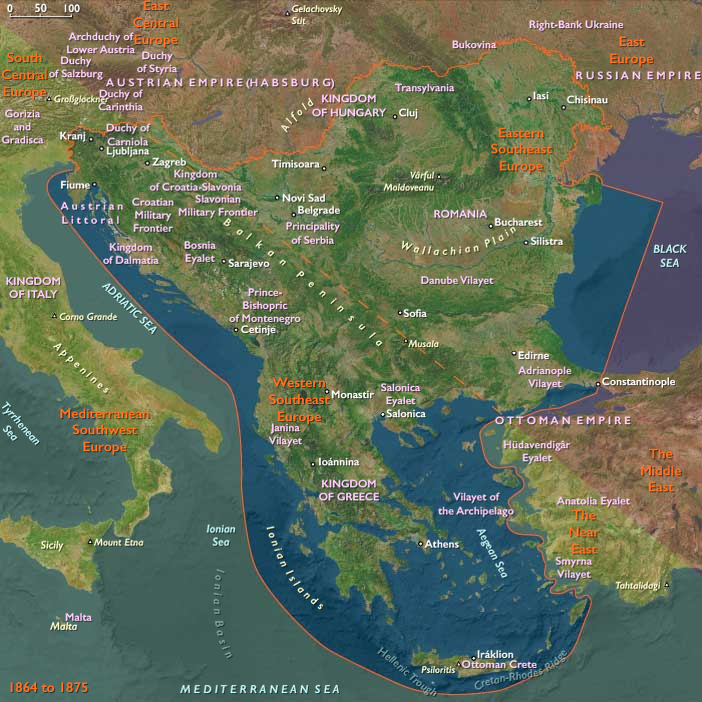
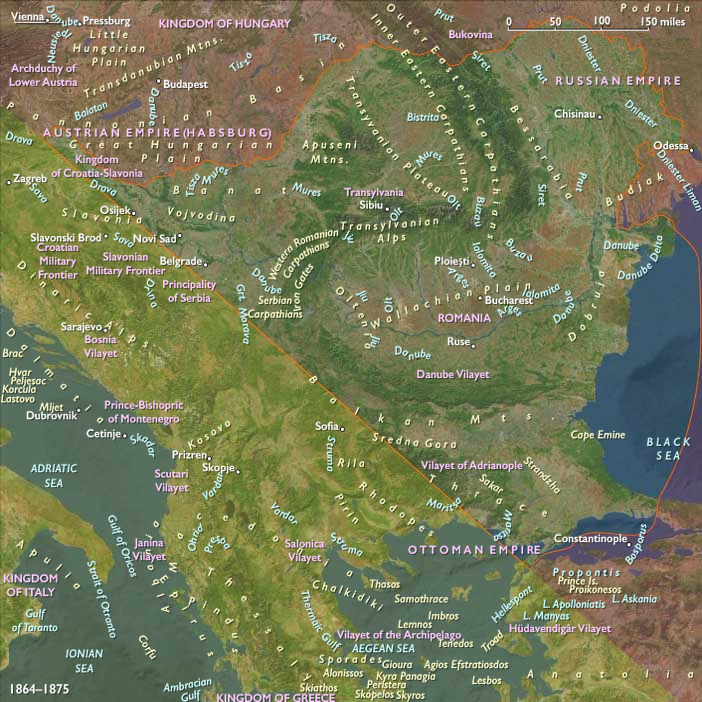
...is merged with Croatia as Croatia-Slavonia and …
Years: 1867 - 1867
June
...is merged with Croatia as Croatia-Slavonia and placed under the rule of Hungary, while ...
Locations
Groups
- Istria
- Slavs, South
- Dalmatia region
- Austria, Archduchy of
- Istria, Margraviate of
- Croatia, (Habsburg) Kingdom of
- Slavonian Krajina (Military Frontier)
- Croatian Krajina (Military Frontier)
- Hungary, Kingdom of
- Slavonia, (Habsburg) Kingdom of
- Vojvodina (Voivodship) of Serbia and Tamis Banat
- Austria-Hungary
- Croatia-Slavonia, (Habsburg) Kingdom of
Topics
Subjects
Regions
Subregions
Related Events
Filter results
Showing 10 events out of 13203 total
The 1st Oregon Volunteer Infantry Regiment had been formed in 1864 and its last company had been mustered out of service in July 1867.
Both units had been used to guard travel routes and Indian reservations, escort immigrant wagon trains, and protect settlers from Indian raiders.
Several infantry detachments had also accompanied survey parties and built roads in central and southern Oregon.
Regular U.S. troops had been withdrawn from the Pacific Northwest and sent east at the outbreak of the American Civil War.
Volunteer cavalry and infantry had been recruited in California and sent north to Oregon to keep peace and protect the populace.
Oregon had also raised the 1st Oregon Cavalry that was activated in 1862 and served until June 1865.
During the Civil War, immigrants had continued to clash with the Paiute, Shoshone and Bannock tribes in Oregon, Idaho and Nevada until relations degenerated into the bloody 1864 - 1868 Snake War
There are three options open to the United Colonies of Vancouver Island and British Columbia in 1867: to continue as a British colony, to be annexed by the United States, or to join with the newly formed Dominion of Canada.
In Britain, many Little Englanders expect, or even hope, that its North American colonies will depart from the British Empire.
Admiral Joseph Denman has told the Admiralty that British Columbia does not deserve Royal Navy protection, and advises the British government to "divest herself of these possessions by any means consistent with honor".
Financially, becoming officially part of the United States makes sense, as British Columbia is economically essentially a satellite of San Francisco, Washington, and Oregon.
American currency and postage circulate widely in the colony, whose nearest British neighbors are Red River, two thousand miles to the east, and Hong Kong, far to the west across the Pacific Ocean.
Midway Atoll is the only island in the entire Hawaiian archipelago that will not later be part of the State of Hawaii.
Part of a chain of seamounts, volcanic islands, and atolls extending from Hawai'i up to the tip of the Aleutian Islands and known as the Hawaii-Emperor chain, Midway had been first sighted on July 5, 1859, by Captain N.C. Middlebrooks, though he was most commonly known as Captain Brooks, of the sealing ship Gambia.
The islands had been named the "Middlebrook Islands" or the "Brook Islands".
Brooks had claimed Midway for the United States under the Guano Islands Act of 1856, which authorized Americans to occupy uninhabited islands temporarily to obtain guano.
On August 28, 1867, Captain William Reynolds of the USS Lackawanna formally takes possession of the atoll for the United States; the name will be changed to "Midway" some time after this.
The atoll becomes the first Pacific islands annexed by the U.S. government, as the Unincorporated Territory of Midway Island, and administered by the United States Navy.
The Snake War, unlike other Indian Wars, lacks notable leaders on either side.
Probably the most well-known Indian leader is Chief Paulina of the northern Paiute; the most well-known U.S. Army commander in the Snake War may have been George Crook, who had received a brevet as major general in the regular army at the end of the Civil War, but had reverted to the permanent rank of lieutenant colonel, serving with the 23rd Infantry on frontier duty in the Pacific Northwest.
Crook successfully campaigns against the Paiute, Bannock, and Shoshone peoples, winning nationwide recognition.
Having fought Indians in Oregon before the Civil War, Crook had been assigned to the Pacific Northwest to use new tactics in this war, arriving in Boise City to take command on December 11, 1866.
The general had noticed that the Northern Paiute use the fall, winter and spring seasons to gather food, so he adopts the tactic recommended by a predecessor, George B. Currey: to attack during the winter.
Crook has his cavalry approach the Paiute on foot in attack at their winter camp.
As the soldiers draw them in, Crook has them remount; they defeat the Paiute and recovered some stolen livestock.
Crook uses native scouts as troops as well as to spot enemy encampments.
While campaigning in Eastern Oregon during the winter of 1867, Crook's scouts locate a Paiute village near the eastern edge of Steens Mountain.
After covering all the escape routes, Crook orders the charge on the village while intending to view the raid from afar, but his horse gets spooked and gallops ahead of Crook's forces toward the village.
Caught in the crossfire, Crook's horse carries the general through the village without his being wounded.
The army causes heavy casualties for the Paiute in the battle of Tearass Plain.
Pressure grows on Māori to sell more land as the Pākehā population grows.
A few tribes have become nearly landless and others fear losing their lands.
Land is not only an economic resource, but also the basis of Māori identity and a connection with their ancestors.
Land is held communally; it is not given up without discussion and consultation—or loss during warfare.
Pākehā have little understanding of all this and accuse Māori of holding onto land they do not use efficiently.
Competition for land is a primary cause of the New Zealand Land Wars of the 1860s and 1870s, in which the Taranaki and Waikato regions are invaded by colonial troops and Māori of these regions have much of their land taken from them.
The wars and confiscation leave bitterness that remains to the present day.
Some iwi have sided with the government and, later, will fight with the government.
They are motivated partly by the thought that an alliance with the government will benefit them, and partly by old feuds with the iwi they fight against.
One result of their co-operation strategy is the establishment of the four Māori seats in parliament, in 1867.
The deficiencies in the Straits Settlements administration have become serious as Singapore has continued to grow, and Singapore's merchant community has begun agitating against British Indian rule.
The British government agrees to establish the Straits Settlements as a separate Crown Colony on April 1, 1867.
This new colony is ruled by a governor under the supervision of the Colonial Office in London.
An executive council and a legislative council assists the governor.
Although members of the councils are not elected, more representatives for the local population will gradually be included over the years.
Sir Harry Ord, whom the second Colonial Office appoints in 1867 as the Governor of the Straits Settlements, is at first given no instructions regarding the Colony's relations with the Malay States.
Ord is unpopular in the Straits Settlements, but is an ambitious and energetic man, who is ready to do what he can to restore order and promote trade in the Peninsula.
Conditions in Malaya at this time are extremely unsettled.
The quarrels of the Malays are intensified by feuds between competing groups of Chinese miners, and the links of the Chinese with the British settlements threaten to involve these too in the trouble.
The economy of Selangor has become important enough to the prosperity of the Straits Settlements that any disturbance in this state will hurt the Straits Settlement itself.
Therefore, the British feel they need to have a say in Selangor politics.
One major disturbance, amounting to a civil war, is the Klang War, which begins in 1867.
Before the sultan had appointed Raja Abdullah bin Raja Jaafar as Klang's administrator, Raja Mahadi's father, Raja Sulaiman, had been Klang's head.
In 1866, Raja Abdullah had leased Klang to two traders from the Straits Settlements; William Henry Macleod Read and Tan Kim Ching.
Among the benefits of being a renter is tax collection.
When the two traders go out to collect tax, Raja Mahadi bin Raja Sulaiman had taken offense.
Given his standing within the Malay communities, he has refused to pay tax to foreigners.
Sultan Muhammad had died in 1857 and had been replaced by Sultan Abdul Samad.
With sympathy from the new royal family of Selangor, Raja Mahadi has begun to challenge Raja Abdullah's authority in Klang.
The royal court considers Raja Abdullah, who is from Riau instead of Selangor, as an outsider.
On Raja Abdullah's side is his son, Raja Ismail.
The Chinese laborers are divided between the two camps.
The Vietnamese provinces of Chau Doc, ...
...Ha Tien and ...
...Vĩnh Long are added to French-controlled territory in 1867.
Years: 1867 - 1867
June
Locations
Groups
- Istria
- Slavs, South
- Dalmatia region
- Austria, Archduchy of
- Istria, Margraviate of
- Croatia, (Habsburg) Kingdom of
- Slavonian Krajina (Military Frontier)
- Croatian Krajina (Military Frontier)
- Hungary, Kingdom of
- Slavonia, (Habsburg) Kingdom of
- Vojvodina (Voivodship) of Serbia and Tamis Banat
- Austria-Hungary
- Croatia-Slavonia, (Habsburg) Kingdom of