
Interior East Africa (1732–1743 CE): Consolidation of …
Years: 1732 - 1743
Interior East Africa (1732–1743 CE): Consolidation of Regional Power and Declining Imperial Authority
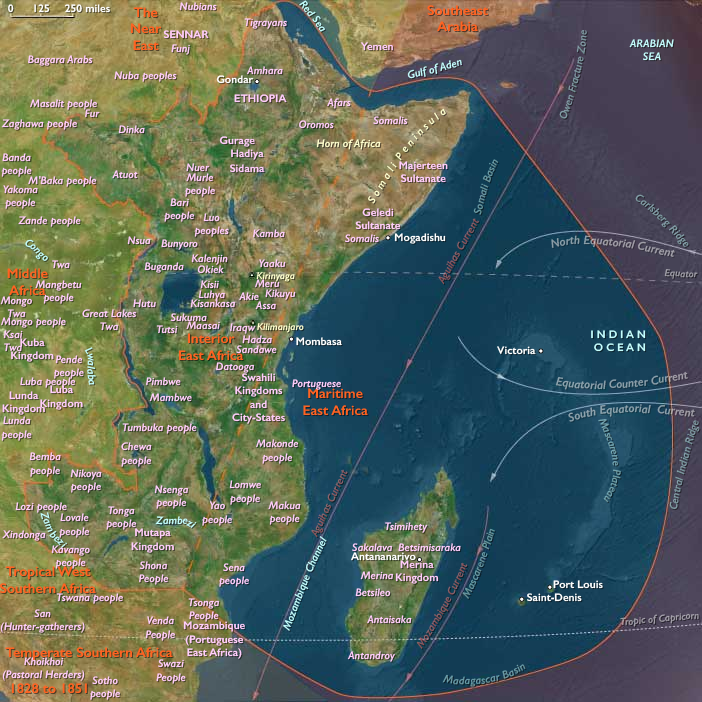
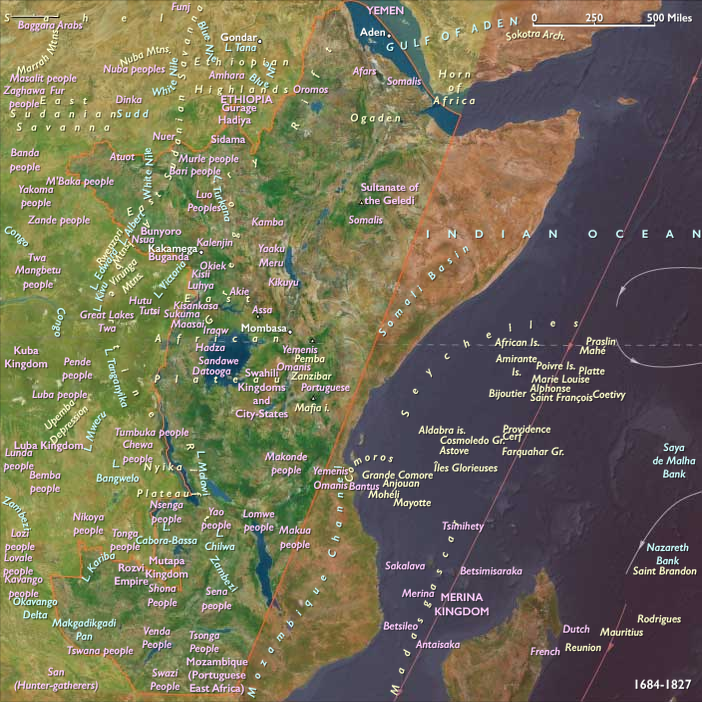
Between 1732 and 1743, Interior East Africa witnessed a continuation of the Ethiopian Empire’s progressive fragmentation, signaling the deepening of Ethiopia’s Zemene Mesafint ("Age of Princes"). Following the death of Emperor Bakaffa in 1730, his successor, Iyasu II (r. 1730–1755), ascended the throne as a child, leaving real power in the hands of his mother, Empress Mentewab, and influential regional nobility. Mentewab, acting as regent, struggled to manage competing provincial factions and maintain cohesion within the empire.
Increasingly autonomous nobles began openly challenging imperial authority, managing their territories independently and engaging in periodic conflicts. These nobles, wielding significant military and economic resources, emerged as powerful regional figures, essentially acting as independent princes. Notably, figures like Ras Mikael Sehul of Tigray started rising to prominence, demonstrating the weakening hold of Gondar’s central authority.
Meanwhile, in the Afar lowlands to the east, the Imamate of Aussa gave way fully by 1734 to the establishment of the Sultanate of Aussa under Sultan Kedafu. Kedafu successfully consolidated power among rival Afar clans and established a more stable polity, which controlled the strategic trade routes linking the highlands to the Red Sea coast. This transition not only marked the reconfiguration of regional power but also highlighted the fragmentation of authority that would characterize Interior East Africa for much of the eighteenth century.
Thus, by 1743, the Ethiopian Empire stood at a crossroads: weakened central authority in Gondar persisted alongside the rising autonomy of regional rulers, setting the stage for further decentralization and conflicts that would dominate Ethiopian politics in the decades to come.
People
Groups
- Tigray-Tigrinya people
- Ethiopian Orthodox Tewahedo Church
- Oromo people
- Amhara people
- Afar people
- Ethiopia, Solomonid Dynasty of
- Aussa, Imamate of
- Aussa, Sultanate of
Topics
Subjects
Regions
Subregions
Related Events
Filter results
Showing 10 events out of 27621 total
Atlantic Southwest Europe (1732–1743 CE): Economic Expansion, Enlightenment Influences, and Regional Dynamics
Between 1732 and 1743, Atlantic Southwest Europe—including northern and central Portugal (Lisbon and Porto), Galicia, Asturias, Cantabria, northern León and Castile, northern Navarre, northern Rioja, and the Basque Country—continued experiencing steady economic growth, political stability, and increasingly vibrant cultural developments. The region benefited from expanding Atlantic trade, early Enlightenment influences, and resilient regional autonomy, reinforcing both economic prosperity and distinctive cultural identities.
Political and Military Developments
Portuguese Diplomatic Stability and Influence
Under King João V of Portugal (r. 1706–1750), Portugal maintained diplomatic neutrality amid European conflicts, strategically benefiting from strong alliances, particularly with Britain. Northern Portugal, particularly Porto and Lisbon, prospered from continued maritime commerce, underpinned by effective royal patronage and governance.
Spain: Regional Autonomy and Central Compromise
In Spain, Philip V continued centralizing efforts but faced enduring resistance from northern territories, notably the Basque provinces and Navarre, which vigorously defended their fueros (traditional privileges). This resulted in pragmatic compromises, preserving considerable regional self-governance and political stability.
Limited Military Involvement
Atlantic Southwest Europe largely remained insulated from direct military conflicts of the period, allowing regional economies to prosper without the disruptive impacts of war. Coastal defense structures, especially in key ports (Bilbao, Santander, Lisbon, Porto), were maintained effectively, safeguarding maritime trade routes.
Economic Developments: Maritime Trade and Industrial Expansion
Portuguese Maritime Prosperity
Portuguese maritime trade flourished, especially in Lisbon and Porto, driven by lucrative transatlantic commerce with colonies in Brazil, Africa, and Asia. Porto’s wine exports (Port wine) grew substantially, solidifying its commercial importance and enriching local merchant classes.
Basque and Cantabrian Economic Growth
The Basque Country and Cantabria enjoyed substantial industrial expansion. Bilbao emerged as a major iron export center, significantly supplying British industries and shipyards. Santander similarly benefited from expanding trade and shipbuilding activities, reinforcing economic vitality along the Cantabrian coast.
Agricultural and Rural Stability
Galicia, Asturias, and northern Castile experienced sustained agricultural stability, supported by improved farming techniques and trade connectivity. Rural productivity provided urban centers with food and raw materials, bolstering regional economic integration and reducing chronic poverty.
Cultural and Religious Developments
Early Enlightenment Influences
Early Enlightenment ideas gradually began influencing the region’s intellectual and cultural life, especially within educated circles in cities like Lisbon, Coimbra, Braga, and Valladolid. Universities and elite intellectual groups increasingly engaged with rationalist and scientific approaches, cautiously challenging traditional scholasticism.
Baroque Artistic and Cultural Flourishing
Baroque cultural expressions continued thriving, visible in extensive architectural and artistic patronage across the region. In cities such as Santiago de Compostela, Braga, Lisbon, and Bilbao, elaborate churches, palaces, and civic buildings showcased sophisticated Baroque styles, reflecting regional wealth and religious devotion.
Continued Strength of Catholic Orthodoxy
Counter-Reformation Catholicism remained influential, maintained through ecclesiastical institutions and regional religious festivities, particularly significant in Galicia and northern Portugal. Pilgrimage traditions, notably to Santiago de Compostela, remained vibrant, reinforcing local identities and spiritual cohesion.
Social and Urban Developments
Urban Expansion and Merchant Class Prosperity
Economic prosperity stimulated urban growth in major cities like Lisbon, Porto, Bilbao, and Santander. Merchant classes expanded significantly, influencing local governance, financing urban improvements, and supporting cultural patronage, thus enhancing social mobility and civic vitality.
Regional Identity and Autonomy
Regional identities, especially in the Basque territories, Navarre, Galicia, and northern Portugal, further strengthened. Fueled by economic prosperity and cultural dynamism, local governance structures and traditional fueros continued empowering regional autonomy, reinforcing distinct identities within broader state frameworks.
Notable Regional Groups and Settlements
-
Portuguese (Lisbon and Porto): Continued maritime prosperity and cultural flourishing, benefiting from robust Atlantic commerce and stable royal governance.
-
Basques and Navarrese: Maintained significant autonomy and economic strength through trade, industry, and strategic defense of their fueros.
-
Galicians and Asturians: Benefited from stable agriculture, maritime trade growth, and ongoing religious and cultural dynamism.
-
Cantabrians and Northern Castilians: Achieved sustained economic prosperity through maritime industries, trade expansion, and urban growth.
Long-Term Significance and Legacy
Between 1732 and 1743, Atlantic Southwest Europe:
-
Consolidated economic prosperity through sustained maritime trade, industrial growth, and agricultural stability.
-
Experienced early influences of Enlightenment thought, subtly shaping intellectual developments despite continued dominance of religious orthodoxy.
-
Strengthened urbanization and regional merchant classes, significantly enhancing local civic life, social mobility, and cultural patronage.
-
Reinforced regional autonomy and distinctive identities, particularly in the Basque territories, Navarre, and northern Portuguese regions, setting critical precedents for future governance and regional resilience.
This period of sustained growth, political stability, and vibrant cultural developments significantly positioned Atlantic Southwest Europe to navigate forthcoming transformations in the mid-eighteenth century.
Northeast Asia (1732–1743 CE)
Russian Maritime Initiatives, Bering's Expedition, and the Origins of Maritime Fur Trade
Between 1732 and 1743, Northeast Asia—a region encompassing the easternmost areas of Siberia (east of 130°E), the extreme northeastern portion of China's Heilongjiang province, the northern half of Russia's Primorsky Krai, and most of the island of Hokkaido (excluding its southwestern portion)—saw significant developments in Russian maritime exploration, colonization, and the emergence of an extensive fur-trading network.
In 1736, the strategically important Russian outpost of Okhotsk was relocated approximately two miles downstream to a spit at the mouth of the Okhota River, transitioning it from a basic ostrog (wooden fort) into a fully functional port. Nevertheless, Okhotsk remained ill-suited as a permanent settlement due to its challenging inland access, inadequate harbor, harsh climate, and limited agricultural potential. These deficiencies severely hampered operations of the ongoing Second Kamchatka Expedition, led by Vitus Bering.
By the mid-1730s, the expedition’s local administrator, Grigory Skornyakov-Pisarev, had made insufficient progress on essential infrastructure in Okhotsk, resulting in extensive delays and resource shortfalls. Despite these impediments, Bering’s Danish lieutenant Martin Shpanberg managed to ready the expedition's vessels. By the end of 1737, Shpanberg had successfully refitted the vessel Gabriel and constructed two new ships: the Archangel Michael and the Nadezhda. These ships were rapidly prepared for voyages aimed at exploring the Kuril Islands and establishing Russia's first sea contact with Japan.
Also in 1737, Vitus Bering himself arrived and established his residence at Okhotsk, overseeing operations during what was now the expedition’s fifth year. By this time, it was clear that initial financial estimates for the project had been vastly underestimated. Original budgets projected costs around twelve thousand rubles, but expenses had already risen dramatically to approximately three hundred thousand rubles, bringing economic hardship to the entire region.
On October 16, 1737, a devastating earthquake with an estimated magnitude of 9.3 struck off the coast of Kamchatka, triggering massive tsunamis reaching heights of sixty meters (approximately two hundred feet) in the northern Pacific Ocean. This catastrophic event further complicated the already strained logistical situation of Russian maritime operations.
Despite setbacks, Shpanberg departed from Okhotsk on June 29, 1738, sailing to the Kuril Islands. He successfully explored this island chain—one island, Shikotan, would eventually be renamed "Shpanberg" by the Russians in 1796—and confirmed the existence of a viable maritime route to Japan, substantially enhancing Russia’s geographic knowledge and maritime capabilities in Northeast Asia.
Following the landmark exploratory voyages of Bering and Aleksei Chirikov in 1741–1742, which conclusively demonstrated that Asia and North America were separate continents, Russian maritime fur trading began in earnest. Bering's voyages proved that extended sea travel in the North Pacific was feasible and revealed the region's abundant fur resources. Private fur traders, primarily promyshlenniki, launched expeditions from Kamchatka targeting nearby islands, particularly the Commander Islands. These maritime operations required greater capital than typical Siberian fur ventures, drawing investment from merchants based in distant cities such as Irkutsk, Tobolsk, and even European Russia.
An early and notably successful trader, Emilian Basov, initiated extensive trade activities in 1743 on Bering Island, harvesting significant numbers of sea otter, fur seal, and blue arctic fox pelts. Basov's profitable voyages to Bering and Medny Island within the Commander Islands group demonstrated the tremendous commercial potential of the region’s maritime fur resources. His successes inspired further Russian maritime expeditions and firmly established a thriving fur trade in the northern Pacific, reshaping the economic landscape of Northeast Asia for generations to come.
Wealthy Dutch settlers in Batavia have built tall houses and canals within the city's walls.
Commercial opportunities attract Indonesian and especially Chinese immigrants, the increasing numbers creating burdens on the city.
Tensions have grown as the colonial government tries to restrict Chinese migration through deportations.
Ten thousand Chinese are massacred on October 9, 1740, and in the following year, Chinese residents are moved to Glodok outside the city walls.
Most accounts of the ensuing massacre in October 1740 estimate that ten thousand Chinese were killed within Batavia's city walls, while at least another five hundred were seriously wounded.
Between six hundred and seven hundred Chinese-owned houses were raided and burned.
Vermeulen gives a figure of six hundred survivors, while the Indonesian scholar A.R.T. Kemasang estimates that three thousand Chinese survived.
The Indonesian historian Benny G. Setiono notes that five hundred prisoners and hospital patients were killed, and a total of three thousand four hundred and thirty-one people survived.
The massacre is followed by an "open season" against the ethnic Chinese throughout Java, causing another massacre in 1741 in Semarang, and others later in Surabaya and Gresik.
As part of conditions for the cessation of violence, all of Batavia's ethnic Chinese are moved to a pecinan, or Chinatown, outside of the city walls, now known as Glodok.
This allows the Dutch to monitor the Chinese more easily.
To leave the pecinan, ethnic Chinese require special passes.
By 1743, however, ethnic Chinese have already returned to inner Batavia; several hundred merchants operate here.
Other ethnic Chinese led by Khe Pandjang flee to Central Java where they attack Dutch trading posts, and are later joined by troops under the command of the Javanese sultan of Mataram, Pakubuwono II.
Though this further uprising is quashed in 1743, conflicts in Java will continue almost without interruption for the next seventeen years.
East Europe (1732–1743 CE): Expansion and Internal Consolidation
Political and Military Developments
Continued Imperial Expansion
Between 1732 and 1743 CE, Russia continued its territorial and imperial ambitions, further solidifying control over newly acquired regions. The period saw significant political efforts to integrate these territories effectively into the expanding empire.
Strengthening Central Administration
The Russian government enhanced centralization, reinforcing administrative reforms to improve efficiency and ensure effective governance across extensive and diverse territories.
Diplomatic Strategy and Alliances
Russia further strengthened its international presence through strategic diplomacy, maintaining alliances, and engaging actively in European political affairs. This strategy reinforced Russia’s geopolitical influence and maintained regional stability.
Economic and Technological Developments
Economic Expansion and Industrial Progress
Economic conditions continued to improve significantly, driven by industrial expansion in sectors like mining, manufacturing, and agriculture. Enhanced trade networks further facilitated sustained economic growth.
Infrastructure Improvements
Infrastructure saw ongoing improvements, particularly in transportation and urban development. Roads, canals, and public buildings benefited from continued investments, promoting economic activity and administrative effectiveness.
Cultural and Artistic Developments
Flourishing Cultural Patronage
Cultural development continued vigorously, supported by sustained patronage from the Russian elite. Architectural, artistic, and literary works thrived, reflecting increased European influences and enriching Russia’s cultural landscape.
Intellectual and Educational Growth
Intellectual activities expanded further, with educational institutions proliferating and scholars actively engaging with contemporary European thought. Continued literary and academic production enriched Russia's intellectual tradition.
Settlement Patterns and Urban Development
Urban Expansion and Development
Urban areas, especially Moscow and Saint Petersburg, experienced ongoing growth and development. Urban planning improvements, infrastructure advancements, and public amenities enhanced urban life, economic vitality, and administrative coherence.
Enhanced Defense Infrastructure
Ongoing enhancements in urban and territorial fortifications remained essential, reinforcing security and protecting urban centers and strategic locations from potential threats.
Social and Religious Developments
Social Cohesion and Integration
Social reforms and integration policies continued to develop, further incorporating diverse ethnic and regional groups into the fabric of Russian society, enhancing societal stability and administrative efficiency.
State-Church Relations
The relationship between the state and the Orthodox Church evolved further, with reforms continuing to align religious practices with state goals. These adjustments reshaped the church's societal role, ensuring its continued integration within the broader imperial framework.
Long-Term Consequences and Historical Significance
The period from 1732 to 1743 CE marked continued territorial expansion, administrative strengthening, and cultural enrichment. These developments solidified Russia's status as a powerful European empire and laid essential foundations for its future growth and international prominence.
Northeast Europe (1732–1743 CE): Renewed Conflict, Territorial Shifts, and Cultural Consolidation
Between 1732 and 1743 CE, Northeast Europe entered a period marked by renewed military conflicts, strategic territorial shifts, and sustained cultural and economic consolidation. This era was defined prominently by the outbreak of the War of the Polish Succession, renewed Swedish–Russian tensions culminating in the Russo-Swedish War (1741–1743), ongoing Danish–Norwegian diplomatic prudence, and continued Prussian internal reforms.
War of the Polish Succession and Regional Dynamics
The War of the Polish Succession (1733–1738), triggered by disputes following the death of King Augustus II the Strong, involved key Northeast European powers. Though primarily fought in Central Europe, the conflict significantly impacted regional stability, especially influencing diplomatic alignments among Russia, Prussia, and the weakened Polish–Lithuanian Commonwealth. Russian intervention secured the Polish throne for Augustus III, reaffirming Russian influence over Polish affairs and further diminishing the Commonwealth's autonomy.
Russo–Swedish War and Territorial Losses for Sweden
Tensions between Sweden and Russia resurfaced dramatically in the early 1740s. Encouraged by French diplomatic support, Sweden sought to reverse territorial losses suffered during the Great Northern War. The resulting Russo-Swedish War (1741–1743) ended in a clear Russian victory. The subsequent Treaty of Åbo (Turku) in 1743 forced Sweden to cede additional territory in southeastern Finland—including strategically vital fortress towns such as Lappeenranta (Villmanstrand)—to Russia. This territorial adjustment further consolidated Russian Baltic influence and substantially weakened Sweden’s geopolitical position.
Danish–Norwegian Diplomatic Stability and Economic Consolidation
Under Christian VI (r. 1730–1746), Denmark–Norway continued prudent diplomatic neutrality, largely avoiding direct entanglement in regional conflicts. Internal economic and administrative reforms enhanced stability and prosperity, with significant investments in infrastructure, education, and urban development in Copenhagen and other major cities. Danish naval power was carefully maintained, safeguarding strategic maritime trade routes.
Prussian Military and Administrative Strengthening
King Frederick William I of Prussia continued substantial internal military, administrative, and economic reforms until his death in 1740. His successor, Frederick II (Frederick the Great), accelerated these reforms, significantly enhancing Prussia’s military efficiency, centralized governance, and economic development. Under Frederick II, Prussia began asserting itself more prominently in European diplomacy, cautiously navigating regional power shifts and cultivating alliances.
Economic Resilience and Urban Prosperity
Despite regional conflicts, major urban centers—including Stockholm, Copenhagen, Königsberg, and newly flourishing Saint Petersburg—continued experiencing sustained economic resilience. Maritime trade, strengthened merchant networks, and stable urban governance facilitated ongoing regional prosperity, significantly offsetting disruptions caused by intermittent military conflicts.
Finland’s Territorial Realignment and Economic Adjustments
Finland faced significant territorial realignment and disruption resulting from the Russo-Swedish War. The loss of critical southeastern territories to Russia reshaped Finland's geopolitical role within the Swedish kingdom, compelling extensive internal economic and administrative adjustments. Nevertheless, Finland retained internal stability and economic productivity, mitigating broader impacts of territorial losses.
Cultural Flourishing and Educational Expansion
Cultural and intellectual growth continued robustly across Northeast Europe, particularly in Sweden, Denmark, and Prussia. Universities and academies benefited from heightened royal patronage and private investment, significantly advancing scholarly activities in science, literature, and philosophy. These institutions enhanced Northeast Europe's broader intellectual prominence and cultural identity despite regional turbulence.
Complex Diplomatic Realignments
Regional diplomacy during this period grew increasingly intricate. Sweden’s failed attempt to regain territory highlighted the diplomatic strength of Russia and shifted regional balance. Prussia’s emergence under Frederick II, Denmark–Norway’s careful neutrality, and continued Russian assertiveness underscored increasingly sophisticated diplomatic maneuvering aimed at maintaining regional stability and strategic advantage.
Legacy of the Era
The era from 1732 to 1743 CE significantly reshaped Northeast Europe’s geopolitical and cultural landscape through renewed warfare, territorial realignments, and sustained cultural and economic growth. The territorial adjustments stemming from the Russo-Swedish War reinforced Russia’s dominant regional position, accelerated Sweden’s geopolitical decline, solidified Prussia’s internal strength, and preserved Denmark–Norway’s diplomatic stability. These developments critically influenced regional boundaries, diplomatic relations, and cultural trajectories into subsequent decades.
One major characteristic of this era in the Eastern Baltic is the strife between the two major political parties, the Hats, representing the upper classes, and the Caps, representing the lower classes.
These political parties, however, prove no more competent in the realm of foreign affairs than the kings.
In 1741 the Hats lead Sweden into a war with Russia in order to try to undo the result of the Peace of Uusikaupunki.
Russian forces thereupon invade Finland and begin, virtually without a fight, a short-lived occupation known as the Lesser Wrath.
In accordance with the Peace of Turku signed in 1743, Russia once again evacuates Finland, but takes another slice of Finnish territory along the southeastern frontier.
East Central Europe (1732–1743 CE): War of the Polish Succession, Pragmatic Sanction Diplomacy, and Prussian Strengthening
Between 1732 and 1743 CE, East Central Europe—including modern-day Poland, Czechia, Slovakia, Hungary, and eastern Germany and Austria east of 10°E and north of the defined boundary—experienced significant geopolitical upheaval, most notably the War of the Polish Succession (1733–1738), continued diplomatic maneuvering over the Habsburg succession, further strengthening of Prussian military and bureaucratic capabilities, and steady economic and cultural growth under Enlightenment influences. This era critically shaped the region’s political dynamics, setting the stage for subsequent pivotal mid-century conflicts.
Political and Military Developments
War of the Polish Succession (1733–1738)
-
Following the death of King Augustus II the Strong in 1733, Poland-Lithuania plunged into a succession crisis. The election of Stanisław Leszczyński, supported by France, triggered the War of the Polish Succession against Augustus II’s son, Augustus III, backed by Russia and Austria.
-
The conflict, primarily a proxy struggle among major European powers, saw Poland become a battleground for foreign armies, ultimately resulting in Augustus III’s victory (confirmed by the Treaty of Vienna, 1738), further deepening Polish political instability and dependence on external powers.
Continued Pragmatic Sanction Diplomacy and European Alignments
-
Emperor Charles VI’s persistent diplomatic efforts succeeded in formally securing acceptance of the Pragmatic Sanction by major powers, notably France, through the 1738 Treaty of Vienna, guaranteeing the succession of his daughter, Maria Theresa.
-
Despite diplomatic agreements, unresolved tensions lingered, anticipating future conflicts upon Charles VI’s death in 1740.
Death of Charles VI and the Outbreak of the War of the Austrian Succession (1740)
-
Charles VI’s death in 1740 ignited the War of the Austrian Succession, as rival powers challenged Maria Theresa’s right to inherit the Habsburg dominions.
-
Frederick II (the Great) of Prussia immediately invaded Austrian Silesia (1740–1742), initiating the First Silesian War, profoundly reshaping East Central European geopolitics.
Prussian Military Expansion and Strengthening
-
Prussia, under Frederick William I (1713–1740) and his successor Frederick II (from 1740), significantly enhanced its military strength, bureaucratic efficiency, and centralized governance, transforming the kingdom into a formidable regional power capable of challenging Habsburg authority.
Economic and Technological Developments
Regional Economic Resilience Amid Conflict
-
Despite ongoing conflicts, economic conditions across East Central Europe remained relatively robust. Urban centers such as Vienna, Prague, Leipzig, and Dresden maintained prosperity through regional trade and manufacturing.
-
Agricultural productivity continued rising, bolstered by improved cultivation methods, animal husbandry, and gradual adoption of crop rotations and new crops.
Infrastructure and Industrial Development
-
Prussian investment in infrastructure, including roads and canals, boosted regional economic efficiency, laying early foundations for industrial growth.
-
Austria and Bohemia improved river navigation and infrastructure, enhancing connectivity to broader European markets.
Cultural and Artistic Developments
Enlightenment Thought and Cultural Patronage
-
Enlightenment ideas continued influencing intellectual and cultural life, with royal courts in Vienna, Dresden, and Berlin patronizing intellectual societies, artistic circles, and educational institutions.
-
Architectural and artistic production flourished, notably in the Baroque and early Rococo styles, reflecting regional wealth and cultural sophistication.
Educational and Intellectual Advancement
-
Universities and intellectual societies in Vienna, Prague, and Berlin promoted education, science, and philosophical inquiry, significantly contributing to regional cultural vitality and intellectual exchange.
Settlement and Urban Development
Urban Growth Amid Political Turmoil
-
Urbanization continued steadily, driven by economic resilience and stable demographic conditions. Key cities—including Vienna, Prague, Dresden, Leipzig, Berlin, and Warsaw—maintained robust economic and demographic growth.
-
Infrastructure enhancements and improved urban planning further strengthened urban centers’ administrative and commercial roles across East Central Europe.
Social and Religious Developments
Aristocratic Power and Social Structures
-
Aristocratic power remained deeply entrenched, particularly in Poland-Lithuania, Hungary, and Bohemia, limiting centralized governance and reinforcing noble privileges, even as state centralization advanced in Prussia and Austria.
-
Social stability persisted despite aristocratic tensions, largely supported by economic prosperity and effective bureaucratic management.
Religious Tolerance and Continued Diversity
-
Moderate religious tolerance persisted across the region, notably in Austrian territories and Prussia, fostering social cohesion among diverse religious communities, including Protestants, Catholics, and Jewish minorities.
Long-Term Consequences and Historical Significance
The period from 1732 to 1743 CE critically reshaped East Central Europe, laying foundations for mid-century conflicts. The War of the Polish Succession deepened Poland’s vulnerability and political fragmentation, amplifying foreign influence. Diplomatic agreements surrounding the Pragmatic Sanction set the stage for major conflicts upon Charles VI’s death, leading directly to the transformative War of the Austrian Succession. Prussia’s emergence as a regional military powerhouse under Frederick II dramatically shifted the balance of power, decisively influencing subsequent geopolitical alignments. Continued economic resilience, urban expansion, and Enlightenment cultural flourishing underscored the region’s growing sophistication, providing essential foundations for future political, social, and economic developments.
The Orthodox Serbs look to the tsar for support, and to ...
Eastern Southeast Europe (1732–1743 CE): Cultural Enlightenment and Social Struggles
Settlement and Migration Patterns
Continuing Serb Settlements and Frontier Life
Between 1732 and 1743 CE, the Serb communities settled within the Austrian Military Frontier in southern Hungary and Slavonia continued to thrive, further strengthening their demographic presence. These Serb populations maintained a distinctive cultural identity through Orthodox religious practices and customs, reinforcing the ethnic complexity of the Habsburg domains.
Economic and Social Developments
Increasing Hardship under Ottoman Administration
In the Ottoman-controlled territories, especially in Serbia, Bulgaria, and the Danubian Principalities (Wallachia and Moldavia), the period was marked by economic difficulties and intensifying exploitation. Heavy taxation, corrupt administration, and oppressive feudal obligations intensified social tensions, leading to periodic local unrest.
Agrarian Distress in Wallachia and Moldavia
The agrarian system in Wallachia and Moldavia remained harsh, with most peasants subject to increasingly oppressive serfdom and taxation. Wealthy boyars expanded their control over land, limiting peasants' freedoms and exacerbating rural poverty. The Phanariot princes, appointed by the Ottoman Porte, heavily taxed their subjects, enriching themselves while diminishing local autonomy.
Cultural and Artistic Developments
Phanariot Cultural Patronage
Under the continuing Phanariot rule in Wallachia and Moldavia, cultural life experienced notable enrichment. Princes such as Constantine Mavrocordatos (who repeatedly ruled both principalities during this period) sponsored artistic and literary endeavors, supported the establishment of printing presses, and promoted the translation and dissemination of religious and philosophical texts, reflecting broader European Enlightenment influences.
Monastic and Architectural Flourishing
Monastic and ecclesiastical architecture continued to prosper, exemplified by the completion and embellishment of important monasteries and churches. Religious institutions remained vital centers of literacy, artistic production, and education, contributing to the preservation of national cultural identity amidst foreign rule.
Intellectual and Religious Developments
Continuing Enlightenment Influence
The intellectual currents of the European Enlightenment persisted in shaping the cultural landscape of the Danubian Principalities, particularly through scholarly endeavors, literary production, and the spread of Enlightenment ideas among educated elites. The vibrant intellectual milieu fostered greater interaction with Western Europe, introducing progressive concepts in philosophy, governance, and social organization.
Tensions between Orthodoxy and Catholic Influence
In Austrian-controlled territories, the forced Catholicization policies and aggressive missionary activities continued to fuel tensions and resistance among the Orthodox Serbian populations. Orthodox Serbs viewed these activities as threats to their religious traditions and cultural autonomy, further deepening their resistance to Habsburg rule. The Orthodox Serbs increasingly looked to the Russian tsar for support, as well as to the Serbian Church in southern Hungary, seeking spiritual and political aid against religious and cultural pressures.
Political Dynamics and Regional Rivalries
Continued Phanariot Governance
Ottoman-appointed Phanariot rulers, especially the influential Constantine Mavrocordatos, maintained their dominance over Wallachia and Moldavia, employing strategies of diplomacy, bribery, and administrative efficiency to manage their precarious positions between Ottoman overlords and local boyar elites. Their rule, despite its cultural patronage, was widely resented for its heavy taxation and corrupt administration.
Habsburg-Ottoman Rivalries
The Austro-Ottoman frontier remained politically sensitive, with ongoing tensions despite the temporary peace established by the Treaty of Passarowitz (1718). Both empires maintained significant military presences along their frontiers, and Austria continued to rely on the Serb frontier guards in its Military Frontier as a strategic buffer against potential Ottoman incursions.
Key Historical Events and Developments
-
Continued patronage and cultural contributions of Constantine Mavrocordatos as Prince of Wallachia and Moldavia.
-
Ongoing cultural and educational investments by Phanariot rulers, fostering Enlightenment-inspired intellectual growth.
-
Increased resistance to Catholicization among Serbian populations within Habsburg territories, prompting appeals to Russian support and reliance on the Serbian Church in Hungary.
Long-Term Consequences and Historical Significance
The period from 1732 to 1743 CE further highlighted the cultural tensions, economic disparities, and political rivalries shaping Eastern Southeast Europe. Despite harsh administrative conditions under Ottoman and Habsburg rule, intellectual and cultural life flourished, laying foundations for future nationalist movements. The resistance to forced religious conversions solidified Serbian and Romanian Orthodox identities, which would later play a critical role in regional nationalist awakenings.
...the Serbian Church in southern Hungary.
Years: 1732 - 1743
People
Groups
- Tigray-Tigrinya people
- Ethiopian Orthodox Tewahedo Church
- Oromo people
- Amhara people
- Afar people
- Ethiopia, Solomonid Dynasty of
- Aussa, Imamate of
- Aussa, Sultanate of
Topics
Subjects
Regions
Subregions