
Interior East Africa (1696–1707 CE): Consolidation and …
Years: 1696 - 1707
Interior East Africa (1696–1707 CE): Consolidation and Cultural Flourishing in Gondar
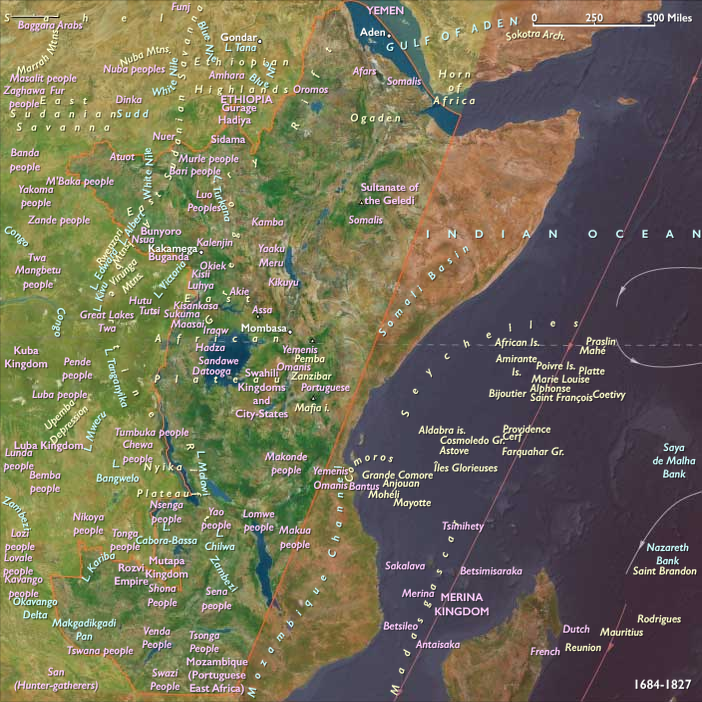
During the late seventeenth century, the Ethiopian city of Gondar solidified its status as a major cultural, political, and religious center under Emperor Iyasu the Great (reigned 1682–1706). Founded earlier in the century as a royal encampment by Emperor Fasilides, Gondar had rapidly grown into a significant urban center, becoming the permanent capital of the Ethiopian Empire.
By the reign of Iyasu the Great, Gondar’s population had swelled to over sixty thousand inhabitants, making it one of the largest cities in East Africa. Its urban landscape was marked by impressive architecture, including churches, monasteries, palaces, and administrative buildings, many of which survive to the present day despite the upheavals that would follow in the eighteenth century.
Emperor Iyasu, who vigorously pursued centralization, attempted to mobilize Gondar’s populace for his military campaigns against the Oromo in Damot and Gojjam. Notably, however, the citizens of Gondar refused the emperor’s command to temporarily relocate with him on campaign—an unprecedented assertion of communal autonomy. This event marked a significant shift in Ethiopian history: Gondar’s inhabitants had developed a distinctive sense of local community identity that superseded traditional royal demands.
Scholar Donald Levine describes Gondar as an "orthogenetic" rather than "heterogenetic" city—a center where Ethiopian culture and Amhara traditions flourished internally rather than through external influences. Unlike later Ethiopian capitals, such as Addis Ababa, which became associated with foreign customs, Gondar represented a proud embodiment of Ethiopia’s indigenous cultural and religious identity.
The cultural legacy of Gondar was thus one of inward development and refinement of traditional Amhara customs, artistic forms, and religious practices. Its flourishing cultural life reinforced Ethiopia’s self-perception as a distinct civilization, rooted deeply in its Orthodox Christian heritage and resistant to outside influences, even as it navigated internal struggles and external threats.
Key Historical Developments:
-
Gondar's population surpasses sixty thousand, reflecting its status as a major urban center in Ethiopia.
-
Citizens of Gondar assert a collective identity and refuse Emperor Iyasu’s demand to follow him on military campaigns, signaling a significant shift in royal-community relations.
-
The city becomes a center of orthogenetic cultural development, strengthening traditional Amhara customs, artistic expressions, and religious practices.
Long-Term Consequences and Historical Significance:
The consolidation of Gondar as a major cultural and political center had long-term implications for Ethiopia’s historical trajectory. Its orthogenetic cultural development fostered a distinctive Ethiopian identity that remained resilient against external cultural pressures. However, the emerging sense of local identity and independence from the imperial will hinted at the political decentralization and fragmentation that would characterize the empire in the subsequent century. Gondar’s cultural vitality, architectural achievements, and assertion of community autonomy made it a powerful symbol of Ethiopian tradition and identity well into modern times.
People
Groups
Topics
Subjects
Regions

Subregions
Years: 1696 - 1707
People
Groups
Topics
Subjects
Regions
Subregions