
Tao Yuanming, an influential Chinese nature poet, …
Years: 400 - 411
Tao Yuanming, an influential Chinese nature poet, had served more than ten years in government service, personally involved with the sordid political scene of the times.
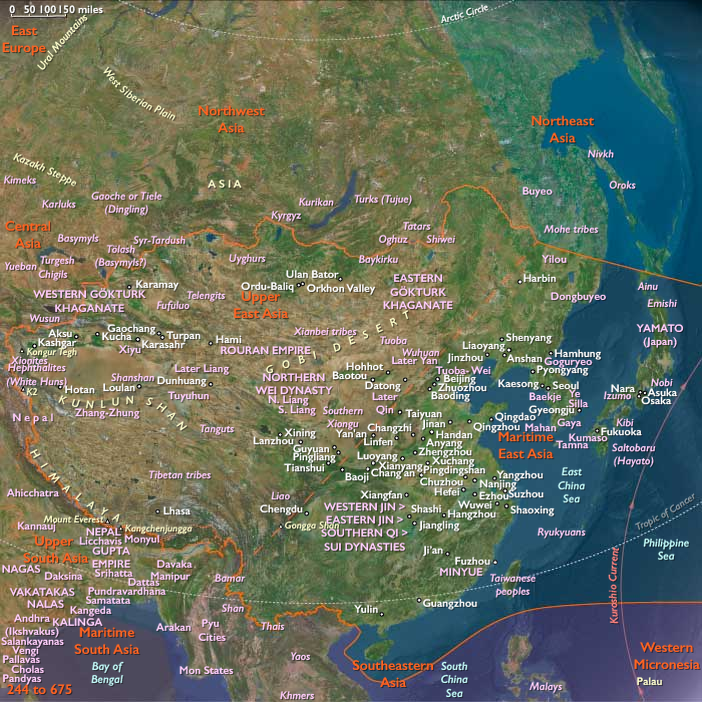
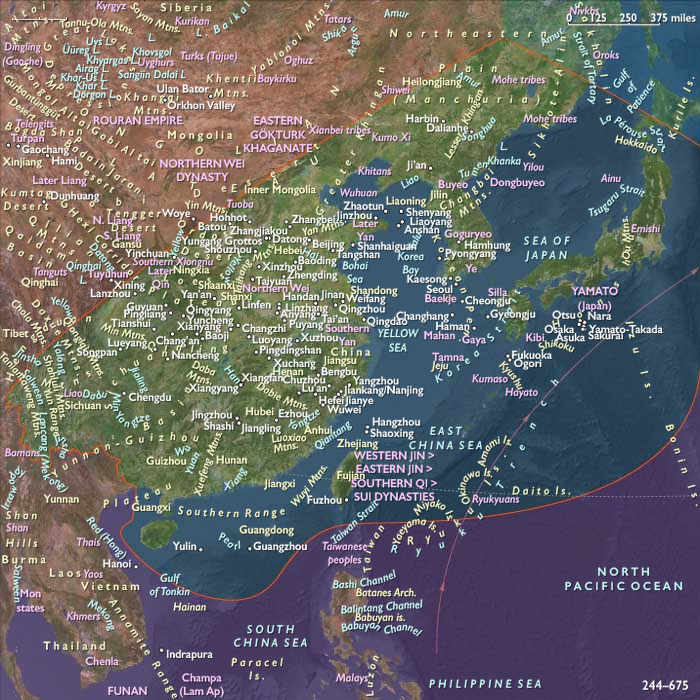
He had served in both civil and military capacities, which included making several trips down the Yangzi to the capital Jiankang, at this time a thriving metropolis, and the center of power during the Six Dynasties; the ruins of the old Jiangkang walls can still be found in the modern municipal region of Nanjing.
During this period of service in a series of minor posts, Tao Yuanming's poems had begun to indicate that he was becoming torn between ambition and a desire to retreat into solitude.
Tao Yuanming in the spring of 405 is serving in the army, as aide-de-camp to the local commanding officer.
The death of his sister, together with his disgust at the corruption and infighting of the Jin Court, prompts him to resign, factors that have led to his becoming convinced that life is too short to compromise on his principles.
He serves briefly as a magistrate in Pengze, but resigns after a tenure of only eighty-three days and returns to his farm to pursue a life of freedom and frugality.
His poetical insight stemming from the Taoist principle of oneness with nature, he produces poems characterized by simple diction and a spontaneous feel.
An artful prose writer, he portrays a utopian world according to the Taoist ideal in The Peach-blossom Spring, and produces an engaging self-portrait in his Biography of Master Five Willows.
The name Peach Blossom Spring (Tao Hua Yuan) has since become the standard Chinese term for 'utopia'.
Approximately one hundred and thirty of his works survive: mostly poems or essays which depict an idyllic pastoral life of farming and drinking.
His poems will inspire not only generations of poets, but also painters and other artists.
Locations
People
Groups
Topics
Commodoties
Subjects
Regions
Subregions
Years: 400 - 411
Locations
People
Groups
Topics
Commodoties
Subjects
Regions
Subregions