
Wang Xizhi, a member of an eminent …
Years: 361 - 361
Wang Xizhi, a member of an eminent family and a master of all types of calligraphic scripts, gains particular renown for his running script, or "hsing-shu," and his cursive script, or "ts'ao-shu."
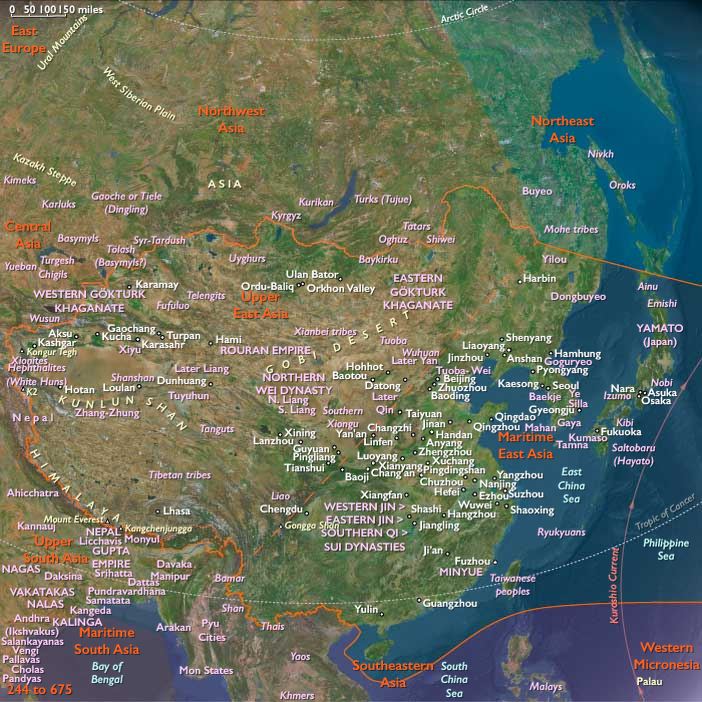
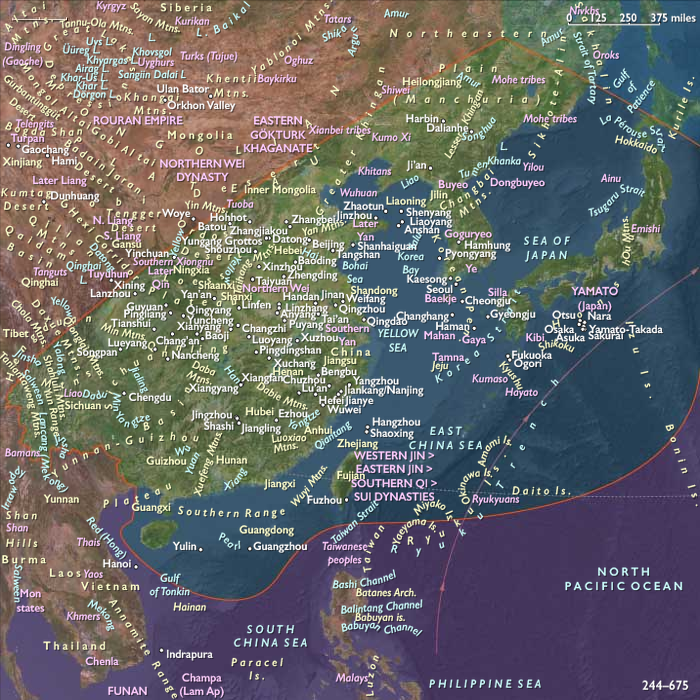
Born in Linyi, Shandong, Wang spent most of his life in present-day Shaoxing, Zhejiang.
He had learned the art of calligraphy from Lady Wei Shuo.
He excels in every script but particularly in semi-cursive script.
Unfortunately, none of his original works remains today.
An outstanding example of his work in “hsing-shu” is his Preface to the Poems Composed at the Orchid Pavilion, the introduction to a collection of poems written by a number of poets during a gathering at Lanting near the town of Shaoxing for the Spring Purification Festival.
The original is lost, but the work is survived in a number of finely traced copies in existence, with the earliest and most well regarded copy being the one made between about 627 to 650 by Feng Chengsu; it is located in the Palace Museum in Beijing.
Experts consider his On the Seventeenth to be the best work in “ts'ao-shu.”
Traditionally referred to as the "Sage of Calligraphy", he leaves government service in 355 in his early fifties.
Wang Xizhi is particularly remembered for one of his hobbies, that of rearing geese.
Legend has it that he learned that the key to how to turn his wrist while writing was to observe how geese moved their necks.
There is a small porcelain cup depicting Wang Xizhi "walking geese" in the China Gallery of the Asian Civilizations Museum in Singapore.
The other side of the cup depicts a scholar "taking a zither to a friend".
Wang Xizhi has seven children, all of whom are notable calligraphers.
The most distinguished is his youngest son, Wang Xianzhi.
A Tang reproduction of one of Wang's calligraphy scrolls on silk with four lines, will be sold in China at an auction in 2010 for an amount equivalent to forty-six million dollars.
Locations
People
Groups
Topics
- Six Dynasties Period in China
- Sixteen Kingdoms Period in China
- Civil Wars in China triggered by the Wu Hu Invasion
Commodoties
Subjects
Regions
Subregions
Related Events
Showing 10 events out of 59727 total
Years: 361 - 361
Locations
People
Groups
Topics
- Six Dynasties Period in China
- Sixteen Kingdoms Period in China
- Civil Wars in China triggered by the Wu Hu Invasion
Commodoties
Subjects
Regions
Subregions