
Sites in central Java, such as Sangiran …
Years: 28557BCE - 7822BCE
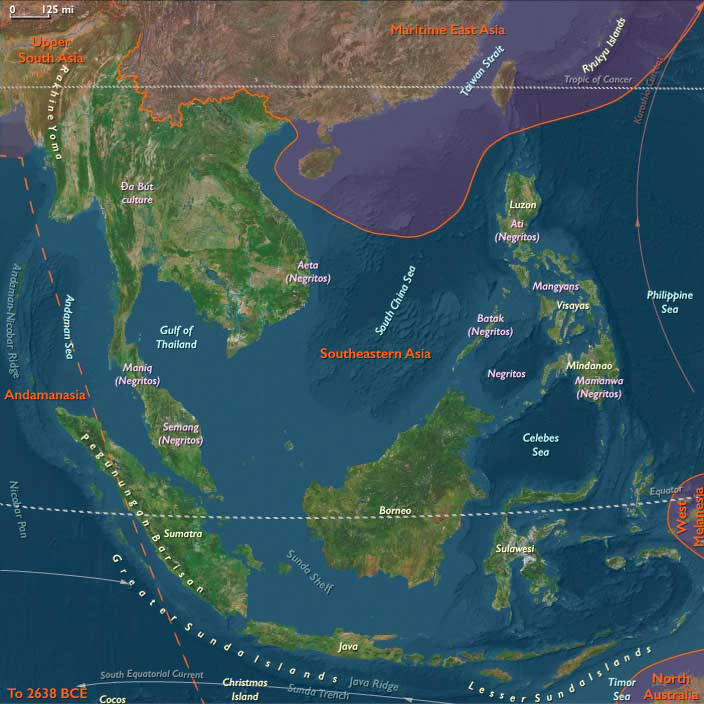
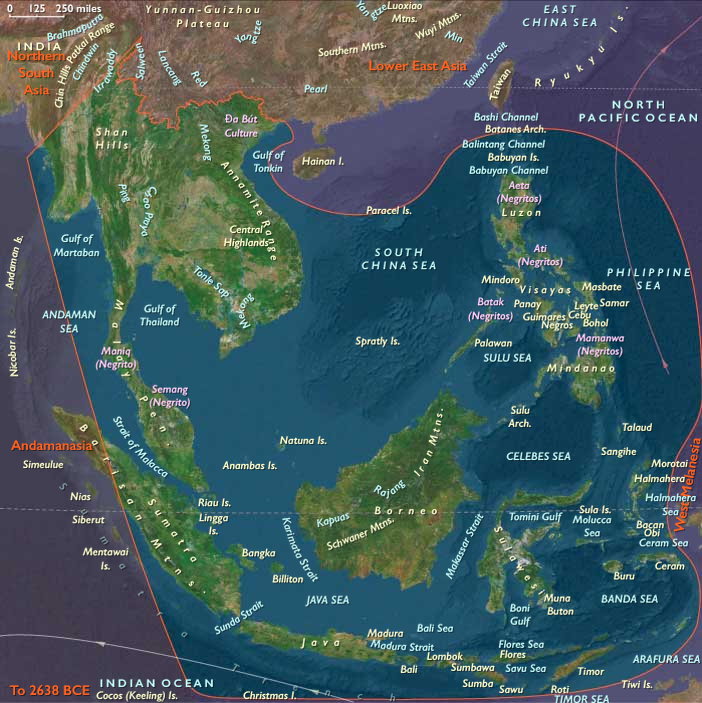
Sites in central Java, such as Sangiran and Ngandong, now account for about seventy-five percent of the world's examples of homo erectus, an early hominid type.
Most recently, the 2004 announcement of discoveries on the island of Flores (between Bali and Timor) created international controversy because they suggested an entirely new, locally evolved, and distinctively smaller hominid form overlapping chronologically with both homo erectus and modern humans.
About eight hundred thousand years ago, some early hominids of the archipelago made stone tools, constructed water craft sophisticated enough to cross twenty-five kilometers of rough sea channel, and may have used fire and language.
About six hundred thousand years ago, a fairly sophisticated hominid culture was widely distributed throughout what is now Indonesia.
The earliest modern humans cannot currently be firmly dated before about 40,000 years ago, but some specialists argue either that they appeared much earlier (as much as 90,000 years ago) in a rapid dispersal from Africa, or that they evolved independently in East or Southeast Asia from existing hominid stock.
Whatever the case, Indonesia's earliest modern humans did not immediately or everywhere displace their hominid relatives but coexisted with them for tens of thousands of years.
The earliest modes of their existence show little evidence of having deviated markedly from those of their predecessors.
A pattern evolves of small hunting-fishing-foraging communities depending on tools made of shell, wood, bamboo, and stone, adapting to a wide variety of ecological niches and remaining in contact with neighboring peoples over land and sea.
One center of these societies is in the northern Maluku and Papua region, where between twenty thousand and about nine thousand years ago there is evidence of long-distance trade (for example, in obsidian, used for making cutting tools), deliberate horticulture, and the transport of plants (bananas, taro, palms) and animals (wallabies, flying squirrels) used as food sources.
Possibly these communities also use sails and outriggers on their boats.
Topics
Commodoties
Subjects
Regions
Subregions
Related Events
Showing 10 events out of 69497 total
Years: 28557BCE - 7822BCE
Topics
Commodoties
Subjects
Regions
Subregions