
Filters:
The Funnelbeaker Culture and the Transition to …
Years: 4365BCE - 2637BCE
The Funnelbeaker Culture and the Transition to Corded Ware in the Low Countries
The Funnelbeaker culture (c. 4300–2800 BCE), closely related to the earlier Swifterbant culture, was among the first fully agricultural societies in the present-day Netherlands, northern Germany, and Denmark. It is notable for its large stone grave monuments, or dolmens, particularly those found in Drenthe, which remain some of the most enduring megalithic structures in the region.
The Transition from Funnelbeaker to Corded Ware (c. 2950 BCE)
- The Funnelbeaker culture eventually transitioned into the Corded Ware culture (c. 2950 BCE), a shift that appears to have been quick and relatively smooth.
- This change reflects a broader pan-European transition from a farming-based society to a more mobile, pastoralist economy, as Corded Ware groups relied heavily on livestock and new social structures.
- The arrival of the Corded Ware culture brought innovations such as single graves, battle axes, and cord-decorated pottery, replacing the collective burial and megalithic traditions of their predecessors.
The Persistence of the Vlaardingen Culture in the Southwest (c. 2600 BCE)
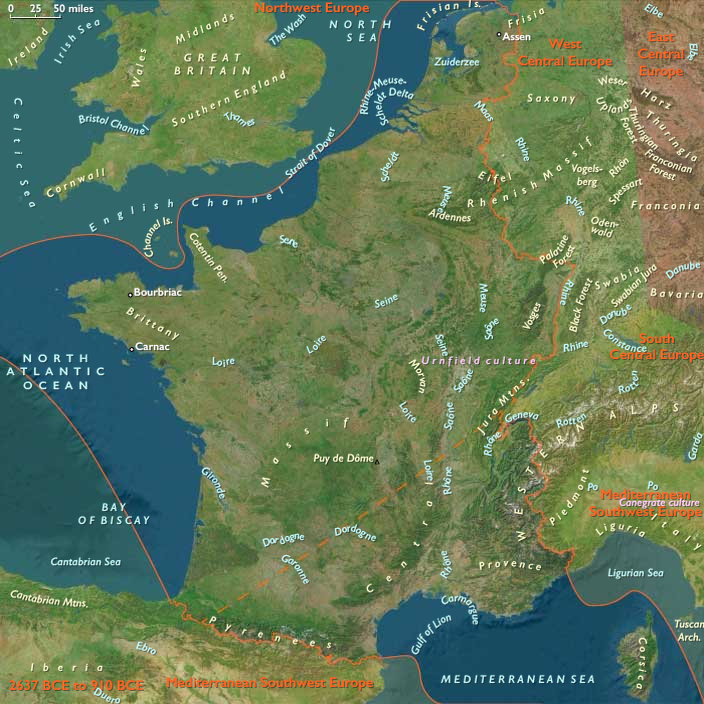
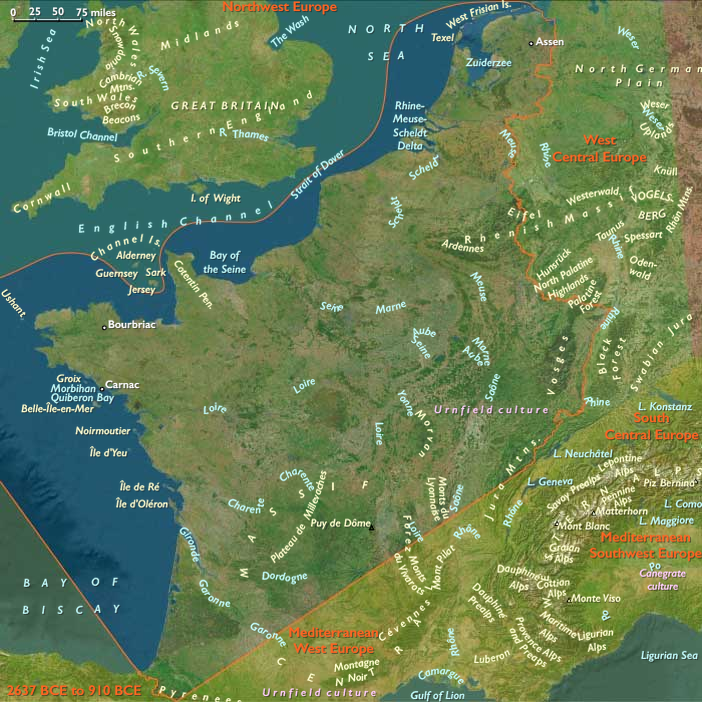
- While the Funnelbeaker culture smoothly integrated into Corded Ware traditions, the Vlaardingen culture—a hunter-gatherer society linked to the Seine-Oise-Marne culture—persisted in the southwestern Netherlands.
- This culture, which appeared around 2600 BCE, was more primitive in terms of subsistence and continued to rely on hunting, fishing, and gathering, despite the widespread adoption of farming elsewhere.
- It remained distinct from neighboring agropastoralist societies until it, too, was eventually replaced by the Corded Ware culture.
Significance of These Cultural Shifts
- The Funnelbeaker-Corded Ware transition represents a major shift from Neolithic farming societies to Bronze Age proto-Indo-European pastoralist communities.
- The Vlaardingen culture's persistence highlights the regional diversity in prehistoric Europe, where hunter-gatherer traditions coexisted with emerging agricultural and pastoralist lifeways.
- These cultural interactions shaped the ethnogenesis of later European populations, influencing the linguistic and genetic landscape of the region.
Thus, the Netherlands and surrounding regions during this period reflect a complex interplay of continuity, transition, and cultural survival, as societies adapted to changing economic and environmental conditions.
Groups
Topics
Commodoties
Subjects
Regions
Subregions
Years: 4365BCE - 2637BCE
Groups
Topics
Commodoties
Subjects
Regions
Subregions