
India's Sarasvati River, mentioned in all books …
Years: 7821BCE - 7678BCE
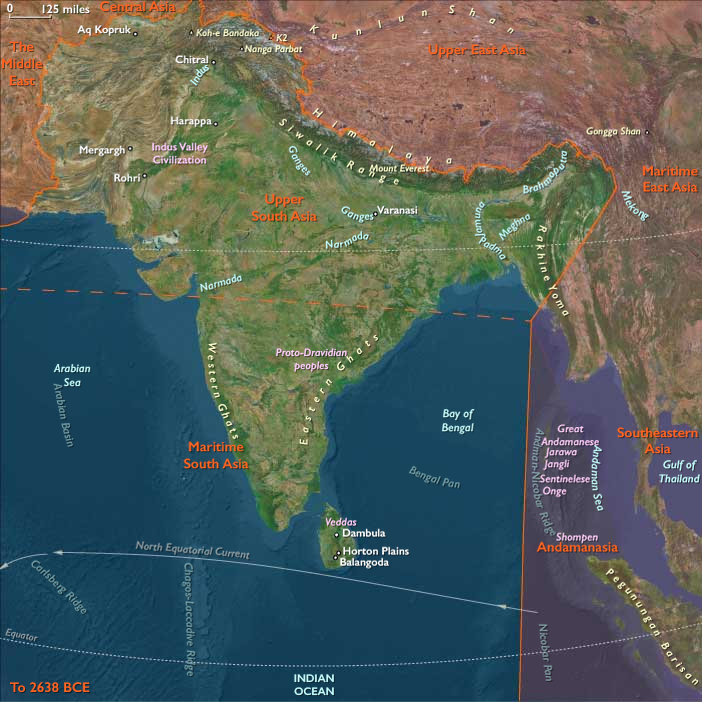
India's Sarasvati River, mentioned in all books of the Rigveda except the fourth, and celebrated as the central watercourse of Vedic culture, may end its oceangoing flow as early as 8000 BCE.
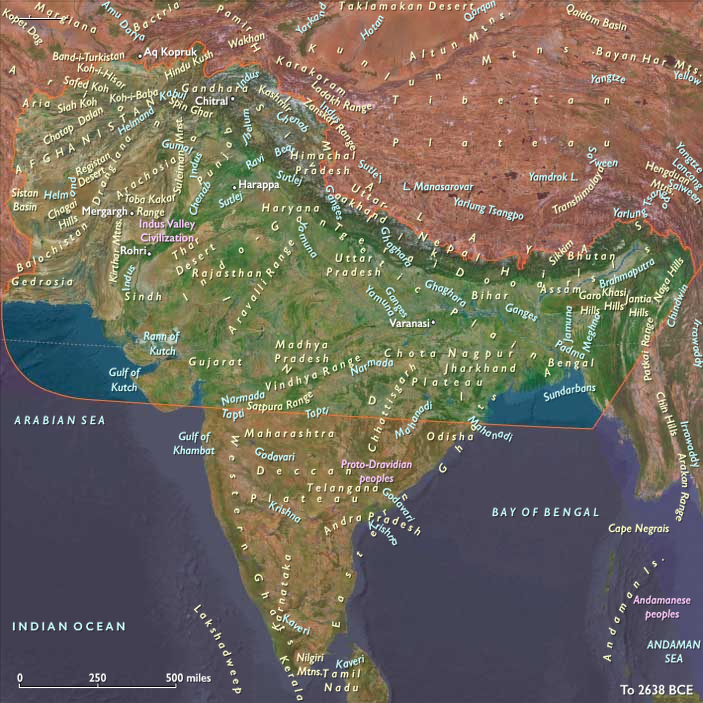
The Nadistuti hymn in the Rigveda (10.75) mentions the Sarasvati between the Yamuna in the east and the Sutlej in the west, and later Vedic texts like Tandya and Jaiminiya Brahmanas as well as the post-Vedic Mahabharata mention that the Sarasvati dried up in a desert.
The goddess Sarasvati was originally a personification of this river, but later developed an independent identity and meaning.
The Ghaggar is an intermittent river in India, flowing during the monsoon rains; the Hakra is the dried-out channel of a river in Pakistan that is the continuation of the Ghaggar River in India.
Evidence from survey fieldwork and recent satellite imagery have been adduced to suggest that the Ghaggar-Hakra system in the undetermined past had the Sutlej and the Yamuna as tributaries, with the Rann of Kutch as the likely remains of its delta.
In this scenario, geological changes diverted the Sutlej towards the Indus and the Yamuna towards the Ganges, following which the river did not have enough water to reach the sea any more and dried up in the Thar desert.
It has been proposed that the Sarasvati of the early Rigveda corresponds to the Ghaggar-Hakra before these changes took place (the "Old Ghaggar"), and the late Vedic end Epic Sarasvati disappearing in the desert to the Ghaggar-Hakra following the diversion of Sutlej and Yamuna.
The wide paleo-channel of the Ghaggar river suggest that the river once flowed full of water during the great meltdown of the Himalayan Ice Age glaciers, some ten thousand years ago, and that it then continued through the entire region, in the presently dry channel of the Hakra River, possibly emptying into the Rann of Kutch.
It supposedly dried up due to the capture of its tributaries by the Indus system and the Yamuna river, and later on, additionally, the loss of water in much of its catchment area due to deforestation and overgrazing.
Locations
Topics
Commodoties
Subjects
Regions
Subregions
Years: 7821BCE - 7678BCE
Locations
Topics
Commodoties
Subjects
Regions
Subregions