
The British begin the Second Anglo-Maratha War, …
Years: 1803 - 1803
August
The British begin the Second Anglo-Maratha War, against the Scindia of Gwalior, on August 3, 1803.
The British had supported the "fugitive" Peshwa Raghunathrao in the First Anglo-Maratha War, continued with his "fugitive" son, Baji Rao II.
Baji Rao II had soon provoked the enmity of Malhar Rao Holkar when he had one of Holkar's relatives killed.
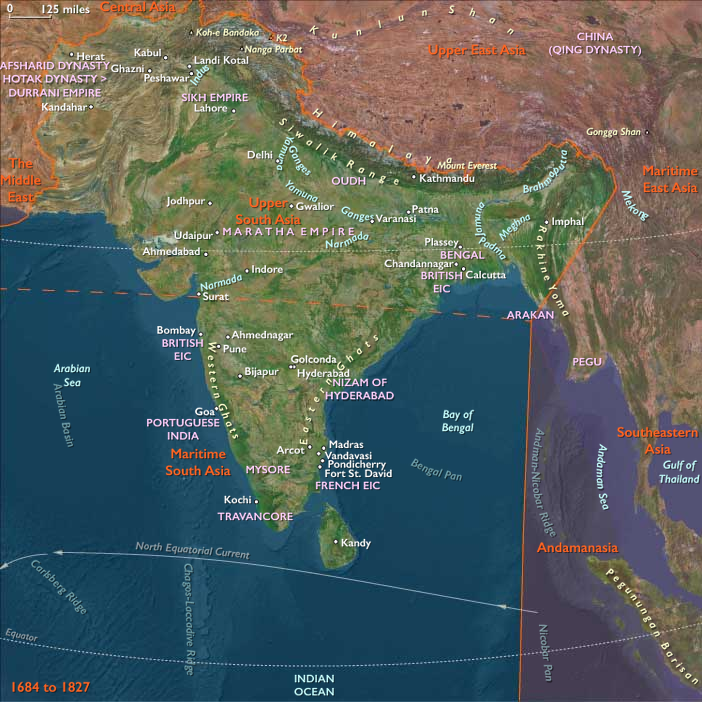
The fall of Mysore in 1799–1800 had left the Marathas as the only major power left outside British control in India.
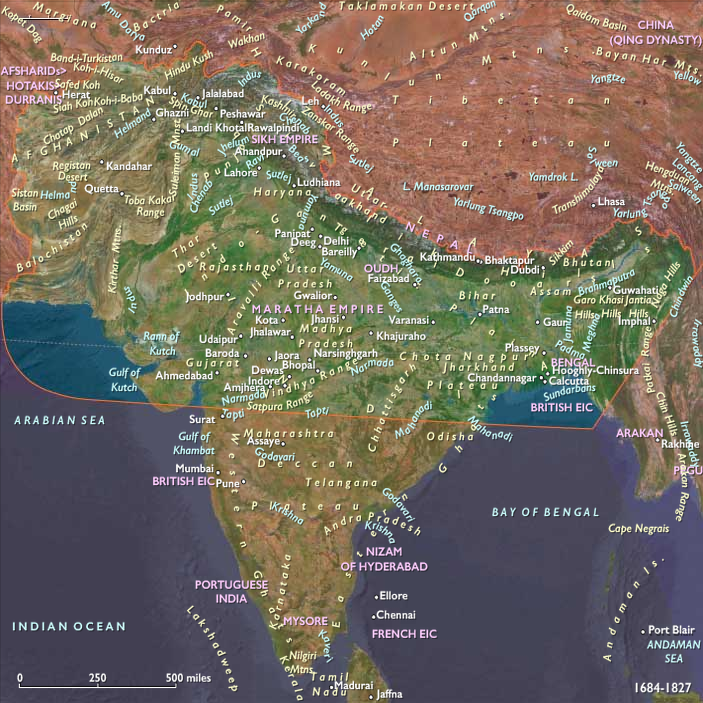
The Maratha Empire at this time consists of a confederacy of five major chiefs: the Peshwa (Prime Minister) at the capital city of Poona, the Gaekwad chief of Baroda, the Scindia chief of Gwalior, the Holkar chief of Indore, and the Bhonsale chief of Nagpur.
The Maratha chiefs are engaged in internal quarrels among themselves.
Lord Mornington, the Governor-General of British India, had repeatedly offered a subsidiary treaty to the Peshwa and Scindia, but Nana Fadnavis had refused strongly.
In October 1802, the combined armies of Peshwa Baji Rao II and Scindia had been defeated by Yashwantrao Holkar, ruler of Indore, at the Battle of Poona.
Baji Rao had fled to British protection, and in December the same year had concluded the Treaty of Bassein with the British East India Company, ceding territory for the maintenance of a subsidiary force and agreeing to treaty with no other power.
This act on the part of the Peshwa, their nominal overlord, had horrified and disgusted the Maratha chieftains; in particular, the Scindia rulers of Gwalior and the Bhonsale rulers of Nagpur and Berar had contested the agreement.
The British strategy includes Wellesley securing the Deccan Plateau, Lake taking Doab, then Delhi, Powell entering Bundelkhand, Murray taking Badoch, and Harcourt neutralizing Bihar.
The British have available over fifty-three thousand men to help accomplish their goals.
Locations
People
Groups
- Maratha Empire
- East India Company, British (United Company of Merchants of England Trading to the East Indies)
- India, East India Company rule in
- Britain (United Kingdom of Great Britain and Ireland)
Topics
Subjects
Regions
Subregions
Years: 1803 - 1803
August
Locations
People
Groups
- Maratha Empire
- East India Company, British (United Company of Merchants of England Trading to the East Indies)
- India, East India Company rule in
- Britain (United Kingdom of Great Britain and Ireland)
Topics
Subjects
Regions
Subregions