
The Chaperon in Jan van Eyck’s Probable …
Years: 1433 - 1433
The Chaperon in Jan van Eyck’s Probable Self-Portrait (1433)
In Jan van Eyck’s probable self-portrait, Portrait of a Man in a Red Turban (1433), the artist wears a chaperon, a fashionable and highly versatile headwear style of the 15th century.
In this painting, van Eyck ties the cornette and patte together on top of the head, creating a flamboyant turban-like effect, a style commonly seen among wealthy individuals and professionals of the time.
I. Structure of the Chaperon in the Portrait
-
The chaperon evolved from a hooded cloak into a more elaborate headdress, typically composed of three parts:
- Bourrelet – A padded, ring-like structure that sits around the head.
- Cornette – A long trailing tail of fabric, originally designed to drape over the shoulder.
- Patte – A decorative flap or liripipe, which could be adjusted for different styling.
-
In van Eyck’s portrait:
- The cornette is wound around the bourrelet, leaving just a patch of the bourrelet visible (right of center).
- This wrapped style creates a turban-like silhouette, which could feature a short tail hanging at the rear.
- The arrangement was both fashionable and practical, making it suitable for a painter at work.
II. Symbolism and Function of the Chaperon
- By 1433, the chaperon had become a symbol of status and profession, worn by nobles, merchants, and scholars.
- The dramatic folds and structured appearance suggest wealth and refinement, reinforcing van Eyck’s social standing as a court painter.
- Its practical function for a painter:
- The wrapped design could prevent dust or paint from getting into the wearer’s hair.
- It could also shield the head from studio drafts and paint fumes.
III. The Chaperon as a Marker of Van Eyck’s Identity
- The self-portrait showcases van Eyck’s mastery of realism, particularly in the rendering of the chaperon’s intricate folds and texture.
- His signature use of light and shadow gives the fabric depth and volume, making it a striking element of the composition.
- This stylized headdress might reflect van Eyck’s personal fashion preferences, or it could serve as a visual symbol of his status as a sophisticated artist.
IV. Conclusion: A Fashion Statement and Practical Headwear
Jan van Eyck’s chaperon in his 1433 self-portrait is both a bold fashion statement and a functional choice for a working painter. The wrapped cornette and patte create a turban-like shape, a stylistic flourish that highlights the luxurious draping techniques of the period.
This striking headwear not only exemplifies van Eyck’s skill in painting fabric but also reinforces his social and artistic identity within the Burgundian court.
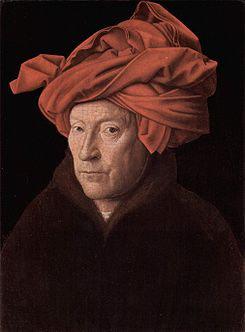
Jan van Eyck: Portrait of a Man in a Turban (actually a chaperon), possibly a self-portrait, painted 1433; oil on wood, 15.5 × 19 cm, National Gallery, London
Locations
People
Groups
Topics
Subjects
Regions

Subregions

Years: 1433 - 1433
Jan van Eyck: Portrait of a Man in a Turban (actually a chaperon), possibly a self-portrait, painted 1433; oil on wood, 15.5 × 19 cm, National Gallery, London
Locations
People
Groups
Topics
Subjects
Regions
Subregions