
Emperor Henry IV had been forced by …
Years: 1075 - 1075
October
Emperor Henry IV had been forced by the Saxon Rebellion to come to amicable terms with Gregory VII at any cost.
Consequently, in May 1074 he had done penance at Nuremberg—in the presence of the papal legates—to atone for his continued friendship with the members of his council who had been banned by Gregory in the two years since his election.
Taking an oath of obedience, he had promised his support in the work of reforming the Church.
This attitude, however, which had at first won him the confidence of the pope, had been abandoned as soon as he defeated the Saxons at the First Battle of Langensalza on June 9, 1075.
The tension between Empire and Church has culminated in the councils of 1074–75, which constitute a substantial attempt to undo Henry III's policies.
Among other measures, they deny secular rulers the right to place members of the clergy in office; this has dramatic effects in Germany, where bishops are often powerful feudatories who, in this way, are able to free themselves from imperial authority.
In addition to restoring all privileges lost by the ecclesiastics, the council's decision deprives the imperial crown of almost half its lands, with grievous consequences for national unity, especially in peripheral areas like the Kingdom of Italy.
Henry, suddenly hostile to Gregory, does not relent from his positions: after defeating Otto of Nordheim, he continues to interfere in Italian and German episcopal life, naming bishops at his will and declaring papal provisions illegitimate.
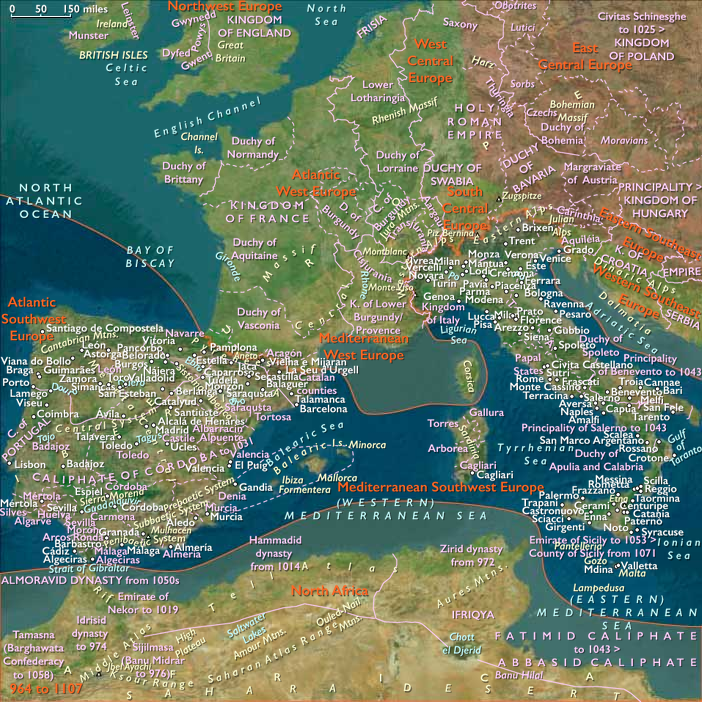
Henry now tries to reassert his rights as the sovereign of northern Italy without delay.
He sends Count Eberhard to Lombardy to combat the Patarenes; nominates the cleric Tedaldo to the archbishopric of Milan, thus settling a prolonged and contentious question; and …
Locations
People
Groups
- Lombards (West Germanic tribe)
- Saxons
- Papal States (Republic of St. Peter)
- Saxony, Duchy of
- Normans
- German, or Ottonian (Roman) Empire
- Italy, Kingdom of (Holy Roman Empire)
- Pataria
- Christians, Roman Catholic
- Apulia, Norman Duchy of
- Bavaria, Welf Duchy of
Topics
Commodoties
Subjects
Regions
Subregions
Related Events
Showing 5 events out of 5 total
Years: 1075 - 1075
October
Locations
People
Groups
- Lombards (West Germanic tribe)
- Saxons
- Papal States (Republic of St. Peter)
- Saxony, Duchy of
- Normans
- German, or Ottonian (Roman) Empire
- Italy, Kingdom of (Holy Roman Empire)
- Pataria
- Christians, Roman Catholic
- Apulia, Norman Duchy of
- Bavaria, Welf Duchy of
Topics
Commodoties
Subjects
Regions
Subregions