The revolutionary movement in the shrinking domains …
Years: 1350 - 1350
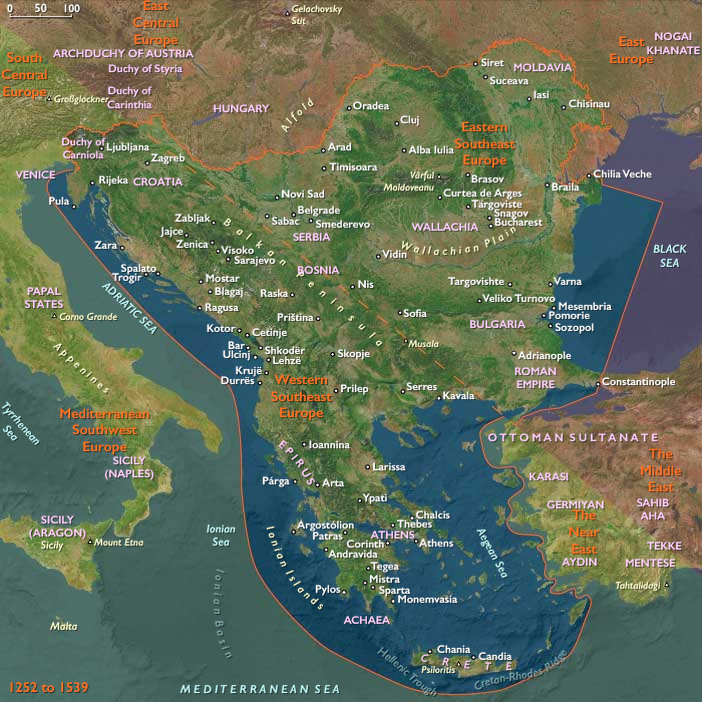
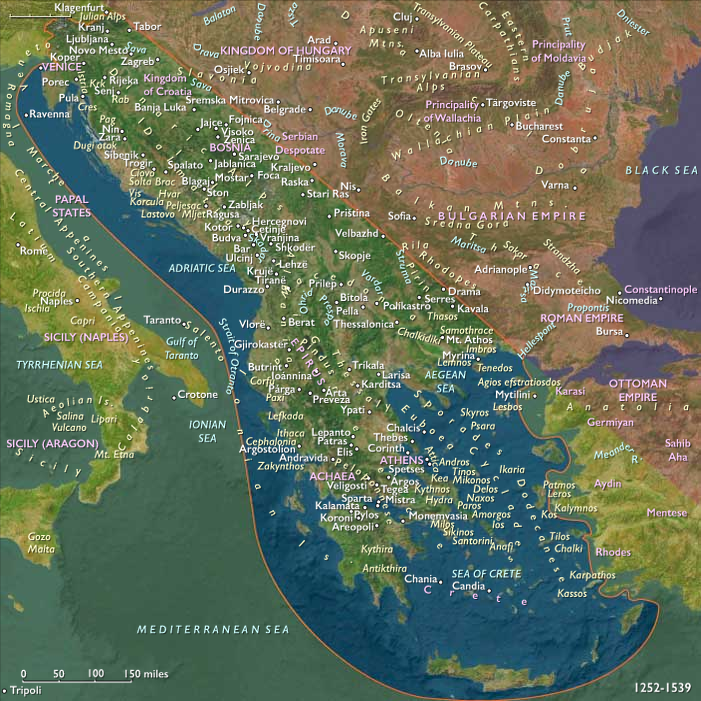
The revolutionary movement in the shrinking domains of the empire is most memorable and lasting in Thessalonica, where a faction known as the Zealots has seized power in a coup d'état and governs the city as an almost independent commune until 1350.
The junior emperor John V will rule in Thessalonica after 1351.
Locations
People
Groups
- Thessalonica, East Roman Theme of
- Roman Empire, Eastern: Palaiologan dynasty
- Neopatras, Duchy of
- Thessalonica, Zealots of
Commodoties
Subjects
Regions
Subregions
Related Events
Filter results
Showing 10 events out of 44200 total
The Genoans in 1350 seize a number of Venetian ships near the flourishing Genoese colony of Kaffa (Feodosiya) in the Crimea, triggering war between the two Italian city-states.
Valdemar remains untouched and takes advantage of the deaths of his enemies to add to his growing lands and properties.
He refuses to reduce the taxes in 1350 although fewer peasants farm less land.
Nobles, too, feel their incomes shrink and the tax burdens fall heavier on them as well.
Uprisings will flare up in the following years.
Tradition has it that the plague came to Denmark on a ghost ship that beached itself on the coast of northern Jutland.
Those who went aboard found the dead swollen and black faced, but stayed long enough to take everything of value from it and thereby introduced the fleas that carried the disease into the population.
People began to die by the thousands.
During the ensuing two years plague has swept through Denmark like a forest fire.
In Ribe twelve parishes ceased to exist in a single diocese.
A few towns simply died with no one left alive.
The general figures for plague in 1349–50 range between thirty-three percent and sixty-six percent of the people of Denmark.
City dwellers have often been harder hit than farm folk leading many people to abandon towns altogether.
Charles, having made good use of the difficulties of his opponents, had again been elected in Frankfurt on June 17, 1349, and on July 25, 1349, had been re-crowned at Aachen and was soon the undisputed ruler of the Empire.
Gifts or promises have won the support of the Rhenish and Swabian towns; a marriage alliance has secured the friendship of the Habsburgs; and an alliance with Rudolf II of Bavaria, Count Palatine of the Rhine, is obtained when Charles, who had become a widower in 1348, married Rudolph's daughter Anna.
The king is visited at Prague in 1350 by the Roman tribune Cola di Rienzo, who urges him to go to Italy, where the poet Petrarch and the citizens of Florence also implore his presence.
Turning a deaf ear to these entreaties, Charles will keep Cola in prison for a year, then hand him as a prisoner to Clement at Avignon.
Dušan evidently wants to expand his rule over the provinces that had earlier been in the hands of Serbia, such as Hum, which had been annexed in 1326 by the Hungarian protégé and Bosnian Ban Stephen II Kotromanić.
Ban Stephen II had launched an attack in 1329, on Lord Vitomir, who held Travunia and Konavle.
The Bosnian army had been defeated at Pribojska Banja by Dušan, when he was still Young King.
The Ban soon took over Nevesinje and the rest of Bosnia.
Petar Toljenović, the Lord of "seaside Hum" and a distant relative of Dušan, sparked a rebellion against the new ruler, but he was soon captured and died in prison.
Dušan attacks Bosnia in 1350, seeking to regain the previously lost land of Hum and stop raids on his tributaries at Konavle.
Venice seeks a settlement between the two but fails.
He invades Hum in October with an army said to be of eighty thousand men, and successfully occupies part of the disputed territory.
Dušan according to Orbini had secretly been in contact with various Bosnian nobles, offering them bribes for support.
Many nobles, chiefly of Hum, are ready to betray the Ban, such as the Nikolić family, which is kin to the Nemanjić dynasty.
The Bosnian Ban avoids any major confrontation and does not meet Dušan in battle; he instead retires to the mountains and makes small hit-and-run actions.
Most of Bosnia's fortresses hold out, but some nobles submit to Dušan.
The Serbs ravage much of the countryside.
With one army they reach Duvno and Cetina; another reaches Krka, on which lies Knin (modern Croatia); and another takes Imotski and Novi, where they leave garrisons and enter Hum.
From this position of strength, Dušan tries to negotiate peace with the Ban, sealing it by the marriage of Dušan's son Uroš with Stephen's daughter Elizabeth, who would receive Hum as her dowry—restoring it to Serbia.
The Ban is not willing to consider this proposal.
Dušan may have also launched the campaign in order to aid his sister, Jelena, who n 1347 had married Mladen III Subic of Omis, Klis and Skradin.
Mladen had died in 1348 from Black Death (bubonic plague), and Jelena seeks to maintain the rule of the cities for herself and her son.
She is challenged by Hungary and Venice, so the Serbian army detachments in western Hum and Croatia may have been for her aid, as operations in this region were unlikely to help Dušan conquer Hum.
If Dušan intends to aid Jelena, rising trouble in the East precludes the plan.

The Genoese, soon after provoking a war with Venice in 1350 by seizing their ships off the Genoese colony of Kaffa in the Crimea, capture the key Venetian colony at Negropont (Evvoia, or Euboea) in Greece.
The Venetians hastily form alliances with Emperor John VI Kantakouzenos and King Peter IV of Aragon and wage an indecisive naval battle at the Bosporus.
Dušan, now that has conquered Epirus and Thessaly, seeks to obtain Constantinople.
To acquire the city, he needs a fleet.
Knowing that fleets of southern Serbian Dalmatian towns are not strong enough to overcome Constantinople, he opens negotiations with Venice, with which he maintains fairly good relations.
Venice fears a reduction of privileges in the Empire if Serbs become the masters of Constantinople over the weakened Greeks, but if the Venetians had allied with Serbia, Dushan would have examined existing privileges.
Once he became master of all imperial lands (especially Thessalonika and Constantinople) the Venetians would gain privileges.
Venice chooses to avoid a military alliance.
While Dušan seeks Venetian aid against the Empire, the Venetians seek Serbian support in the struggle against the Hungarians over Dalmatia.
When sensing that Serbian aid would result in a Venetian obligation to Serbia, Venice politely turns down Dušan’s offers of help.
Kantakouzenos tries to regain lands the Empire has lost while Dušan launches the Bosnian campaign (absent the Serbian troops in Macedonia and Thessaly).
In support, the Constantinopolitan patriarch Kallistos in 1350 excommunicates Dušan in order to discourage the Greek population in Dušan's Greek provinces from supporting the Serbian administration and thereby assist the Kantakouzenos campaign.
The excommunication does not stop Dušan's relations with Mount Athos, which still address him as Emperor, though rather as Emperor of Serbs than Emperor of Serbs and Greeks.
Kantakouzenos raises a small army and takes the Chalcidic peninsula, then Veria and Voden.
Veria is the richest town in the Botia region.
Dušan had earlier replaced many Greeks with Serbs, including a Serb garrison.
However, the remaining locals are able in 1350 to open the gates for Kantakouzenos.
Voden resists Kantakouzenos but is taken by assault.
Kantakouzenos now marches toward Thessaly but is stopped at Servia by Caesar Preljub and his army of five hundred men men.
The imperial force retires to Veria, and the aiding Turk contingent goes off plundering, reaching Skopje.
Dušan, once word of the imperial campaign reaches in Hum, quickly reassembles his forces from Bosnia and Hum and marches for Thessaly.
Years: 1350 - 1350
Locations
People
Groups
- Thessalonica, East Roman Theme of
- Roman Empire, Eastern: Palaiologan dynasty
- Neopatras, Duchy of
- Thessalonica, Zealots of