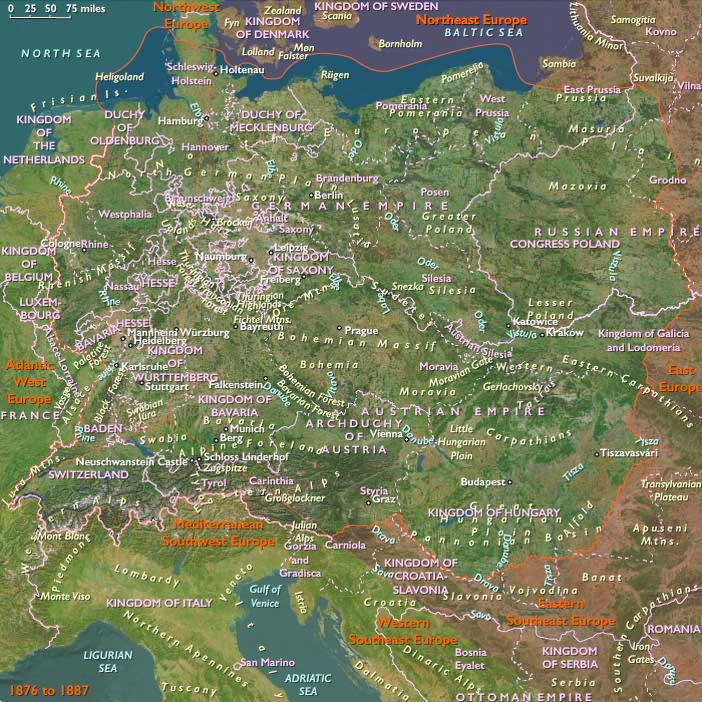
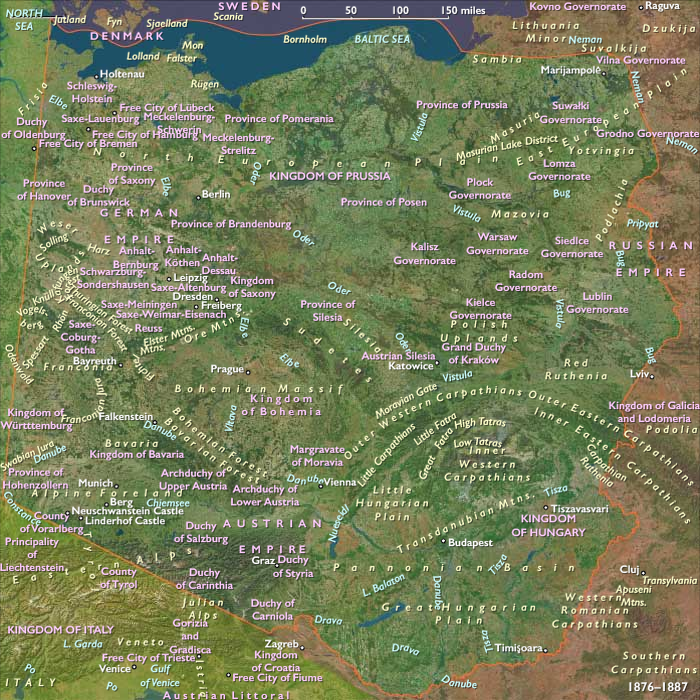
The Socialist Labor party receives more than …
Years: 1877 - 1877
January
The Socialist Labor party receives more than ten percent of the vote and wins twelve deputies out of three hundred and forty-five in the Reichstag elections of January 10, 1877.
Locations
Groups
Topics
Subjects
Regions
Subregions
Related Events
Filter results
Showing 10 events out of 11822 total
Sir George Grey is elected New Zealand Premier by Parliament on October 13, 1877, upon the defeat of Harry Atkinson.
Grey's opposition to the abolition of New Zealand’s provinces had proved ineffective, and the system had been abolished in 1876.
New Zealand’s 1877 Education Act declares free, compulsory, and secular education for Pakehas and Maoris alike.
The Bank of Japan, founded in 1877, uses taxes to fund model steel and textile factories.
Japan’s recently instituted conscript army defeats the anti-reform Satsuma rebellion of 1877, a major samurai revolt reluctantly led by national hero Saigo Takamori, who commits ritual suicide upon the defeat of his followers.
The manufacturing industries of Kashgar are supposed to have declined with the overthrow of Chinese rule in 1865 by Yaqub Bek.
Zuo's army defeats Yaqub Beg's forces in battle at Kashgar and the defeated Muslims again acknowledge China's authority over them.
Yaqub Bek, Amir of Kashgaria, has entered into relations and signed treaties with the Russian Empire and Great Britain, but he had failed in his attempts to their support against Qing China.
Kashgar and the other cities of the Tarim basin remain under Yakub Beg's rule until May 1877, when he dies at Korla and his state collapses as Kashgaria is reconquered by the forces of the Qing general Zuo Zongtang (also known as General Tso).
Anna Karenina, a novel by Leo Tolstoy, has been published in serial installments from 1873 in the periodical The Russian Messenger.
Tolstoy clashes with its main editor, Mikhail Katkov, over political issues that arise in the final installment (Tolstoy's unpopular views of volunteers going to Serbia); therefore, the novel's first complete appearance will be in book form.
Widely regarded as a pinnacle in realist fiction, Tolstoy considers Anna Karenina his first true novel, when he comes to consider War and Peace to be more than a novel.
Fyodor Dostoevsky will declare it to be "flawless as a work of art".
His opinion will be shared by Vladimir Nabokov, who especially admires "the flawless magic of Tolstoy's style", and by William Faulkner, who will describe the novel as "the best ever written". (Tolstoy, Leo. Anna Karenina. Penguin Publishing. Faulkner's opinion is used as an advert on the inside cover.)
The Danish labor movement has become increasingly popular, and the newspaper, now called Social Demokraten, has a wide circulation, but the movement has become increasingly unhappy over Louis Pio's authoritarian leadership style.
Pio leaves Denmark in 1877 to the great indignation of Danish socialists, who discover that he had been bribed by the police to leave the country.
He travels to Smoky Hill River, near Hays City, Kansas, to found an ill-starred socialist colony, which will soon fail because of the lack of agricultural expertise among the colonists.
He will then move to Chicago, Illinois, where he will live in poverty, working at odd jobs, until he dies on June 27, 1894.
Queen Victoria is proclaimed, in absentia, Empress of India at the Delhi Durbar of 1877.
Called the "Proclamation Durbar", held beginning on January 1, 1877 to designate the coronation, the 1877 Durbar is largely an official event and not a popular occasion with mass appeal.
It is attended by the 1st Earl of Lytton, Viceroy of India, maharajas, nawabs, and intellectuals.
This is the culmination of transfer of control of much of India from the British East India Company to the Crown.
Princes who were styled Raas had ruled the Gilgit region before the establishment of the princely state of Jammu and Kashmir by the Dogra rulers in the mid-nineteenth century,
The rulers of the neighboring Baltistan region used the Tibetan title of rGyal-po, having been founded as a western Tibetan kingdom in the thirteenth century.
Gilgit and Baltistan, together with their neighbors Hunza, Nagar and Ladakh, had become vassals of of Jammu and Kashmir, but have maintained considerable autonomy.
In order to guard against the advance of Russia, the British Government, acting as the suzerain power of Kashmir, establishes the Gilgit Agency, overseen by a political agent of the Governor-General of British India, in 1877.
The seat of the agent is Srinagar; he is to report on Russian activities as well as on developments in the nearby states of Hunza and Nagar.
After the formation of the Gilgit Agency, these territories—including the Wazarats of Gilgit and Ladakh, the State of Hunza and Nagar, the Punial Jagir; the Governorships of Yasin, Kuh-Ghizr and Ishkoman, and Chilas—are administered directly by the British, though the Princely state of Jammu and Kashmir retains sovereignty.