The Song clan of Emperor Ān's grandmother …
Years: 121 - 121
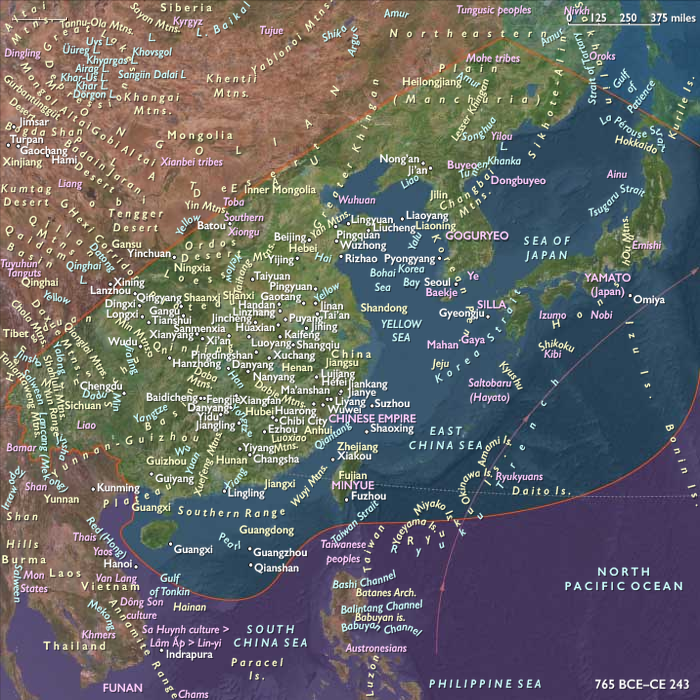
The Song clan of Emperor Ān's grandmother has become honored in the place of the Dengs, but the clan of the empress, the Yáns—particularly Empress Yán's brothers Yán Xiǎn, Yán Jǐng, and Yán Yào—wieldi much more actual power.
Also powerful are the eunuchs Jiang and Li, who are created marquesses.
They, along with several other eunuchs, as well as Wang and her daughter Bó Róng, have become extremely corrupt in their ways, without any punishment from Emperor Ān, who ignores all criticism of these individuals.
The emperor often listens to their suggestions, while ignoring the advice of his key officials.
One of the most outspoken of these is Yáng Zhèn, the commander of the armed forces, who will eventually be removed from his post in 124 and commit suicide in protest.
Locations
People
Groups
Topics
Subjects
Regions
Subregions
Related Events
Filter results
Showing 10 events out of 61204 total
Emperor Ān had in 120 named his only son, Prince Bǎo, crown prince.
Empress Dowager Deng dies in 121, and An, at the age of 27, finally has the reins of the imperial administration.
He posthumously honores his father Prince Qing as Emperor Xiaode and his mother Consort Zuǒ as Empress Xiaode; his paternal grandmother Consort Song as Empress Jingyin; and his stepmother Consort Gěng with the unique title of "Grand Consort of Gānlíng" (Gānlíng being Prince Qing's tomb) -- a title inferior to his mother's, even though Consort Gěng was his father's wife.
He, however, was close to her and her brother Gěng Bǎo, and he quickly makes his stepuncle a powerful official in his administration.
Initially, Ān continued to follow the Empress Dowager's policies, including leaving members of her clan in important advisorial positions.
However, his own close circle of associates, including Jiang, Li, Wang, and Empress Yan, are ready to act.
Late in 121, he strips members of the Deng clan of their posts and fiefs, and many of them commit suicide, probably under duress.
Later, he relents and allows some of the survivors to return, but by that time the Deng clan has been decimated.
In 121, there are again Qiang and Xianbei rebellions, which will continue to plague the emperor for the rest of his reign.
The reign of Hadrian, despite his own great reputation as a military administrator, will be marked by a general lack of major military conflicts, apart from the Second Roman-Jewish War.
He has surrendered Trajan's conquests in Mesopotamia, considering them to be indefensible.
There is almost a war with Parthia around 121, but the threat is averted when Hadrian succeeds in negotiating a peace.
Around this time, Suetonius publishes his highly readable combination of fact and unverifiable rumor, Lives of the Caesars, an often scandalous account of the histories of Julius Caesar and of Rome's first eleven emperors, from Augustus to Domitian.
The Roman settlement at present Wiesbaden is first mentioned in 121 using the name Aquae Mattiacorum (Latin for "Waters of the Mattiaci").
The Mattiaci are a Germanic tribe, possibly a branch of the neighboring Chatti, who live in the vicinity at this time.
The town also appears as Mattiacum in Ptolemy's Geographia (2.10).
The line of Roman frontier fortifications, the Limes Germanicus, is constructed in the Taunus not far north of Wiesbaden.
Just over the Rhine, connected by a bridge at the present-day borough of Mainz-Kastel (Roman "castellum"), a strongly fortified bridgehead, is …
…the capital of the province of Germania Superior, Moguntiacum (present-day Mainz), which serves as base of two (at times three) Roman legions.
Hadrian, a conservative emperor more interested in consolidating Rome’s imperial acquisitions then gaining new territory, abandons the Roman attempt to subjugate Scotland.
A permanent fortified wall built across northern England, to extend west from Segedunum at Wallsend on the River Tyne to the shore of the Solway Firth, was likely planned before Hadrian's visit to Britain in CE 122.
According to restored sandstone fragments found in Jarrow that date from 118 or 119, it was Hadrian's wish to keep "intact the empire," which had been imposed upon him by "divine instruction."
(Anthony Everitt [2009] Hadrian and the Triumph of Rome, Random House, Inc.); the fragments then announce the building of the wall.
It is entirely possible that, on his arrival in Britain in 122, one of the stops on his itinerary was the northern frontier and an inspection of the progress of the wall as it was being built.
Later called Hadrian’s Wall and still partially intact, it runs across northern England at its narrowest point, between the Solway Firth and the River Tyne, situating the barrier to take advantage of available high ground.
The wall, seventy-three and a half miles (one hundred and eighteen kilometers) long, 1.6 to 11.5 feet (two to three and a half meters) thick and twenty-three feet (seven meters) high, is less a defensive line than a barrier to large-scale, swift movements by hostile forces, and a defensive screen behind which the Romans can maneuver.
A ditch on either side protects both faces of the wall, some stretches of which are originally constructed of turf, but later rebuilt in stone.
Towers containing gates are built into the wall at intervals of 1 Roman mile (about 1,665 yards/1,522 meters), with two smaller turrets placed at equal distances between each pair of "mile castles."
Large forts, constructed across or adjacent to the wall, house its garrisons.
Reasons for the wall’s construction vary, as no recording of any exact explanation survives.
However, a number of theories have been presented by historians, primarily centering around an expression of Roman power and Hadrian's policy of defense before expansion.
For example, on his accession to the throne in 117, Hadrian had been experiencing rebellion in Roman Britain and from the peoples of various conquered lands across the Empire, including Egypt, Palestine, Libya, Mauretania.
These troubles may have been a factor in Hadrian's plan to construct the wall, and his construction of limes in other areas of the Empire, but to what extent is unknown.
Scholars also disagree over how much of an actual threat the sparsely populated land of northern Britannia (Scotland) actually presented, and whether there was any more economic advantage in defending and garrisoning a fixed line of defenses like the Wall over simply conquering and annexing the Scottish Lowlands and manning the territory with a loose arrangement of forts.
The limes of Rome were never expected to stop whole tribes from migrating or entire armies from invading, and while a frontier protected by a palisade or stone wall would surely help curb cattle-raiders and the incursions of other small groups, the economic viability of constructing and constantly manning a seventy-two-mile (one hundred and sixteen kilometer long boundary along a sparsely populated border to stop small-scale raiding is dubious.
Another possible explanation for the erection of the great wall is the degree of control it would have provided over immigration, smuggling, and customs.
Limes do not strictly mark the boundaries of Rome, with Roman power and influence often extending beyond its walls.
People inside and beyond the limes travel through it each day when conducting business, and organizes checkpoints like those offered by Hadrian's Wall provide good opportunities for taxation.
With watch towers only a short distance from gateways in the limes, patrolling legionaries would be able to keep track of entering and exiting natives and Roman citizens alike, charging customs dues, and checking for smuggling activity.

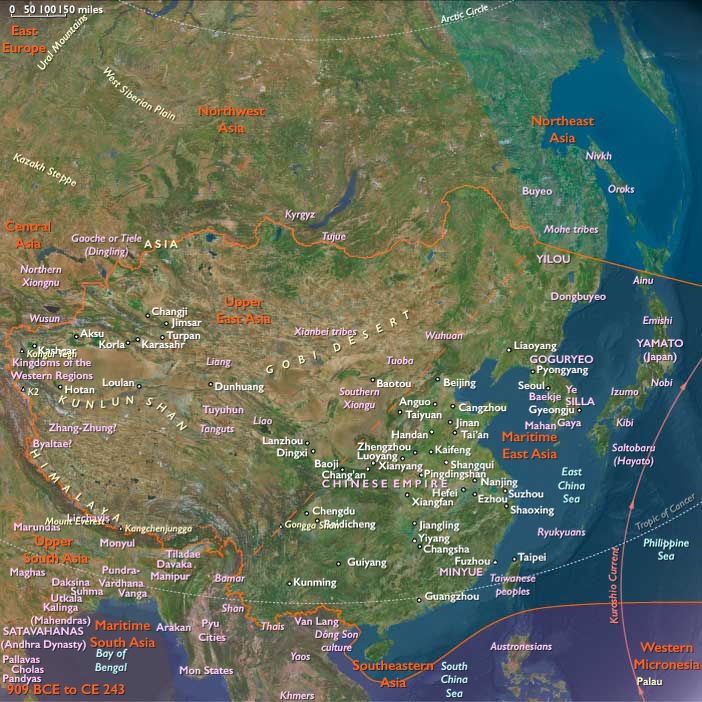
The only border where there are Hàn accomplishments during Ān's reign is on the northwestern front—the Xiyu (modern Xinjiang and former Soviet central Asia)—where Ban Chao's son Ban Yong is able to reestablish Hàn suzerainty over a number of kingdoms.
The great Han general Ban Chao had written a request to the Emperor in 100 CE, saying, among other things: "I have taken care to send my son (Ban) Yong to enter the frontier following porters with presents, and thus, I will arrange things so that (Ban) Yong sees the Middle Territories [usually referred to as the 'Western Regions'—mainly the kingdoms in and around the Tarim Basin] with his own eyes while I am still alive." (From the Hou Hanshu (Book of the Later Han), Chapter 77 [sometimes given as Chapter 47], translated and adapted by E. Chavannes.).
The Western Regions in modern Xinjiang province in 107 CE had rebelled against Chinese rule.
Ban Yong had been appointed as a major and, with his elder brother, Ban Xiong, had gone via Dunhuang to meet up with the Protector General of the Western Regions, Ren Shang (?-119 CE), who had replaced Ban Chao as Protector General in 102 CE.
The Chinese had been forced to retreat and, following this, there have been no Chinese functionaries in the Western Regions for more than ten years.
Emperor An in 123 CE gives Ban Yong the title of 'Senior Clerk of the Western Regions' so that he can lead five hundred freed convicts west to garrison Liuzhong (Lukchun, in the southern Turpan Basin).
Ban Yong afterward conquers and pacifies Turpan and …
…Jimasa (in modern Jimsar County).
Turbo accompanies Hadrian to Mauretania in North Africa in 123, where they jointly lead a military campaign against local rebels after the Jewish revolt had been quelled elsewhere.
The sources are not clear on the relation of this revolt to that of Jews elsewhere in the Empire, although Caesarea will continue to be a major center of Jewry until the spread of Christianity after 300.
However, the emperor’s visit is to be short, as reports come through that the Eastern nation of Parthia is again preparing for war; as a result, Hadrian quickly heads eastwards.
As another example of how much Hadrian trusts Turbo, he puts him in charge of the two western provinces in North Africa, Mauretania Caesariensis and …
…Mauretania Tingitana, where archaeology has documented the presence of a Jewish community in the Roman period.