
In the January 1946 elections, Muslims win …
Years: 1946 - 1946
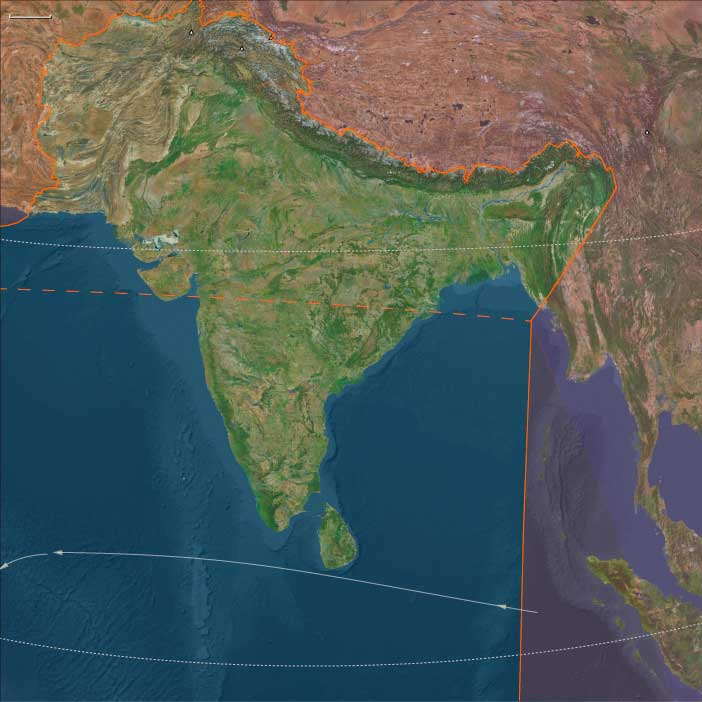
In the January 1946 elections, Muslims win majorities in Bengal, Punjab and Assam.
Related Events
Filter results
Showing 10 events out of 5115 total
Chinese communists forces enter the vacuum left in Manchuria by the departed Japanese.
Mao Zedong, adapting Marxist-Leninist philosophy to Chinese realities, champions the role of the peasantry in successful social revolutions.
Fighting in China between the Nationalists and Communists becomes open civil warfare in 1946.
The US commences war crimes trials for Japanese military leaders in June 1946.
General Douglas MacArthur’s occupation administration promoites democratic government throug h a 1946 constitution that makes the emperor a constitutional monarch while denying him his former divine status.
The US, as sole occupier, dissolves large banking and industrial combinations and institutes land reform in an effort to decentralize economic power.
The Philippines gain independence from the US on July 4, 1946.
President Manual A. Roxas heads the new republic.
The communist-dominated HUKS peasant party appropriates land in central Luzon.
The French return to Indo-China in 1946.
Vietnam’s Viet Minh guerrillas, who have spent the past five years fighting their Japanese overlords, do not welcome a replacement set of foreign masters.
Britain dissolves the Straits Settlements crown colony in 1946.
Penag and Malacca become part of the Malayan Union; Singapore becomes a separate crown colony; and Labuan becomes part of North Borneo;
The Soviets begin to fold Eastern Europe into the apron of the Communist Bloc after the war, eventually to draw a so-called “Iron Curtain” between their new satellites and the capitalist nations of Western Europe.
President Truman’s aid package keeps Greece and Turkey within the Western capitalist sphere.
The Lebanon, Syria and Transjordan are decolonized in 1946.
When the viceroy proceeds to form an interim government without the Muslim League, Jinnah calls for demonstrations, or "Direct Action," on August 16, 1946.
Communal rioting breaks out on an unprecedented scale, especially in Bengal and Bihar.
The massacre of Muslims in Calcutta brings Gandhi to the scene, where he works with the Muslim League provincial chief minister, Hussain Shahid Suhrawardy.
Gandhi's and Suhrawardy's efforts calm fears in Bengal, but rioting quickly spreads elsewhere.
The Muslim League's success can be gauged from its sweep of 90 percent of the Muslim seats in the 1946 election, compared with only 4.5 percent in the 1937 elections.
The 1946 election is, in effect, a plebiscite (a direct vote by all of the electorate concerning a proposal ) among Muslims on Pakistan.
The 1940 Lahore Resolution had called for independent "states" in the northwest and the northeast.
This objective is changed, by a 1946 meeting of Muslim League legislators, to a call for a single state (the acronym Pakistan has no letter for Bengal).
Following the war, the USSR retains the Baltic states; the Allies divide Germany into three Western-dominated sectors and a Soviet-ruled Eastern Zone.
The Allies divide Austria and its capital, Vienna, into four zones along the German model.
The United Nations forms.
The Soviets fold Eastern Europe into the apron of the Communist Bloc, drawing an ‘Iron Curtain’ between their new satellites and the capitalist nations of Western Europe.
Truman’s aid package keeps Greece and Turkey within the Western sphere.
British prime minister Clement Attlee states in 1946 that the Empire and Commonwealth is strategically indefensible.
His new goverment prepares for Indian independence.
Yugoslavia’s 1946 constitution reintegrates Croatia as a constituent province.
The Bulgarian monarchy is toppled in 1946 and replaced by a socialist republic.
Former Nazi General Rudolph Gehlen returns to Germany in 1946 to continue intelligence work for the US Army.
In 1946, waves of unexplained ghost rockets are seen in Europe, especially Scandinavia.
Moslems riot in India in 1946.
The Nuremburg trials end in October 1946 with death sentences for Hermann Goering and eleven other Nazis.
Three others receive life imprisonment, four recieve prison sentences, and three are acquitted.
Iran’s prime minister Ahmad Qavan signs an agreement allowing Russian development of oil fields.
Russian troops depart; the subsequent collapse of the Azerbaijan and Kurdistan republics allows Iran to regain control over the regions.
(Russia never pursues the Russo-Iranian oil agreement.)
The Dead Sea Scrolls are discovered in 1946.
The countries of the nearer Middle East are decolonized in the post-war years (the Lebanon, Syria and Trans-Jordan in 1946; Egypt in 1947).
Congress and the Muslim League emerge from the 1946 elections as the two dominant parties, although the Muslim League again is unable to capture a majority of the Muslim seats in the North-West Frontier Province.
Initially, both parties seem to accept the Cabinet Mission Plan, despite many reservations, but the subsequent behavior of the leaders soon leads to bitterness and mistrust.
Nehru effectively quashes any prospect of the plan's success when he announces that Congress will not be "fettered" by agreements with the British, thereby making it clear that Congress will use its majority in the newly created Constituent Assembly to write a constitution that conforms to its ideas.
The formation of an interim government is also controversial.
Jinnah demands equality between the Muslim League and Congress, a proposal rejected by the viceroy.
The Muslim League boycotts the interim government, and each party disputes the right of the other to appoint Muslim ministers, a prerogative Jinnah claims belongs solely to the Muslim League.
Expatriate writer Peter Abrahams protests the treatment of South African blacks under apatheid in his 1946 novel “Mine Boy” and the short stories of his 1942 collection, “Dark Testament.”
The Muslim Brotherhood, which has organized a terrorist arm in Egypt, poses a threat to the monarchy and the ruling Wafd Party when the Egyptian government seems to weaken in the mid-1940s.