…in The Fens through the vehemence of …
Years: 1287 - 1287
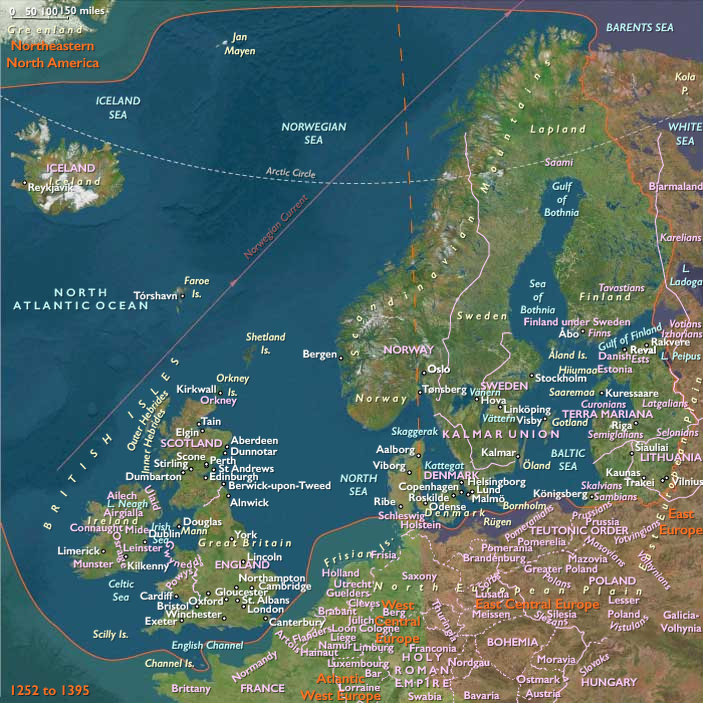
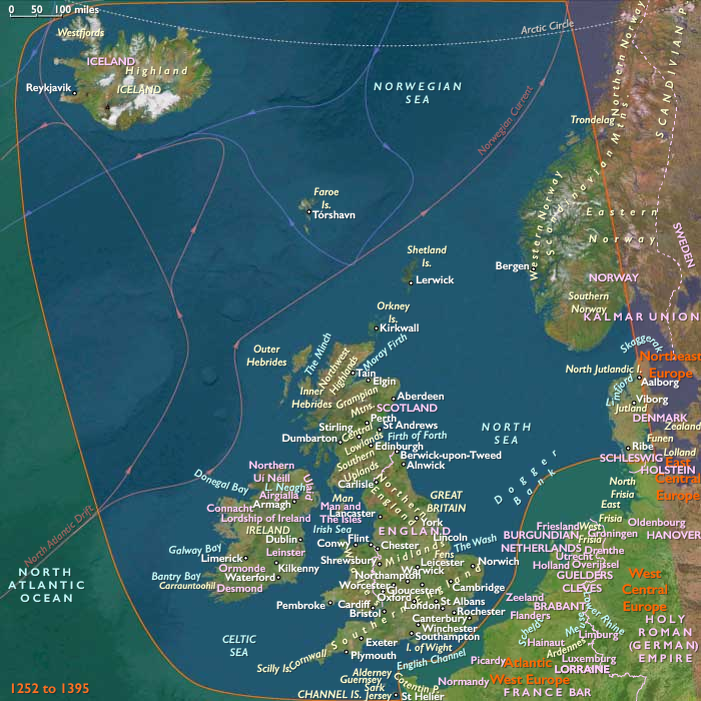
…in The Fens through the vehemence of the wind and the violence of the sea, the monastery of Spalding and many churches are overthrown and destroyed.
Locations
Groups
Topics
Subjects
Regions
Subregions
Related Events
Filter results
Showing 10 events out of 45394 total
Yesin Timur, Kublai’s grandson, after the victory at Nhamo, leads his Mongol forces down the Irrawaddy River valley, captures the flourishing walled city of Pagan (from which King Narthihapate had fled south to Bassein) and establishes a puppet government.
Narthihapate decides, under the circumstances, to finally recognize Mongol suzerainty, but his son murders him soon after, in 1287.
The two-hundred and fifty-year-old Pagan Empire now disintegrates.
The kingdom is fractured into several small power centers as the Mongols do not fill the power vacuum in the searing heat of the Irrawaddy valley.
The Mongol army instead stays farther north in Tagaung (present-day northern Mandalay Region).
Wareru, born as Magadu near Thaton to a Shan father and a Mon mother, was the eldest child, and had at least two brothers and a sister.
As a young man, Magadu had become a merchant traveling between Martaban and Sukhothai.
In the 1270s, he had entered the service of Sukhothai King Ram Khamhaeng in the elephant stablesand had risen to become the Captain of the Palace Guards.
He had eloped in 1280 with the king's daughter Me Nang Soy Da and fled Sukhothai with a few dozen followers.
Back at Martaban, Wareru scheme to take over the governorship.
According to the Burmese chronicles, Wareru supposedly had asked his beautiful sister Hnin U Yaing to choose her bathing place in a river spot where Aleimma, the governor, would see her.
Aleimma asked to marry her.
At the wedding ceremony, Wareru killed the governor, and became the lord of Martaban.
The year of revolt was 1281 according to Mon records but 1286 according to Burmese records.
At any rate, the Pagan Empire, preoccupied with the Mongol invasions, was on its last legs and could not take any effective action.
After the invading Mongols sacked Pagan in 1287, central authority collapsed throughout the kingdom.
Many governors, especially those in remote parts of the empire, who are already ruling like sovereign kings, openly revolt.
Wareru, who has been technically already in revolt since 1281 (or 1286), makes an alliance with Tarabya, the governor of Pegu (Bago), each marrying the other's daughter.
Their southern forces together defeats the northern forces led by Yazathingyan, who will later become a cofounder of Myinsaing Kingdom, and proceed to conquer the whole of Lower Burma.
Then the two rebel leaders themselves quarrel, and in a skirmish, Tarabya is captured and executed.
[1] Wareru proclaims himself king of the Ramanya Kingdom, more commonly known as Kingdom of Hanthawady Pegu, on April 4, 1287 according to Mon records (or January 18 ,1288 per Burmese records).
The new kingdom is a nominal vassal state of Sukhothai, and of the Mongol Yuan dynasty.

The guerilla war between the Mongol invaders and the Vietnamese-Cham alliance has dragged on for years.
Vietnamese General Tran Hung Dao slowly pushes the Mongols back into China, successfully counterattacking on both sea and land.
The Mongols invade in 1287 with a three hundred thousand-man force and seize Hanoi, but encounter increasingly fierce resistance as they advance southward.
The Order's master, Villekin of Endorpe, in 1287 builds a castle called Heiligenberg right next to the Tērvete castle to conquer the remaining Semigallian hillforts.
The Semigallians in the same year, make another attempt to conquer Rīga, but again fail to take it.
Livonian knights attack them on their return home, but are defeated at the Battle of Garoza, in which the Orders' master Villekin and at least thirty-five knights lose their lives.
The relics of Saint Eric, the treasure of Uppsala, had been moved from Gamla Uppsala to …
…the site of the new Uppsala Cathedral in 1273, along with the formal move of the archbishopric.
The church is designed by French architects although the name of the author of the detailed initial plans who supervised work until 1281 has not been recorded.
Aa promissory note drawn up in 1287 by the provost of Paris covers the expenses to be incurred by master builder Étienne de Bonneuil and his assistants in traveling to Sweden to work on the construction of a cathedral at Uppsala.
Étienne is credited with work at the east and south chapels of the chancel, the transepts and probably the south portal, although in most of his work he appears to have meticulously followed the plans of his predecessor.
Progress will be slow as a result of the cold climate, the plague and many financial difficulties.
It will not be not until the end of the fourteenth century that work on the initial plans is completed, thanks in particular to the contribution of the master builder Nikolaus från Västerås, who began construction of the nave.
Khan Talabuga raids of into Poland once more in 1287, this time together with Alguy, son of Mengu-Timur.
On the way back, Telebuga is accompanied by Dukes Leo and Mstislav to Lviv.
At this point, Duke Vladimir, in the presence of Telebuga and Alguy, decides to pass his throne to Mstislav (son of Danylo).
Duke Leo will attempt to break this act later, taking into consideration the existence of "his friend" khan Nogai, but Mstislav forces him to withdraw, explaining that the power transfer had been made and agreed by the rulers of the Golden Horde and their counselors, and that it is frightening to complain to the Golden Horde.
Mongol Ilkhan Arghun is one of a long line of Genghis-Khanite rulers who endeavors to established a Franco-Mongol alliance with the Europeans, against their common enemies, the Egyptian Mamluks.
Arghun even promises that if Jerusalem were conquered, he would have himself baptized, but by the late thirteenth century, Western Europe is no longer as interested in the waning crusades, and Arghun's missions will ultimately prove fruitless.
In 1285, Arghun had sent an embassy and a letter to Pope Honorius IV, a Latin translation of which is preserved in the Vatican.
Arghun's letter mentioned the links that Arghun's family has to Christianity, and proposed a combined military conquest of Muslim lands.
Apparently left without an answer, Arghun sends another embassy to European rulers in 1287, headed by the Ongut Turk Nestorian monk from China Rabban Bar Sauma, with the objective of contracting a military alliance to fight the Muslims in the Middle East, and take the city of Jerusalem.
King Hugh III of Antioch had signed a treaty with Sultan Baibars concerning Latakia following the fall of the Principality of Antioch in 1268 to the Mamluks under Baibars.
Under the treaty, concluded on July 4, 1275, the town obtained its freedom from the Muslims in return for an annual tribute.
Remaining as a truncated Crusader enclave, Latakia had lost its prominence and was already declining as other ports, such as Tripoli and Alexandria, developed.
Baibars had been forced to surrender Latakia to Emir Sunkur of Damascus on July 24, 1281, but had regained control of the city after the fall of Sunkur.
In 1287, an earthquake devastates the town and causes widespread damage to the fortifications, destroying the Pigeon Tower, the Pier Tower and the lighthouse.
Taking advantage of this misfortune, Sultan Qalawun, who had already captured the great Hospitallers castle of Margat, immediately dispatches Emir Turuntay to attack the town.
On April 20, 1287, Latakia falls to Turuntay.
The Duchy of Vasconia between the Adour and the Garonne, had gradually become the Duchy of Gascony, moving away from the history of the Basque Country as Gascon (a romance language) took hold in 'greater Gascony', so stripping the name of its former ethnic connotations and lending it a political one.
By the eleventh to twelfth century, Basque language is believed to have extended on the northeast only up to the upper reaches of the Adour river, far short of its extension three hundred years earlier years.
After the reign of Sancho the Great, Gascony distanced again from Pamplona.
By 1053, Gascony had been inherited and conquered by the Duchy of Aquitania; it had thus became a part of the Angevin Empire in the twelfth century.
The ducal title, reemployed by Edward I of England, will form a base of support for the English during the Hundred Years' War with France.
Gascony has been called England's first foreign colony.
Edward orders the expulsion of Jews from the duchy of Gascony in 1287 and confiscates their property.