Gnaeus Domitius Ahenobarbus had taken the side …
Years: 81BCE - 81BCE
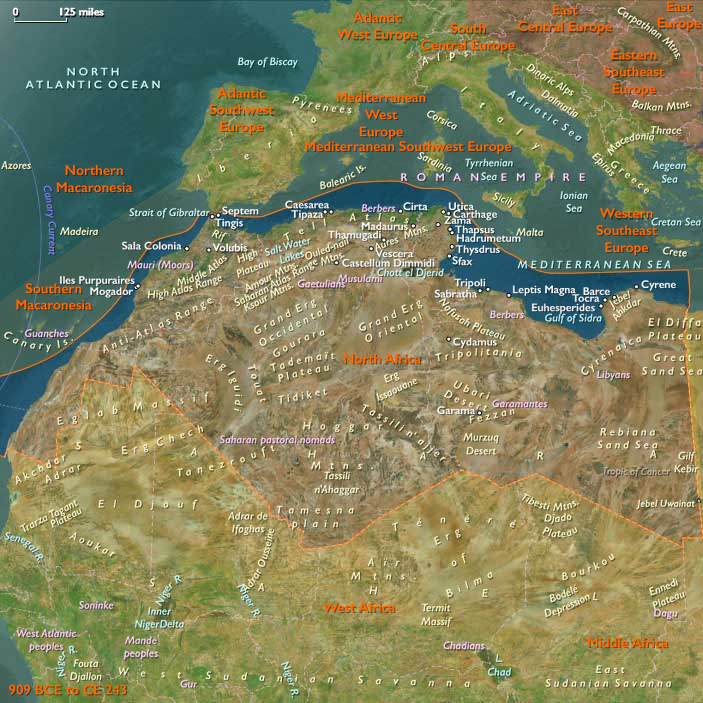
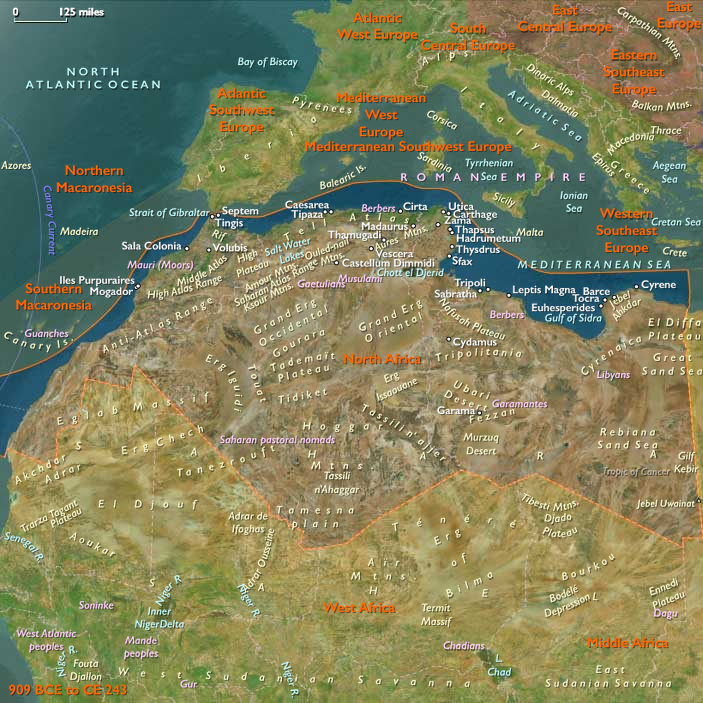
Gnaeus Domitius Ahenobarbus had taken the side of Marius in latter's civil war with Sulla.
Proscribed when Sulla obtained the supreme power in 82 BCE, Ahenobarbus had fled to Africa, where he was joined by many who were in the same condition as himself.
He has collected an army ith the assistance of the Numidian king, Hiarbas, but is defeated near Utica by Pompey, whom Sulla had sent against him, and is afterwards killed in the storming of his camp, in 81 BCE.
According to some accounts, he was executed after the battle on the orders of Pompey.
Locations
People
Groups
Topics
Commodoties
Subjects
Regions
Subregions
Related Events
Filter results
Showing 10 events out of 62751 total
The Middle East: 81–70 BCE
The Third Mithridatic War and the Rise of Parthia
Between 81 and 70 BCE, significant geopolitical shifts occur in the Middle East as Rome consolidates its dominance in the region and Parthia emerges as a significant power.
Peace is initially restored between Pontus and Rome on the orders of Lucius Cornelius Sulla, ending the Second Mithridatic War. However, stability proves fleeting, and the Third Mithridatic War (73–63 BCE) soon erupts as the last and most prolonged conflict between Mithridates VI of Pontus and his allies against the Roman Republic. The alliance formed between Mithridates VI and Quintus Sertorius, leader of the anti-Sullan faction, creates a formidable coalition capable of threatening Roman supremacy in the region.
The immediate catalyst for this war is the bequest to Rome by King Nicomedes IV of Bithynia upon his death in 74 BCE, leaving his kingdom to the Roman Republic. Exploiting the simultaneous revolt of Sertorius in Spain, Mithridates launches an offensive in Asia Minor, initially encountering minimal resistance. The Roman Senate responds by dispatching the consuls Lucius Licinius Lucullus and Marcus Aurelius Cotta. While Lucullus governs Cilicia, Cotta is assigned to Bithynia. With Rome's attention divided and its forces stretched thin—Pompey, Rome’s preeminent general, occupied in Gaul and Spain suppressing the Sertorian rebellion—Mithridates finds an opening for early successes.
Meanwhile, in Mesopotamia, the city of Hatra emerges as a significant commercial and religious center. Located strategically sixty-eight miles southwest of modern Mosul, Iraq, Hatra gains prominence as the capital of Araba, a semi-autonomous state under increasing Parthian influence, benefiting from its location along critical caravan trade routes.
In Parthia, the historical record during this period is fragmented, though the reign of King Orodes ends amidst internal strife. The subsequent succession is initially obscure until the ascent of Sanatruces around 77 BCE, stabilizing the Arsacid dynasty. The only direct reference to Orodes as king of kings is found in a Babylonian account of a lunar eclipse dated to April 11, 80 BCE.
Thus, this period, from 81 to 70 BCE, sees the continuing struggle for dominance between Rome and Pontus, the strengthening of Parthian influence in Mesopotamia, and the rise of critical regional centers such as Hatra, shaping the geopolitical landscape for future centuries.
Peace is restored between Pontus and Rome on the orders of Sulla, ending the Second Mithridatic War.
The Third Mithridatic War (73–63 BCE) is the last and longest of three Mithridatic Wars fought between Mithridates VI of Pontus and his allies and the Roman Republic.
The alliance between Mithridates VI and Quintus Sertorius, the main leader of the opposition to Sulla, joins these two threats into a unity much larger than its parts and has the serious potential of overturning Roman power.
The immediate cause of the Third War is the bequest to Rome by King Nicomedes IV of Bithynia of his kingdom upon his death in 74 BCE.
Having launched an attack at the same time as a revolt by Sertorius sweeps through the Spanish provinces, Mithridates is initially virtually unopposed.
The Senate responds by sending the consuls Lucius Licinius Lucullus and Marcus Aurelius Cotta to deal with the Pontic threat.
The only other possible general for such an important command, Pompey, is in Gaul, marching to Hispania to help crush the revolt led by Sertorius.
Lucullus is sent to govern Cilicia and Cotta to Bithynia.
Hatra, located sixty-eight miles southwest of present Mosul, Iraq, has prospered and become an important religious center because of its strategic position along caravan trade routes.
Established under the Seleucid kingdom and probably built in the third or second century BCE, Hatra rises to prominence as the capital of Araba, a small semiautonomous state under Parthian influence.
The history of Parthia is obscure during this period, but Orodes' reign seems to have ended, as it had begun, in civil war with an unknown claimant.
The name of his successor is also unknown, and it is only with the beginning of the reign of Sanatruces in about 77 BCE, that the line of Parthian rulers can again be reliably traced.
Orodes is mentioned as king of kings of the Arsacid dynasty in a Babylonian report of the lunar eclipse of April 11, 80 BCE.
Buddhist temple complexes, or chaityas, have evolved into colonnaded halls of worship housing the Buddha's image, which has become an integral part of the Buddhist temple, exemplified by the chaitya at Karli constructed in about 80.
At forty meters (one hundred and thirty feet) long and fifteen meters (forty-nine feet) in height, the Karla Caves site, cut from stone, is the largest such chaitya in India.
The aisle of the temple is flanked by thirty-seven pillars that are topped with kneeling elephants.
Near East (81–70 BCE): Increasing Roman Influence and Local Responses
Between 81 and 70 BCE, the Near East experiences further intensification of Roman political and cultural influences, as the Roman Republic actively extends its interests into Anatolia and the broader Eastern Mediterranean. Hellenistic traditions, long dominant in these regions, continue their transformation and fusion with Roman elements, reshaping urban life, governance, and cultural expressions.
Local kingdoms and city-states navigate carefully amid growing Roman dominance. Native rulers increasingly seek favor with Rome, leveraging diplomatic connections to secure their autonomy and prosperity. This era sees the rise of regional powers, particularly in Anatolia and Syria, whose leaders skillfully balance alliances and local interests to maintain stability and influence.
Roman authority solidifies further through strategic alliances and military interventions, prompting regional elites to adapt administrative and social structures to align with Roman expectations while preserving traditional practices.
Legacy of the Era
The era 81–70 BCE marks a crucial phase in the Roman Republic’s consolidation of influence in the Near East, laying the foundations for subsequent imperial dominance. The evolving blend of Roman and Hellenistic traditions during this time significantly shapes the future cultural and political landscape of the region.
Gaul’s population of possibly ten million—a mix of Celtic immigrants and invaders of past centuries mingled with the native Ligure of the Alps, Iberians of the Pyrenees, and numerous folk elsewhere who were often of Phoenician, Greek, or Roman stock—possesses neither unified rule nor homogeneous roots.
The Gallic clans sometimes function separately and sometimes form into one of over four hundred tribes, which in turn often join into one of the seventy or so nations.
The Gauls, who have no single leader or authority, and except for Marseille and Nice, no cities or towns either, mostly live in scattered mud huts generally surrounded by a stockade.
The Gauls derive their basic needs from hunting, fishing, and pastoral pursuits, sending surpluses and craftwork in wood and leather to local markets for sale or exchange.
Local Gauls are not philhellenes who want to imitate Greek culture, but peoples who selectively consume a very limited range of Greek objects (mostly wine and drinking ceramics) that they incorporate into their own cultural practices according to their own systems of value.
Gallic religious life is localized and pluralistic, with pantheistic worship of rivers, woods, and other elements of nature.
Mediterranean Southwest Europe (81–70 BCE): Civil Strife and the Sertorian and Servile Wars
The period 81–70 BCE is defined by continuing political turbulence and civil conflict within the Roman Republic, marked notably by the ambitious challenges to Sulla’s conservative constitutional order and two significant military conflicts: the Sertorian War in Iberia and the Third Servile War in Italy.
Lepidus' Rebellion (78–77 BCE)
Following Sulla's resignation from the dictatorship in 79 BCE, political tensions resurface swiftly. Marcus Aemilius Lepidus, initially a beneficiary of Sulla’s regime, positions himself against the conservative faction. Elected consul in 78 BCE with the support of the influential commander Pompey, Lepidus advocates popular reforms, including returning confiscated land to dispossessed Italians, thereby threatening Sulla’s constitutional legacy. This stance ignites conflict with his consular colleague, Quintus Lutatius Catulus, leading to armed confrontation. Lepidus marches on Rome in 77 BCE, but is decisively defeated by Catulus on the Campus Martius and retreats to exile in Sardinia, where he dies shortly thereafter.
Sertorian War (80–72 BCE)
Concurrent with internal Roman strife, the Sertorian War erupts in Iberia (80–72 BCE). Quintus Sertorius, a gifted general and charismatic leader of the Marian faction, establishes a stronghold in Hispania. Allied with local Iberian tribes, Sertorius effectively challenges Roman rule through adept guerrilla warfare, establishing a significant rival government. Despite his military successes, Sertorius is assassinated by his subordinate, Marcus Perperna, in 72 BCE. Perperna quickly falls to the military prowess of Pompey, concluding the rebellion and restoring Roman dominance over Hispania.
Third Servile War (73–71 BCE)
In Italy, the Republic faces the Third Servile War (73–71 BCE), commonly known as Spartacus’ Revolt. Initiated by the Thracian gladiator Spartacus, this uprising represents the most severe and alarming slave rebellion in Roman history, directly threatening the Italian heartland. Spartacus amasses a formidable force of escaped slaves, repeatedly defeating Roman armies dispatched to crush the insurrection. The conflict deeply unsettles the Roman political establishment and populace alike.
The Roman response crystallizes under Marcus Licinius Crassus, who mobilizes a large, disciplined force and defeats Spartacus decisively in southern Italy in 71 BCE. The revolt ends brutally, with the mass crucifixion of captured insurgents along the Appian Way, reaffirming Roman authority and sending an unmistakable warning against future rebellions.
Cultural Developments: Architectural Innovations
Amidst these conflicts, significant cultural developments continue. Notably, Roman architecture and art flourish. The Sanctuary of Fortuna Primigenia at Praeneste is significantly redeveloped, epitomizing Hellenistic influence in Roman architecture with its complex terraced design. Simultaneously, the Temple of Portunus (formerly known as the Temple of Fortuna Virilis) exemplifies the blend of Greek aesthetics and Roman innovation in temple architecture. Built around 75 BCE, this pseudoperipteral temple features Ionic columns, influencing subsequent Roman and Renaissance architecture profoundly.
Legacy of the Era
The era 81–70 BCE underscores the continuing instability of the late Republic, revealing systemic vulnerabilities in the Roman state structure. The repeated civil conflicts and rebellions indicate Rome’s susceptibility to powerful military leaders and internal dissension, setting a precedent for future political upheavals and ultimately contributing to the gradual decline of Republican governance

The Third Servile War (73–71 BCE), also called the Gladiator War and the War of Spartacus by Plutarch, is the last of a series of unrelated and unsuccessful slave rebellions against the Roman Republic, known collectively as the Roman Servile Wars.
The Third Servile War is the only one to directly threaten the Roman heartland of Italy and is doubly alarming to the Roman people due to the repeated successes of the rapidly growing band of escaped former slaves against the Roman army between 73 and 71 BCE.
The rebellion is finally crushed through the concentrated military effort of a single commander, Marcus Licinius Crassus, although the rebellion will continue to have indirect effects on Roman politics for years to come.
Marcus Aemilius Lepidus had gained wealth and power by politically allying himself with Sulla, but once the dictator resigns in 79 BCE, Lepidus attempts to undermine the Sullan constitution.
Elected consul for the year 78 BCE with the support of Pompey, he tries to stop Sulla from being buried in the Campus Martius.
However, Pompey turns against his candidate and uses his influence to ensure that the full funeral and burial goes ahead.
Lepidus passes several resolutions during his term that firmly place him in the camp of the populares.
His offer to restore land that had been taken by Sulla to the Italians puts him at odds with his fellow consul, Quintus Lutatius Catulus.
The two factions come so close to war that the senate makes them swear not to fight, and sends Lepidus to administer the province of Transalpine Gaul.
The terms of their oath do not prevent Lepidus from returning the next year with an army, so he agrees to it.
Before he leaves, he offers those Sulla had sent into exile a chance to return, a move that alarms the Senate.
They correctly judge that he is attempting to gather his allies around him to start a civil war.
Lepidus, recalled from his province, brings his army with him back to Rome, where he is defeated by Catulus in a pitched battle on the Campus Martius.
Forced into exile in Sardinia, he dies soon afterwards.