
Saudi Arabia helps found the Organization of …
Years: 1960 - 1960
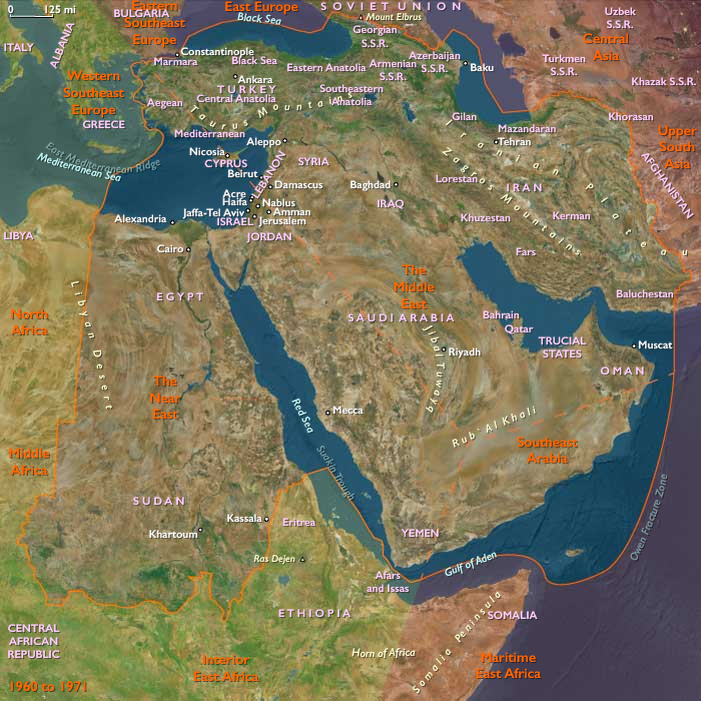
Saudi Arabia helps found the Organization of Petroleum Exporting Countries (OPEC) in September of 1960 to coordinate the petroleum policies of its members and to provide the member states with technical and economic aid.
This organization, born of exasperation, is formed in response to the oil companies having, in 1959, twice cut crude oil prices in Venezuela and the Middle East without consulting their host governments.
Faisal, more competent than his brother, has developed the ministries of government and established for the first time an efficient bureaucracy.
In December 1960, however, he is obliged to resign as prime minister and Saud himself assumes the office.
Locations
People
Groups
Topics
Commodoties
Subjects
Regions
Subregions
Related Events
Filter results
Showing 10 events out of 3698 total
Sino-Soviet relations disintegrate; Albania, alone among the European communist governments, supports the Chinese.
Moscow’s relations with the other eastern European satellites disintegrate also as Czechoslovakia revolts, Romania pursues an independent course, and Yugoslavia leads twenty-one African and Asian states in the nonaligned movement.
Similarly, the era sees the disintegration of relations between Greece and the western democracies (with the exception of the United States.)
as a military coup stifles liberal democracy in that country.
This era also sees the collapse of the elaborate power-sharing arrangements between the Greek majority and the Turkish minority on Cyprus.
Egypt's President Gamal Abdel Nasser, who champions the creation of a multi-state Arab “superpower” in the Near East, gives substance to the Arab nationalist movement known as Pan-Arabism, which smolders throughout the twentieth century.
Regime changes in Iraq and Syria, at the hands of those countries' respective branches of the Ba'th Party, which advocates the formation of a single Arab socialist nation, reinforce Nasser's aggressive posture.
The Palestinians meanwhile find a voice in the Palestinian Liberation Organization, or PLO, established under Arab League auspices.
Yasir 'Arafat's Fatah, which has merged with smaller groups to form the PLO, initiates small-scale military operations against Israel; Israel responds in kind, staging raids on Jordanian territory.
After border tensions with Egypt and Syria escalate in 1967, Israel, whose right to exist as a state has gone unrecognized by its Arab neighbors since its birth as a modern nation, abruptly launches a sneak attack on Egypt, Syria and Jordan in 1967.
Called the Six-Day War, the conflict results in an Israeli victory and the occupation of the Sinai Peninsula, the Gaza Strip, the Golan Heights and the West bank of the Jordan, Thus, the Israeli Jews, now numbering three million, come to rule some one million two hundred thousand Arabs, including the three hundred thousand already living in the State of Israel.
Egypt, in early 1969, initiates what becomes known in 1970 as the “war of attrition” against Israel.
Using heavy artillery, new MiG aircraft, Soviet advisers, and an advanced Soviet-designed surface-to-air missile system, the Egyptians inflict heavy losses on the Israelis.
Golda Meir, who had become Israel's prime minister following the sudden death of Levi Eshkol in February 1969, escalates the war by ordering massive air raids deep into Egypt.
The increased agricultural yields of the Third World’s green revolution stem from research into soil fertility and plant genetics.
Canada and Japan attempt to control narcotics in much the same manner as the United States, with much the same consequence in terms of high rates of addiction.
North Polynesia (1960–1971 CE)
Early Statehood and Economic Expansion
Following statehood in 1959, the newly formed State of Hawaii entered a period of rapid economic expansion and modernization between 1960 and 1971. Federal funding increased significantly, supporting extensive improvements in infrastructure, housing developments, and transportation networks. The islands also experienced substantial population growth, driven by domestic migration from the continental United States as well as continued international immigration.
Continued Tourism Boom and Commercial Growth
Tourism remained the cornerstone of North Polynesia's economy, reaching unprecedented levels as Hawaii’s profile as a premier global destination solidified. The introduction of commercial jet service substantially boosted tourist arrivals, particularly after the establishment of regular flights by major airlines. Landmark developments like the construction and opening of the Ala Moana Shopping Center in Honolulu in 1959—which rapidly became the world's largest open-air shopping mall—highlighted the ongoing commercial boom and development.
Environmental Awareness and Preservation Efforts
With increased economic activity came heightened awareness of the islands' environmental fragility. During this era, efforts intensified to preserve Hawaii’s unique ecosystems, natural resources, and cultural landscapes. In 1961, the establishment of the Hawaii Volcanoes National Park (formerly part of the larger Hawaii National Park) as a separate protected area underlined a growing commitment to conservation and environmental stewardship, reflecting broader environmental concerns emerging in American society.
Social Movements and Civil Rights Progress
Social movements also gained prominence during this era, particularly in advocacy for civil rights, indigenous rights, and labor conditions. Activists intensified their focus on the challenges faced by Native Hawaiians, advocating for improved access to education, economic opportunities, and land rights. Additionally, the labor movement continued its strong advocacy through influential unions, resulting in better wages, safer working conditions, and comprehensive social reforms.
Cultural Revival and Identity Affirmation
North Polynesia continued its robust cultural revival, emphasizing a renewed respect for and preservation of indigenous Hawaiian culture. Educational curricula increasingly incorporated traditional Hawaiian history, language, and cultural practices. This period witnessed heightened visibility of Hawaiian music, hula, and cultural festivals, marking a significant affirmation of identity that celebrated Polynesian heritage in contrast to earlier pressures toward Americanization.
Continued Military and Strategic Importance
The ongoing Cold War reinforced the strategic value of Hawaii and Midway Atoll within North Polynesia. Major military bases on Oahu, notably Pearl Harbor, continued as essential hubs for U.S. military operations in the Pacific, including support roles during the escalating conflict in Vietnam (1955–1975). This ongoing military significance brought sustained federal investment, though also perpetuated controversies over land use and environmental concerns.
Political Developments and Local Governance
The first decades of statehood saw growing political maturity and active local governance. Leaders of diverse ethnic backgrounds began to hold increasingly influential positions, reflecting Hawaii’s multicultural composition. The state also navigated significant governance challenges as it sought to balance rapid economic development and population growth with preservation of local resources and cultural values.
Technological Advances and Communications
Technological advancements transformed daily life and economic activity during this era. Improved telecommunications and mass media infrastructure brought the Hawaiian Islands closer to the U.S. mainland and global community. Notably, television and radio became important means for cultural expression, entertainment, education, and political dialogue, shaping local perceptions and identities.
Conclusion of the Era
The period from 1960 to 1971 in North Polynesia was characterized by dynamic growth, significant societal shifts, and increasing integration within American and global contexts. It established the foundations for future economic, cultural, and environmental development, highlighting the ongoing importance of Hawaii and the broader North Polynesian region both strategically and culturally.
According to later allegations by former CIA agent Victor Marchetti, Australia’s conservative parties, the National Country party and the Liberal party, receive covert funding from the US CIA in the late 1960s.
Red-haired Australian tennis player Rodney Laver, born in Rockhampton, Queensland in 1938, is the the only tennis player in the World to win the Grand Slam for the Australian Open, French Open and Wimbledon twice.
He does this in 1962 and 1969.
He also wins two doubles for the Grand Slam titles, and is the first tennis player to attain $1,000,000 in prize money.
The recently changed New South Wales administration, concerned to limit cost overruns on the project, fires design architect Jorn Utzon from the Sydney Opera House project.
Resembling a series of immense, wind-filled sails, the building is currently little more than a shell.
A team of government architects assumes the work of designing the interior spaces.
Maritime East Asia (1960–1971 CE): Ideological Upheaval, Economic Expansion, and Diplomatic Realignments
Between 1960 and 1971 CE, Maritime East Asia—comprising lower Primorsky Krai, the Korean Peninsula, the Japanese Archipelago south of northern Hokkaido, Taiwan, and southern, central, and northeastern China—undergoes a dramatic period marked by profound ideological upheaval, accelerated economic expansion, cultural transformation, and significant diplomatic realignments amid the backdrop of global Cold War tensions.
China: The Cultural Revolution and Internal Turmoil
Under the leadership of Mao Zedong, China plunges into the Great Proletarian Cultural Revolution (1966–1976), a decade-long political and ideological movement aimed at purging "counter-revolutionary" elements and consolidating Maoist orthodoxy. Young Red Guards, mobilized by Mao, attack perceived "bourgeois" and traditional influences, leading to widespread social disruption, persecution of intellectuals, destruction of historical artifacts, and severe damage to educational and cultural institutions.
The chaos paralyzes China's political and economic apparatus, yet solidifies Mao's control. Although the initial revolutionary zeal eventually subsides by the early 1970s, the period significantly reshapes China’s society, leaving deep scars and fundamentally altering its political trajectory.
Korea: Deepening Division, Economic Miracle in the South, Isolation in the North
The Korean Peninsula remains rigidly divided, politically and economically, between North and South. North Korea, under Kim Il-sung, adheres to rigid state-controlled economic policies emphasizing heavy industry, military strength, and self-reliance (Juche ideology), becoming increasingly isolated internationally.
Conversely, South Korea, led by authoritarian leader Park Chung-hee after a military coup (1961), begins rapid industrialization through state-directed policies, export-oriented industrial strategies, and heavy foreign investment. Park’s Five-Year Economic Plans transform South Korea into a major economic player, laying foundations for the later South Korean economic miracle (“Miracle on the Han River”), though political repression and human rights abuses accompany these achievements.
Japan: Rapid Economic Growth and Global Re-emergence
In Japan, this period is defined by unprecedented economic growth, as it fully emerges as a global economic power. The Ikeda administration’s “Income Doubling Plan” (1960–1964) dramatically accelerates economic expansion, driven by high technology industries, automotive manufacturing, electronics, and exports to Western markets.
By the late 1960s, Japan is second only to the United States in economic scale, hosting major international events like the 1964 Tokyo Olympics and 1970 Osaka World Expo—both symbols of its remarkable recovery and new status as a global economic and cultural powerhouse. Internally, political stability under the dominant Liberal Democratic Party (LDP) provides a favorable environment for sustained economic expansion.
Taiwan: Continued Economic Development and Authoritarian Rule
Under Chiang Kai-shek’s authoritarian regime, Taiwan continues its economic transformation through rapid industrialization, export-driven growth, and strategic economic planning. The development of advanced manufacturing sectors—including electronics, textiles, and petrochemicals—dramatically increases Taiwanese prosperity, earning it recognition as one of Asia’s emerging economic successes.
Despite severe political repression under continued martial law, Taiwan benefits significantly from U.S. military protection and economic support, solidifying its position within Western geopolitical alignments and laying crucial groundwork for future democratization.
Regional Diplomacy: Shifts and Realignments Amid Cold War Context
Lower East Asia also sees significant diplomatic shifts. In 1971, in a diplomatic watershed moment, the People’s Republic of China replaces the Republic of China (Taiwan) as the legitimate representative of China at the United Nations, dramatically altering international diplomatic alignments. Concurrently, Japan normalizes relations with South Korea (1965), strengthening economic cooperation. Throughout, the region remains a pivotal theater for Cold War geopolitical maneuvering.
Legacy of the Era: Transformation, Expansion, and Persistent Tensions
Between 1960 and 1971 CE, Maritime East Asia endures transformative upheaval, economic dynamism, and complex diplomatic realignment. China experiences profound ideological and social turmoil, while South Korea, Japan, and Taiwan rapidly modernize, dramatically expanding their economic influence and international roles. North Korea’s continued isolation and militarization deepen regional tensions. This dynamic period profoundly shapes East Asia’s subsequent political, economic, and diplomatic trajectories, setting lasting precedents for the region’s contemporary global significance.
After the US military presence in South Vietnam creates a local demand for No.
4 heroin, the Hong Kong narcotics networks extend their operations into Southeast Asia.
In 1968-1969, Hong Kong syndicate chemists open a cluster of No.
4 heroin laboratories along the Thai-Burma border at the epicenter of the Golden Triangle.
Controlled by the Nationalist Chinese generals in Thailand and the Commander of the Royal Lao Army, these laboratories introduce the technology that makes the Golden Triangle the world's largest heroin producer, churning out substantial quantities of 90 percent pure heroin.
Heroin use among US troops in South Vietnam, fueled by these nearly limitless supplies, reaches epidemic proportions.
The occupation of northeastern Burma by KMT irregulars, combined with the Shan secessionist revolt after 1958, transforms the Shan State into a region of conflict that reduces government control and permits a marked expansion in local opium production.
The Chinese strongmen have terrorized local villagers into growing opium for them and made the so-called Golden Triangle the world's leader in opium production.
After a joint Burma-China military operation evicts them from the Shan State in 1961, the KMT forces establishes new base camps just across the border in Thailand and from there continue to dominate the Shan State opium trade.
During their decade-long occupation of Burma's prime opium lands, the KMT had fostered a generation of local opium warlords such as Olive Yang, Lo Hsing-han, and Khun Sa who remain in Burma after the KMT departure to vie, as both antagonists and allies, for control of the local traffic.
By the early 1960s, Southeast Asia is home to much of the world's heroin production.
By the mid-1960s, the high profits of the Shan opium trade finances the formation of new armies, notably Khun Sa's Ka Kwe Ye, a local militia loyal to the Burmese government.
US involvement in Vietnam is blamed for the surge in illegal heroin being smuggled into the States.
To aid U.S. allies, the CIA establishes a charter airline, Air America, which is allegedly involved in the transport raw opium from Burma and Laos (though veteran pilots deny that this was done knowingly).
Some of the opium ends up being transported to Marseille by Corsican gangsters to be refined into heroin and shipped to the US via the so-called “French Connection”.
East Europe (1960–1971 CE): Détente, Reform Movements, and Economic Challenges
Political and Military Developments
Khrushchev Era and the Policy of Détente
This period saw significant shifts in Soviet leadership under Nikita Khrushchev, who pursued policies of détente to reduce Cold War tensions. Khrushchev advocated for peaceful coexistence with the West, although geopolitical rivalries persisted, notably during the Cuban Missile Crisis (1962).
Prague Spring and Soviet Intervention
Eastern Europe experienced significant reform movements, exemplified by the Prague Spring (1968) in Czechoslovakia, led by Alexander Dubček. The Soviet Union intervened militarily with Warsaw Pact forces to suppress these reforms, reinforcing Moscow's authority and limiting regional autonomy.
Continued Military Development
Despite détente, substantial military advancements continued, including the expansion of nuclear arsenals, development of missile technology, and conventional force modernization, ensuring strategic parity with Western powers.
Economic and Technological Developments
Economic Stagnation and Reform Attempts
Centralized economic planning faced increasing inefficiencies, leading to economic stagnation and limited consumer goods availability. Attempts at economic reforms aimed to improve productivity and living standards but yielded limited success due to structural challenges.
Technological Achievements
Significant technological milestones were achieved, especially in aerospace, highlighted by Yuri Gagarin becoming the first human in space in 1961. Scientific research and technological innovation continued to receive substantial investment, underscoring Soviet prestige.
Cultural and Artistic Developments
Cultural Thaw and Liberalization
A brief cultural thaw under Khrushchev allowed greater artistic and intellectual freedoms, though strict control resumed following the Prague Spring suppression. Nevertheless, cultural life experienced a modest diversification, reflecting broader societal aspirations.
Expanded Education and Scientific Research
Educational institutions and scientific research further expanded, with significant achievements in higher education, technical training, and scientific inquiry. These advances supported technological progress and contributed to Soviet prestige in international academic communities.
Settlement Patterns and Urban Development
Ongoing Urbanization and Infrastructure Improvements
Urban expansion continued steadily, accompanied by enhancements in housing, transportation, and public services. Efforts focused on improving urban living conditions, albeit constrained by economic limitations and planning inefficiencies.
Enhanced Military and Strategic Infrastructure
Continued investments in strategic military installations, fortified borders, and missile sites reflected ongoing security concerns and the strategic emphasis on military preparedness amid Cold War dynamics.
Social and Religious Developments
Social Reform and Limited Liberalization
Social policies experienced modest liberalization, improving living standards and social services. However, the state maintained tight control over society, with limited tolerance for dissent and continuous surveillance.
Persistent Anti-Religious Policies
Anti-religious policies continued, though with somewhat less intensity than under Stalin. Religious activities remained heavily monitored and restricted, with state-promoted atheism remaining central to ideological conformity.
Long-Term Consequences and Historical Significance
The era from 1960 to 1971 CE was characterized by fluctuating tensions, reform movements, and economic challenges within Eastern Europe. The suppression of reformist aspirations, coupled with sustained military and technological advancements, solidified Soviet authority while underscoring inherent systemic vulnerabilities. These dynamics significantly influenced the region's subsequent historical developments, laying foundations for future change.
Russian cosmonaut Yuri Gagarin becomes the first human to orbit the Earth, aboard the Vostok 1 manned spacecraft on April 12, 1961.
Following the ousting of Khrushchev in 1964, another period of collective rule ensues, until Leonid Brezhnev becomes the leader of the Soviet Union.
Years: 1960 - 1960
Locations
People
Groups
Topics
Commodoties
Subjects
Regions
Subregions