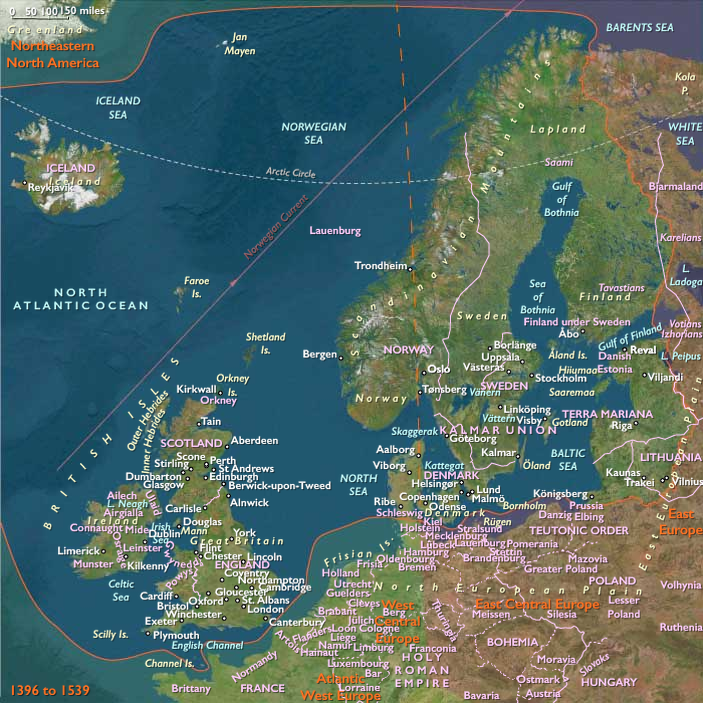
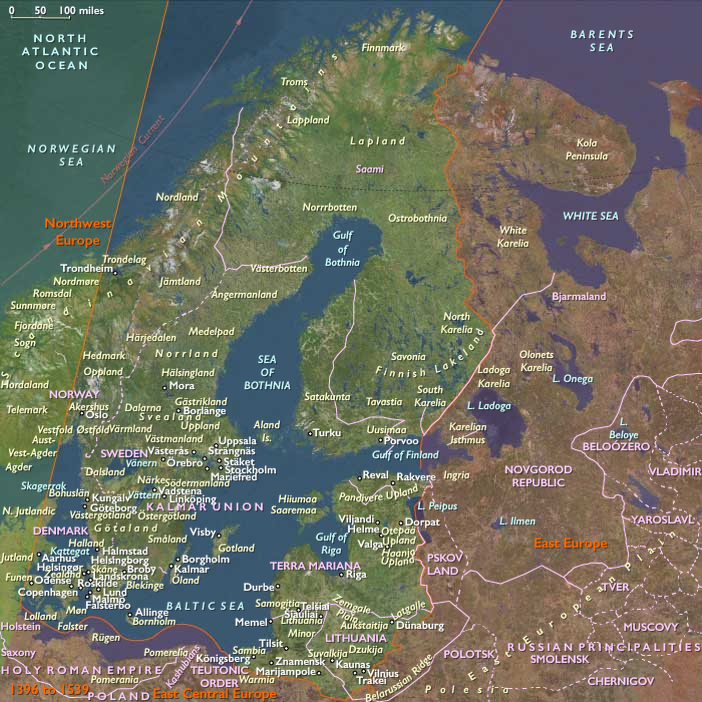
...Magnus Bengtsson, an enemy of Engelbrekt, slays …
Years: 1436 - 1436
...Magnus Bengtsson, an enemy of Engelbrekt, slays him near Örebro in May 1436.
Locations
People
Groups
- Danes (Scandinavians)
- Swedes (Scandinavians)
- Kalmar Union (of Denmark, Norway and Sweden)
- Sweden, autonomous Kingdom of
Topics
Subjects
Regions
Subregions
Related Events
Filter results
Showing 10 events out of 41900 total
The Emerald Buddha had been discovered in Chiang Rai, the former walled capital city of the independent Thai principality of Lanna in 1432, when, according to legend, an earthquake, or lightning, split the Chedi at Wat Phra Kaeo.
The beautiful green jade figure was then seen concealed within.
It is removed to Chiang Mai in 1436.
The Buddha had been dug out and the people believed the figurine to be made of emerald, hence its name.
King Sam Fang Kaen of Lannathai had wanted it in his capital, Chiang Mai, but the elephant carrying it had insisted, on three separate occasions, on going instead to Lampang.
This had been taken as a divine sign and the Emerald Buddha will stay in Lampang.
It is today considered the palladium of the Kingdom of Thailand.
When renewed war is decided upon, Engelbrekt again leads his forces against the King's forts in January 1436, taking Stockholm almost immediately.
The Swedish nobles have begun to quarrel, however, and …
The radical Täborites, their military power shattered, have become isolated following their defeat at Lipany.
Some of the victorious Utraquists continue their reform efforts; others, however, had in 1435 accepted the Compactata, in which many Hussites had agreed to a Catholic compromise on doctrine in return for being taken back into the Catholic church.
Hussite Utraquists and representatives of the Council of Basel sign a treaty at Jihlava in 1436.
Their demands largely satisfied, the Utraquists recognize Sigismund as king of Bohemia.
The rulers of Wallachia are officially vassals of the King of Hungary, as well as margraves with the responsibility of protecting commerce and trade routes from Transylvania to Wallachia for the Roman Catholic Church.
Vlad, son of Mircea cel Batran, though in favor of Catholicism, is known to have murdered members of the rival princely House of Danesti, related to his own father's House of Basarab, and gains power in Wallachia, upon returning from exile in Transylvania in 1436.
He rules as voivode Vlad II.
Isidore, a native of southern Greece who had become the abbot of St. Demetrius monastery in Constantinople and recognized for his cultured rhetoric, had been sent abroad as envoy of the emperor John VIII Palaeologus to arrange for a council to unite the Eastern and Western churches.
Unsuccessful, he returns to Constantinople and in 1436 is named patriarch of Kiev and of all Russia; his mission is to persuade Vasily to participate in the movement for reunion set by Pope Eugenius IV as the agenda for the general Council of Ferrara-Florence in Italy.
Shah Rukh installs a Timurid governor in Tabriz once more, this time Qara Iskander’s brother Jahan Shah in 1436.
Iskander marches on Tabriz but is defeated by Jahan Shah at Sufiyan to the north of the city, having been betrayed by some of his emirs.
He then flees and takes refuge in the castle of Alincak.
Jahan Shah besieges the castle, and during the siege Iskander is murdered by his own son, Shah Kubad.
Paolo Uccello, commissioned in 1436 to paint a posthumous equestrian monument of the famous English mercenary soldier Sir John Hawkwood for Florence Cathedral, creates an extraordinary fresco portraying a monumental stone statue; the pedestal is seen from below, but the horse and rider are seen from the side.
Florence’s Gothic cathedral of Santa Maria del Fiore is consecrated in 1436.
The ideal church type of the age is based on the centralized plan, admired by architects and theoreticians for its geometrical purity and clarity (and thus to heavenly order), and directly exemplified by Florentine sculptor-architect Filippo Brunelleschi's remarkable 1434 design for the first centrally planned church of the Renaissance, Florence’s vast (and still unfinished) Santa Maria degli Angeli (also called the Duomo of Florence): a domed octagon with eight radiating chapels.
His centralized plan, formed by a ring of eight piers, becomes the ideal among his Florentine contemporaries and his followers in Rome.
In 1436, he begins the church of Santo Spirito, using such traditional Italian Romanesque elements as a basilican plan, round arches, and a flat ceiling, but combines these with a new sense of proportion, the use of Corinthian columns, and a dome over the crossing of nave and transepts.
Italian polymath Leone Battista Alberti had moved in 1434 to Florence, becoming a member of the inner circle of humanists in Tuscany, among them the sculptor Donatello, and has gained recognition as an authority on art and classical literature.
He has become especially interested in the work of Brunelleschi, to whom he dedicates the Italian edition of Della pittura (On Painting), a treatise on the theory and technique of painting published in 1436, in which the author sets forth all that is currently known on the subject.
(Alberti had dedicated the 1435 Latin edition to Gian Francesco Gonzaga of Milan.)
Instability in the Lombard region caused by the political and military crisis n the beginning of the fifteenth century, coupled with the untimely death of Gian Galeazzo Visconti, had induced the teaching staff of the Universities of Pavia and Piacenza to propose to Ludovico di Savoia-Acaia the creation a of new Studium generale.
Choice of the location fell on Turin for a number of reasons: first it was at the crossroads between the Alps, Liguria and Lombardy; it was also an episcopal seat and in addition the Savoy Prince was willing to establish a university on his own land, like those in other parts of Italy.
In autumn 1404, a bull issued by Benedict XIII, the Avignon Pope, marked the actual birth of a center of higher learning, formally ratified in 1412 by the Emperor Sigmund's certification and subsequently, in 1413, by a bull issued by antipope John XXIII, the Pisan Pope, and probably by another issued in 1419 by Martin V, Pope of Rome, and by a series of papal privileges.
The new institution, which initially only held courses in civil and canon law, was authorized to confer both the academic "licentia" and "doctoratus" titles that later became a single "laurea" (degree) title.
The Bishop, as Rector of Studies, proclaimed and conferred the title on the new doctors.
The early decades are marked by discontinuity, due to epidemics and crises that plagued the region between the 1420s and the 1430s following the annexation of the Piedmont territories to the Duchy of Savoy and by difficult relations between the University and the local Public Administration.
After a series of interruptions in its activities, the university had been moved to Chieri (between 1427 and 1434) and later, in 1434, to Savigliano.
When the institution returns to Turin in 1436, Louis of Savoy, who had succeeded Amedeus VIII, introduces a new order of studies whereby the Government gains greater control over the University.
The ducal licenses of October 6, 1436 set up the three faculties of Theology, Arts and Medicine, and Law, and twenty-five lectureships or chairs.
The growth and development of the role of Turin as the subalpine capital will lead to the consolidation of the University and a stability that lasted for almost a hundred years.
(It will start to gain its modern shape after the model of University of Bologna.
During the eighteenth century, the University of Turin will become one of the most prestigious universities in Italy and a point of reference of the Italian Positivism; in the twentieth century, will be one of the centers of the Italian anti-fascism movement.
By the end of the 1990s, the local campi of Alessandria, Novara and Vercelli will become autonomous units under the new University of Eastern Piedmont.)

Alfonso, imprisoned in Milan, impresses his captor with his wide culture and persuades Visconti to release him by making it plain that it is not in Milan's interest to prevent the victory of the Aragonese party in Naples.
Years: 1436 - 1436
Locations
People
Groups
- Danes (Scandinavians)
- Swedes (Scandinavians)
- Kalmar Union (of Denmark, Norway and Sweden)
- Sweden, autonomous Kingdom of