
The Sefer ha-bahir (Hebrew: Book of Brightness …
Years: 1168 - 1179
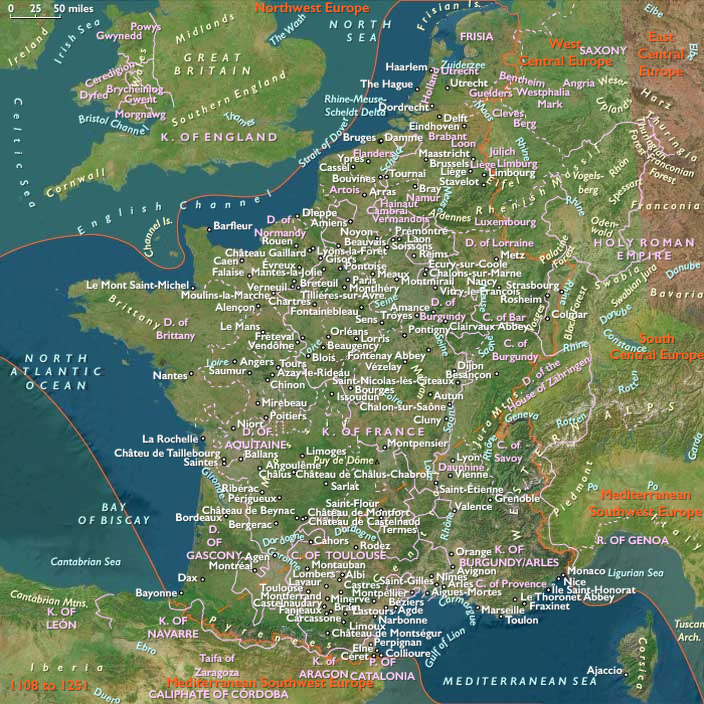
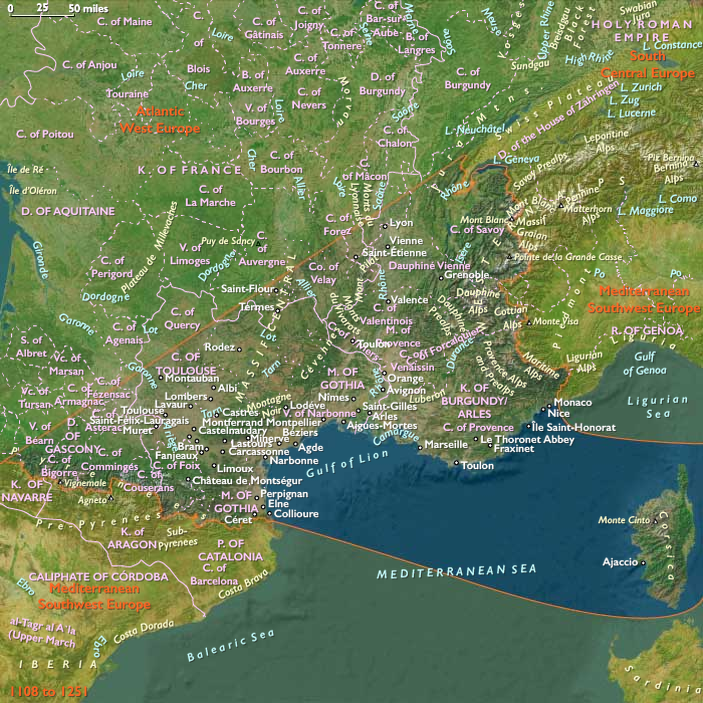
The Sefer ha-bahir (Hebrew: Book of Brightness), a largely symbolic commentary on the Old Testament, the basic motif of which is the mystical significance of the shapes and sounds of the Hebrew alphabet, appears in late twelfth-century Provence, ruled by the Spanish from Catalonia from 1113.
The influence of the Bahir on the development of Kabbala (esoteric Jewish mysticism) is profound and lasting.
Kabbalists themselves consider the book to be much older, falsely attributing its oldest traditions to Rabbi Nehunya ben Haqana, who flourished in the first century CE, and crediting many of the book's sayings to early Jewish scholars called tannaim (first to third century) and amoraim (third to sixth century).
The Bahir, although unsystematic, generally enigmatic, and written in a mixture of Hebrew and Aramaic, successfully introduces into Kabbala—and through Kabbala, into Judaism—an extensive mystical symbolism.
The Bahir, for example, contains the earliest-known explanation of the ten “divine emanations” that, in a mysterious way, are said to symbolize and explain the creation and continued existence of the universe.
These ten ma'amarot (sayings”), divided into three upper and seven lower manifestations, become widely known in Kabbala as sefirot (”numbers”).
The Bahir also introduces into Kabbalistic speculations the concept of the transmigration of souls (gilgul) and the notion of a cosmic, or spiritual, tree to symbolize the flow of divine creative power.
In addition, evil is said to be a principle found within God himself.
The last part of the book draws heavily on an ancient mystical text called Raza rabba (”The Great Mystery”).
Kabbalists view the Bahir as authoritative, whereas others reject it as heretical.
Locations
Groups
Subjects
Regions
Subregions
Years: 1168 - 1179
Locations
Groups
Subjects
Regions
Subregions