
The plague breaks out in Bremen-Verden, whose …
Years: 1712 - 1712
The plague, as in formerly Swedish Livonia and Estonia, is a main reason for the defendants' surrender.
Locations
Groups
- Bremen, Imperial Free City of
- Hamburg, Imperial Free City of
- Denmark-Norway, Kingdom of
- Bremen-Verden
Topics
Subjects
Regions
Subregions
Related Events
Filter results
Showing 10 events out of 28418 total
Engelbert Kaempfer in 1712 describes addiction to madak, the blend of opium and tobacco: "No commodity throughout the Indies is retailed with greater profit by the Batavians than opium, which [its] users cannot do without, nor can they come by it except it be brought by the ships of the Batavians from Bengal and Coromandel."
Contemporary to the plague, there is also a cattle plague in Silesia.
Vladika Danilo I leads Montenegrins in several battles against the Turks, winning a decisive, major victory at Carev Laz in Ljesanska Nahija, on July 14-28, 1712, defeating a Turkish army of between thirty thousand and forty thousand men with approximately five thousand casualties.
Crespi paints a celebrated series of canvases, the Seven Sacraments, around 1712; the series now hangs in the Gemäldegalerie, Dresden.
Originally completed for Cardinal Pietro Ottoboni in Rome, and upon his death passing to the Elector of Saxony, these imposing works are painted with a loose brushstroke, but still maintain a sober piety.
Making no use of hieratic symbols such as saints and putti, they utilize commonplace folk to illustrate sacramental activity.
The War of the Spanish Succession has raged since 1701.
France, after eleven years of war, is in a dark period, both financially and militarily.
The early victories of Marshal Villars at the Battle of Friedlingen and the Battle of Höchstadt have been followed by numerous defeats to the Allied forces, most notably the armies under Prince Eugene of Savoy and the Duke of Marlborough.
After the rout of Oudenaarde in 1708, nearly all the strongholds of northern France had come under the control of the Austro-English coalition.
There had also been an economic crisis (the winter of 1708-1709 is one of the most rigorous of the eighteenth century) leading to famine and high mortality in the populace.
The command of the French northern army had gone to Marshal Villars in 1709, who had wasted no time in seeing to its reorganization.
When the Allied campaign led by Prince Eugene and the Duke of Marlborough engaged the French at Malplaquet, Villars had been wounded and the French retreated from the field, but the Allies had suffered twice as many casualties and their campaign had soon sputtered out.
France's precarious position has been stabilized, the Allies are unable to achieve their goal of forcing harsh terms on the Bourbons, and the war continues.
Giacomo F. Maraldi of the Paris Observatory has worked from 1700 on a catalog of fixed stars, and from 1672 has studied Mars extensively.
His most famous astronomical discovery is that the ice caps on Mars are not exactly on the rotational poles of that body.
He is most known in mathematics for obtaining the angle in the rhombic dodecahedron shape in 1712, which is still called the Maraldi angle.
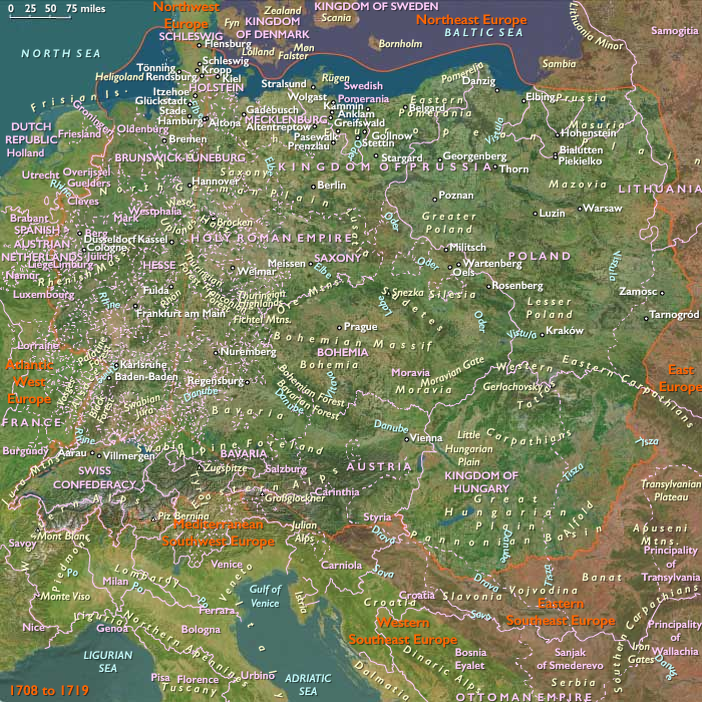
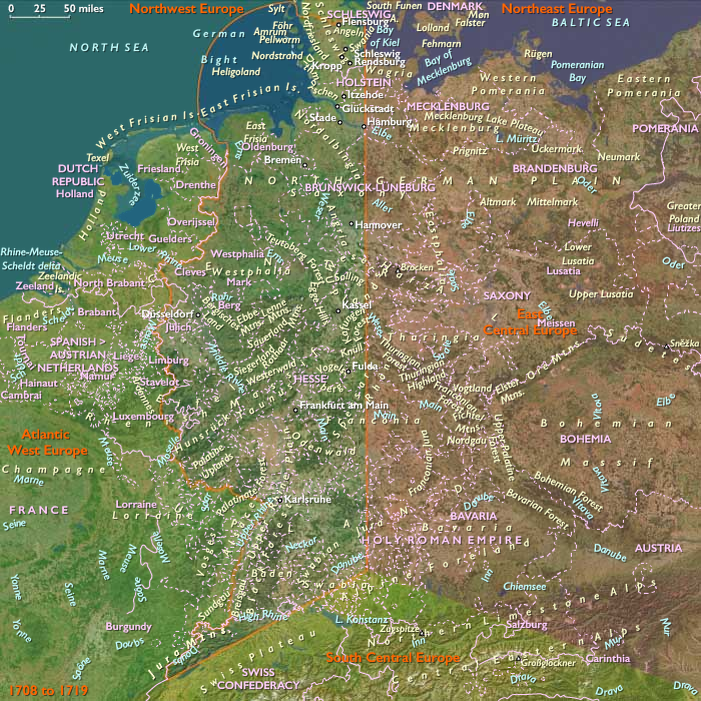
When the plague reaches Pinneberg and Rellingen just north of the Hamburg territory in the summer of 1712, Hamburg restricts travel to the town, which the Danish king uses as a pretext to encircle Hamburg with his forces and confiscate Hamburg vessels on the River Elbe, demanding five hundred thousand thalers (later reduced to two hundred and forty-six thousand thalers) to make up for this alleged discrimination against his subjects in Altona.
Twelve thousand Danish soldiers are moved before Hamburg's gates.
When the plague breaks out in Hamburg less than three weeks later, it is carried there from the Danish troops by a prostitute from Hamburg's Gerkenshof lane, where out of fifty-three people thirty-five fall ill and eighteen die.
The lane is blocked and isolated; however, the quarantine cannot prevent the disease from spreading through the densely built-up neighborhoods.
Among the dead is the plague doctor Majus, who belongs to those physicians who wear a beak-shaped mask containing a vinegar-soaked sponge to protect him against the miasma.
In December, the plague fades out.
The city council downplays the plague cases in order not to impair trade, but sets up a health commission and a pest house for quarantine measures.
Isolation of the infected does not prevent the plague from spreading into Bremen, but reduces the resulting deaths, which in 1712 are "only" fifty-six in Gröpelingen, which had a population of three hundred and sixty, and twelve in Bremen, which has a population of twenty-eight thousand.
The plague will return to Bremen in 1713, however, killing another one hundred and eighty people.
The new abbey church at Fulda, dedicated on August 15, 1712, stands on the site of the Ratgar Basilica (once the largest basilica north of the Alps), which was the burial site of Saint Boniface and the church of Fulda Abbey, functions which the new building is intended to continue.
The plans of the new church had been drawn up in 1700 by one of the greatest German Baroque architects, Johann Dientzenhofer, who had been commissioned by the Prince-Abbot Adalbert von Schleifras for the new building on the recommendation of the Pope after Dientzenhofer's study trip to Rome in 1699.
The deliberate similarity of the church's internal arrangement to that of St. Peter's Basilica in Rome is testimony to Dientzenhofer's visit.
The Ratgar Basilica has been demolished to make way for the new Baroque structure, on which construction had begun on April 23, 1704, using in part the foundations of the earlier basilica.
The shell had been completed in 1707, the roof finished in 1708, and the interior in 1712.
The dedication tablet placed on the facade by von Schleifras gives the dedication as Christus Salvator.
The atmospheric engine invented by Thomas Newcomen in 1712, today referred to as a Newcomen steam engine (or simply Newcomen engine), is the first practical device to harness the power of steam to produce mechanical work.
It is possible that the first Newcomen engine was in Cornwall.
Its location is uncertain, but it is known that one was in operation in 1715 at Wheal Vor mine.
The earliest examples for which reliable records exist are two engines in the Black Country, of which the more famous is that erected in 1712 at the Conygree Coalworks near Dudley in Worcestershire.
This is generally accepted as the first successful Newcomen engine, but it may have been preceded by one built a mile and a half east of Wolverhampton.
Both of these are used by Newcomen and his partner John Calley to pump out water-filled coal mines. (A working replica can today be seen at the nearby Black Country Living Museum, which stands on another part of what was Lord Dudley's Conygree Park.)
Soon orders from wet mines all over England are coming in, and some have suggested that word of Newcomen’s achievement had been spread through his Baptist connections.
Since Savery's patent had not yet run out, Newcomen is forced to come to an arrangement with Savery and operate under the latter's patent, as its term is much longer than any Newcomen could have easily obtained.
The patent belongs during the latter years of its currency to an unincorporated company, The Proprietors of the Invention for raising water by fire.
Years: 1712 - 1712
Locations
Groups
- Bremen, Imperial Free City of
- Hamburg, Imperial Free City of
- Denmark-Norway, Kingdom of
- Bremen-Verden
