
The kaleidoscopic coalitions of internal Greek politics …
Years: 1884 - 1884
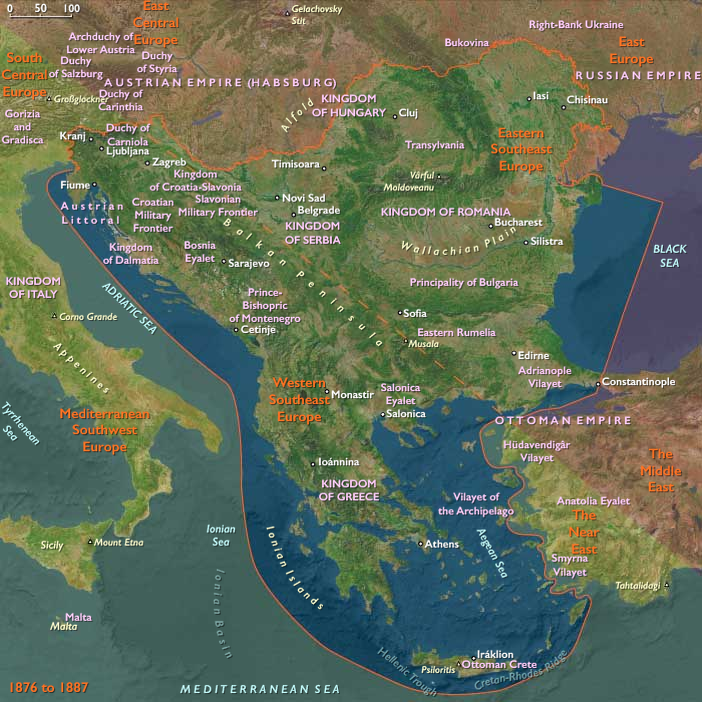
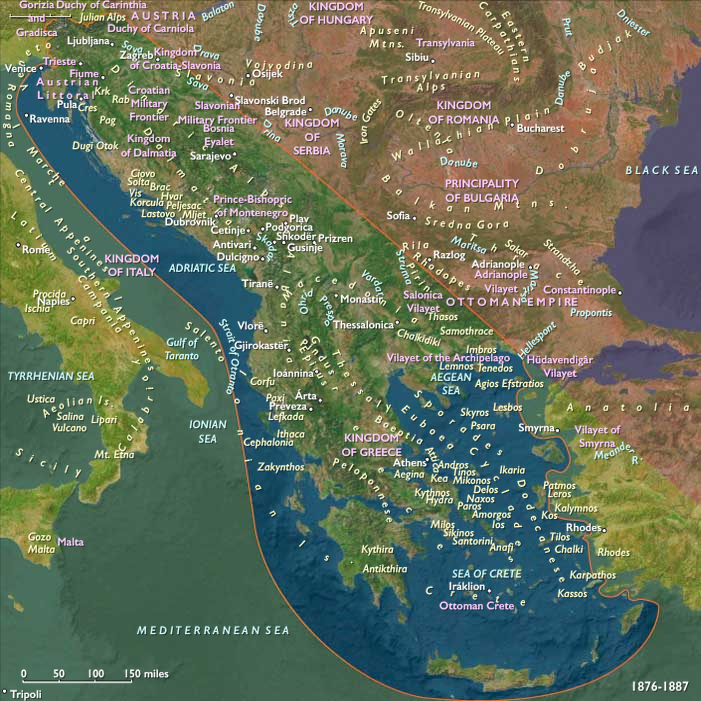
The kaleidoscopic coalitions of internal Greek politics in earlier years have given way to a two-party system, in which power alternates between two men, Charilaos Trikoupis, Prime Minister of Greece and Theodoros Deligiannis.
Trikoupis represents the modernizing, Westernizing trend in politics, while his archrival Deligiannis is a political boss in the traditional mold, whose only real program is the overturning of the reforms of Trikoupis.
Believing the modernization of the political system and economic development to be the essential preconditions of territorial expansion, Trikoupis struggles to establish Greece's credit-worthiness in international markets and encourages the country's hesitant steps in the direction of industrialization.
He also promotes infrastructural projects such as road building, railway construction, the building of the Corinth Canal, and the draining of Lake Kopaïs in Thessaly.
Such measures, however, together with Trikoupis' concurrent efforts to modernize the country's armed forces, must be paid for, and the increased taxation they entail, prove an easy target for the populist demagogue Deligiannis.
Deligiannis is able to court further popularity by advocating an aggressive policy toward the Ottoman Empire, but his belligerence is to have disastrous economic consequences.
Locations
People
Groups
- Ottoman Empire
- Montenegro, prince-bishopric of
- Russian Empire
- Austria-Hungary
- German Empire (“Second Reich”)
- Bulgaria (Ottoman vassal), Principality of
- Romania, Kingdom of
- Serbia, Kingdom of
- Britain (United Kingdom of Great Britain and Northern Ireland)
- Italy (Italian Republic)
Subjects
Regions
Subregions
Related Events
Showing 10 events out of 11131 total
Years: 1884 - 1884
Locations
People
Groups
- Ottoman Empire
- Montenegro, prince-bishopric of
- Russian Empire
- Austria-Hungary
- German Empire (“Second Reich”)
- Bulgaria (Ottoman vassal), Principality of
- Romania, Kingdom of
- Serbia, Kingdom of
- Britain (United Kingdom of Great Britain and Northern Ireland)
- Italy (Italian Republic)
Subjects
Regions
Subregions