
In Chinese mythology, the Yan emperor, Shennong, …
Years: 2925BCE - 2782BCE
In Chinese mythology, the Yan emperor, Shennong, besides having taught humans the plow and basic agriculture, and been a god of the burning wind, was sometimes said to be a progenitor or minister of Chi You; and, like him, “ox-headed, sharp-horned, bronze-foreheaded, and iron-skulled”.
One difference between mythology and science is exemplified in Chinese mythology: Shennong and Huangdi, the Yellow Emperor, were supposedly friends and fellow scholars, despite the five hundred years or seventeen or eight generations between the first Shennong and Huangdi, and that together they shared the alchemical secrets of medicine, immortality, and making gold.
According to Sima Zhen's commentary to the Shiji, he is a relative of the Yellow Emperor and is said to be a patriarch of the Chinese.
The Han Chinese regarded them both as their joint ancestors.
Shennong cannot be said to be a historical figure.
However, Shennong, individual and clan, are very important, in the history of culture—especially in regards to mythology and popular culture.
Indeed, Shennong figures extensively in historical literature.
Even Sima Qian, regarded as the father of Chinese historiography, mentions that the rulers directly preceding the Yellow Emperor were of the house, or societal group, of Shennong.
Sima Zhen, who added a prologue for the Shiji, says his surname was Jiang and proceeded to list his successors.
An older, and today evidently more globally popular reference is in the Huainanzi: this is the famous one that says how before Shennong people were sickly and wanting, starved and diseased; but, that he taught them agriculture, which he researched himself, eating hundreds of plants, indeed, in one day even consuming seventy poisons.
Shennong also features in the book popularly known in English as I Ching, in which he is referenced as coming to power at the end of house Paoxi/Fuxi, inventing a bent-wood plow, a cut-wood rake, teaching these skills to others, and establishing a noonday market.
Another reference is in the Lüshi Chunqiu, mentioning some violence concerning the rise of Shennong, and that Shennong power lasted seventeen generations.
There are various subsequent notices of Shennong.
For example, Anthony Christie's Chinese Mythology references Shennong (as Shen-nung) six times, three times with pictures, according to the 1968 index.
The most well-known work attributed to Shennong is The Divine Farmer's Herb-Root Classic—first compiled some time during the end of the Western Han Dynasty, several thousand years after Shennong existed—which lists the various medical herb, such as lingzhi, which were discovered by Shennong and given grade and rarity ratings.
This work, considered the earliest Chinese pharmacopoeia, includes three hundred and sixty-five medicines derived from minerals, plants, and animals.
Shennong is credited with identifying hundreds of medical (and poisonous) herbs by personally testing their properties, which was crucial to the development of Traditional Chinese medicine.
Legend has it that Shennong had a transparent body and thus could see the effects of different plants and herbs on himself, and that in 2737 BCE, he first tasted tea from tea leaves on burning tea twigs, which were carried up from the fire by the hot air, and landed in his cauldron of boiling water.
Venerated as the Father of Chinese medicine, Shennong is also believed to have introduced the technique of acupuncture.
Shennong is said to have played a part in the creation of the Guqin musical instrument, together with Fu Xi and the Yellow Emperor.
Groups
Topics
- Piora Oscillation ending the Neolithic Subpluvial
- Subboreal Period
- Three Sovereigns and Five Emperors Period in China
Commodoties
Subjects
- Commerce
- Performing Arts
- Environment
- Public health
- Labor and Service
- Conflict
- Faith
- Government
- Technology
- Invention
- Anthropology
- Pharmacology
- Alchemy
- Archaeology
- Mythology
Regions
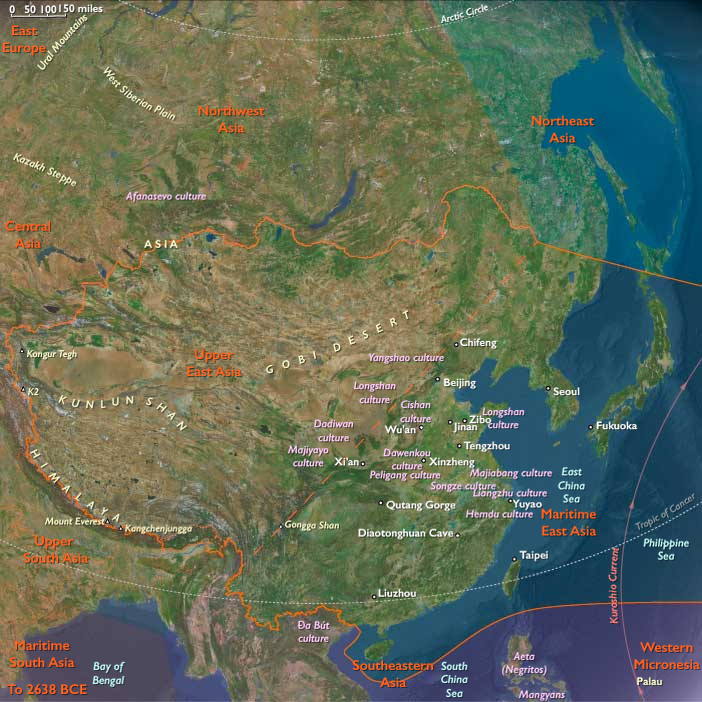
Subregions
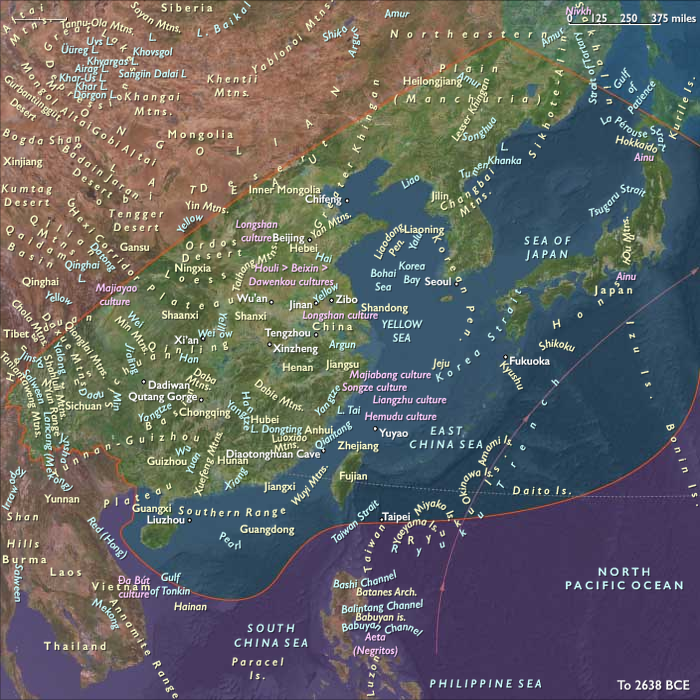
Years: 2925BCE - 2782BCE
Groups
Topics
- Piora Oscillation ending the Neolithic Subpluvial
- Subboreal Period
- Three Sovereigns and Five Emperors Period in China
Commodoties
Subjects
- Commerce
- Performing Arts
- Environment
- Public health
- Labor and Service
- Conflict
- Faith
- Government
- Technology
- Invention
- Anthropology
- Pharmacology
- Alchemy
- Archaeology
- Mythology
Regions
Subregions