
James Lind is the first to study …
Years: 1747 - 1747
James Lind is the first to study the effects of citrus fruit effect as a cure for scurvy by a systematic experiment in 1747, although he is not the first to suggest citrus fruit.
It ranks as one of the first clinical experiments in the history of medicine.
Shortly after this experiment Lind retires from the Navy and at first practices privately as a physician.
In 1753, he will publish A treatise of the scurvy, which will be virtually ignored.
Lind was born in Edinburgh, Scotland in 1716 into a family of merchants; he has an elder sister.
In 1731 he began his medical studies as an apprentice of George Langlands, a fellow of the Incorporation of Surgeons which preceded the Royal College of Surgeons of Edinburgh.
In 1739, he entered the Navy as a surgeon's mate, serving in the Mediterranean, off the coast of West Africa and in the West Indies.
By 1747 he has become surgeon of HMS Salisbury in the Channel Fleet, and conducts his experiment on scurvy while that ship is patrolling the Bay of Biscay.
Scurvy is a disease now known to be caused by a Vitamin C deficiency, but the concept of vitamins is unknown in Lind's day.
Vitamin C is necessary for the maintenance of healthy connective tissue.
In 1740 the catastrophic result of Anson's circumnavigation attracted much attention in Europe; out of nineteen hundred men, fourteen hundred had died, most of them allegedly from having contracted scurvy.
According to Lind, scurvy caused more deaths in the British fleets than French and Spanish arms.
Since antiquity in various parts of the world, and since the seventeen century in England, it had been known that citrus fruit had an antiscorbutic effect, when John Woodall (1570–1643), an English military surgeon of the British East India Company recommended them, but their use did not become widespread.
It ranks as one of the first clinical experiments in the history of medicine.
Shortly after this experiment Lind retires from the Navy and at first practices privately as a physician.
In 1753, he will publish A treatise of the scurvy, which will be virtually ignored.
Lind was born in Edinburgh, Scotland in 1716 into a family of merchants; he has an elder sister.
In 1731 he began his medical studies as an apprentice of George Langlands, a fellow of the Incorporation of Surgeons which preceded the Royal College of Surgeons of Edinburgh.
In 1739, he entered the Navy as a surgeon's mate, serving in the Mediterranean, off the coast of West Africa and in the West Indies.
By 1747 he has become surgeon of HMS Salisbury in the Channel Fleet, and conducts his experiment on scurvy while that ship is patrolling the Bay of Biscay.
Scurvy is a disease now known to be caused by a Vitamin C deficiency, but the concept of vitamins is unknown in Lind's day.
Vitamin C is necessary for the maintenance of healthy connective tissue.
In 1740 the catastrophic result of Anson's circumnavigation attracted much attention in Europe; out of nineteen hundred men, fourteen hundred had died, most of them allegedly from having contracted scurvy.
According to Lind, scurvy caused more deaths in the British fleets than French and Spanish arms.
Since antiquity in various parts of the world, and since the seventeen century in England, it had been known that citrus fruit had an antiscorbutic effect, when John Woodall (1570–1643), an English military surgeon of the British East India Company recommended them, but their use did not become widespread.
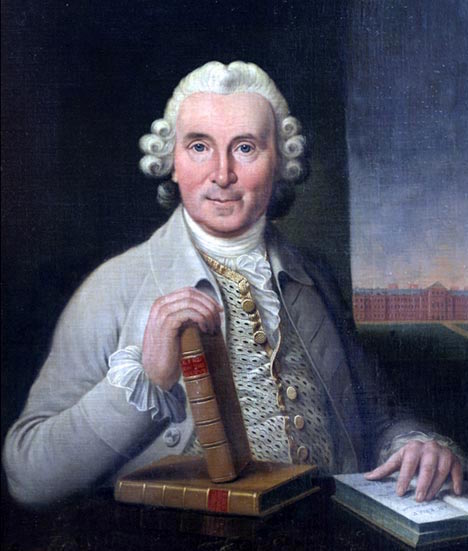
James Lind (Unknown date) Sir George Chalmers, c 1720-1791
Locations
People
Groups
- Austria, Archduchy of
- Netherlands, United Provinces of the (Dutch Republic)
- France, (Bourbon) Kingdom of
- Spain, Bourbon Kingdom of
- Britain, Kingdom of Great
Topics
Subjects
Regions
Subregions
Related Events
Showing 10 events out of 27058 total
Years: 1747 - 1747
James Lind (Unknown date) Sir George Chalmers, c 1720-1791
Locations
People
Groups
- Austria, Archduchy of
- Netherlands, United Provinces of the (Dutch Republic)
- France, (Bourbon) Kingdom of
- Spain, Bourbon Kingdom of
- Britain, Kingdom of Great
Topics
Subjects
Regions
Subregions