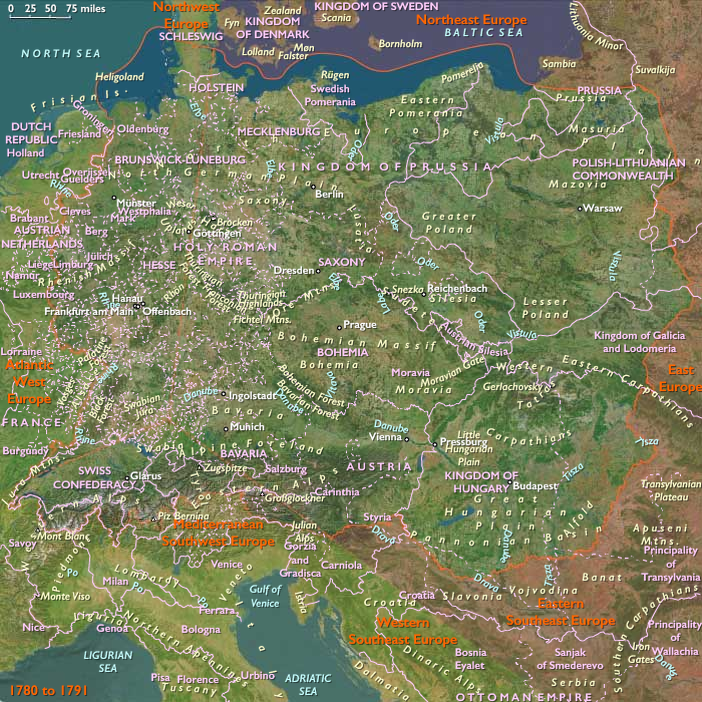
The Frankists, or Zoharists, in Bohemia-Moravia outwardly …
Years: 1780 - 1791
The Frankists, or Zoharists, in Bohemia-Moravia outwardly remain Jews, although they are antirabbinical.
The crisis posed by Frankism does not discredit Kabbala, but it leads the spiritual authorities of Judaism to watch over and severely curtail its spread and to exercise rigorous ideological control, by concrete acts of censorship and repression, over anyone, even a person of tested piety and recognized knowledge, who is suspected of Sabbatean sympathies or of messianic pretensions.
Locations
Groups
Topics
Subjects
Regions
Subregions
Related Events
Filter results
Showing 10 events out of 25141 total
Northeast Asia (1780–1791 CE)
Expansion of Russian Influence and Maritime Commerce
From 1780 to 1791, Russian maritime exploration and commercial activities in Northeast Asia accelerated further, consolidating Russian presence and administrative control. Fur traders and explorers expanded their voyages throughout the Aleutian Islands, reaching further into Alaskan territories, and intensifying interactions with indigenous peoples. The resulting trade networks significantly impacted local economies, often exploiting indigenous labor and resources.
The strategic port of Okhotsk continued to serve as the main logistical hub despite its inherent disadvantages, including harsh climate conditions, limited agricultural productivity, and challenging terrain. Nevertheless, it remained critical for the supply and provisioning of distant Russian settlements and fur-trading expeditions throughout the region.
Ships typically stopped at the Commander Islands during the early decades of the maritime fur trade, largely to slaughter and preserve the meat of Steller's sea cows, whose range was limited to those islands. This large sirenian mammal had been discovered in 1741 by German naturalist Georg Wilhelm Steller, who was traveling with Vitus Bering. The species, driven rapidly to extinction by overhunting, was completely wiped out by 1768, underscoring the ecological strain placed on local wildlife by European traders.
The continued exploitation of natural resources placed increasing ecological strain on local wildlife populations, particularly the prized sea otters, fur seals, and various fox species, further altering the ecological balance of the region.
This period also saw remarkable intercultural encounters. In 1787, the Japanese castaway Daikokuya Kōdayū and eight other survivors, stranded for five years in the Aleutian Islands, reached Kamchatka after sailing a driftwood craft for a month and a half. Initially disbelieved by Russian officials, their story eventually gained recognition through the writings of French diplomat Barthélemy de Lesseps.
Meanwhile, French explorer Jean François de Galaup, comte de Lapérouse, explored the Northeast Asian coast, reaching the island of Oku-Yeso (modern-day Sakhalin Island), where the indigenous Ainu people provided crucial geographic information. Lapérouse then sailed through what became known as La Pérouse Strait (between Sakhalin and Hokkaidō), further charting the area and interacting with additional Ainu communities in the Kuril Islands. He reached Petropavlovsk on the Kamchatka Peninsula in September 1787, where he enjoyed Russian hospitality. Lapérouse's expedition would later dispatch Barthélemy de Lesseps on a significant overland journey across Siberia and Russia to carry expedition records back to France.
Russian officials during this period began to emphasize a more structured administrative presence, establishing fortified outposts and trading posts to reinforce control over fur-rich territories. These outposts became key nodes in Russia’s expanding Pacific trade, with furs transported inland to be exchanged primarily at the Chinese border trading town of Kyakhta, maintaining a steady flow of luxury goods and profits.
This era laid a significant foundation for the sustained Russian presence in Northeast Asia and set the stage for deeper engagement and eventual settlement efforts in subsequent decades.
Although Russian fur hunters had established temporary shore stations in Alaska earlier, they intend the Three Saints site to be a permanent colonial settlement.
The site is poorly chosen, for the hillside above the shore area is too steep to build on, and the shore area is too small for a substantial settlement.
When it is visited in 1790, it is described as a cluster of small structures (probably barabaras), with a population of about fifty men and a small number of women.
The site is harmed by subsidence and a probable tsunami in the wake of a 1788 earthquake.
In 1791 Alexander Baranov begins moving the main Russian settlement to the site of Paul's Harbor, now known as the city of Kodiak.
The Tây Sons will spend the 1780s consolidating their control over the former Nguyen territory.
Nguyen Ánh proves to be a stubborn enemy, having convinced the King of Siam, P'ya Taksin, to invade Vietnam in support of him.
The Siamese army attacks in 1780, but in several years of warfare is unable to defeat the Tây Son army, as gains are followed by losses.
The Siamese king is killed in 1782 in a revolt, and Nguyen Ánh's forces are driven out of Vietnam less than a year later.
Nguyen Huệ, having vanquished the Nguyen for the time being, decides to destroy the power of the Trịnh.
He marches north at the head of a large army in 1786, and after a short campaign, defeats the Trịnh army.
The Trịnh are also unpopular and the Tây Son army seems invincible.
The Trịnh clan flees north into China.
Huệ marries Lê Ngọc Hân, the daughter of the nominal Lê Emperor, Lê Hiển Tông.
The Lê Emperor, realizing that his hope of retaining power has gone, flees north a few months later to the Qing Empire, where he formally petitions the Qianlong Emperor for aid.
Qianlong agrees to restore Lê Chiêu Thống to power, and in 1788, a large Qing army marches south into Vietnam and captures the capital Thăng Long (present Hanoi).
Nguyen Huệ gathers a new army and prepares to fight the Qing army.
He addresses his troops before the battle saying: “The Qing have invaded our country and occupied the capital city, Thăng Long. In our history, the Trưng Sisters fought against the Han, Đinh Tiên Hoàng against the Song, Trần Hưng Đạo against the Mongol Yuan, and Lê Lợi against the Ming. These heroes did not resign themselves to standing by and seeing the invaders plunder our country; they inspired the people to fight for a just cause and drive out the aggressors... The Qing, forgetting what happened to the Song, Yuan and Ming, have invaded our country. We are going to drive them out of our territory.”
Nguyễn Huệ's army defeats the Qing in a surprise attack at the Battle of Đống Đa while the army is celebrating the Lunar New Year, and forces them, along with Lê Chiêu Thống, to flee to Qing-controlled China.
Nguyen Huệ has won the battle, but eventually submits himself as a vassal of the Qing Empire and agrees to pay annual tribute.
Siamese King Rama I, a facile administrator who ascends the throne in 1782 after deposing Taksin, spearheads a Thai literary renaissance, personally rewriting and revising classic literary works.
The Tajiks had been part of the Uzbek emirate of Bukhara, established in 1500 by a branch of the Shaybanid dynasty, which had won control of Transoxania from the Timurids in the late fifteenth and early sixteenh centuries.
The Shaybanids at Bukhara had been replaced successively by the Janid Dynasty (Astrakhanids or Ashtarkhanids) in 1599, and the Manghit, or Mangit, in 1785.
Power in southern Central Asia has already shifted to three energetic Uzbek tribal formations by the time the Ashtarkhanid dynasty is finally extinguished in 1785.
Chief among these is the khanate of Bukhara, which includes the cities of Bukhara and ...East Europe (1780–1791 CE): Enlightened Absolutism and Geopolitical Expansion
Political and Military Developments
Strengthened Absolutist Rule
Between 1780 and 1791 CE, Russia further embraced enlightened absolutism, strengthening centralized rule under the influence of Enlightenment philosophies. The monarchy promoted administrative efficiency, rational governance, and legal reforms to modernize the state apparatus.
Continued Territorial Expansion
Russia continued its territorial expansion, notably in Eastern Europe and around the Black Sea region, consolidating previous gains from earlier conflicts and strategic diplomacy. Military successes reinforced Russia’s geopolitical influence and regional dominance.
Diplomatic Engagement and Alliances
Active diplomacy persisted, with Russia securing strategic alliances and exerting substantial influence in European affairs. Diplomatic achievements during this era further elevated Russia's international prominence and diplomatic strength.
Economic and Technological Developments
Ongoing Economic Prosperity
Economic prosperity continued robustly, bolstered by further industrialization, agricultural development, and expansive trade networks. Increased production supported both domestic stability and military expenditures.
Technological Innovation and Infrastructure
Russia saw substantial advancements in technological innovation, particularly in infrastructure and military engineering. Continued improvements in transportation networks and fortifications greatly enhanced administrative efficiency and security.
Cultural and Artistic Developments
Cultural Patronage and European Influence
Elite patronage of culture and the arts remained vibrant, promoting significant architectural, artistic, and literary achievements. European cultural influences continued to enrich Russia’s cultural expressions and sophistication.
Intellectual Growth and Educational Advances
The intellectual environment continued to flourish, with ongoing expansion of educational institutions and scholarly activities. Interaction with European intellectual currents further enriched Russia’s academic landscape.
Settlement Patterns and Urban Development
Continued Urban Development
Major urban centers, especially Saint Petersburg and Moscow, experienced sustained growth and modernization, driven by strategic urban planning, improved infrastructure, and increased administrative capabilities.
Enhanced Defensive Measures
Urban and regional fortifications were continuously upgraded, ensuring robust defense and regional stability, vital for securing economic and administrative centers from external threats.
Social and Religious Developments
Social Integration and Stability
Social cohesion continued to strengthen, driven by inclusive policies that accommodated diverse ethnic groups and regions. Enlightenment-inspired social reforms enhanced societal harmony and administrative effectiveness.
Evolution of Church-State Relations
Relations between the Orthodox Church and the Russian state evolved further, with ongoing reforms designed to align religious institutions with state objectives. These adjustments significantly reshaped the societal role and influence of the Church.
Long-Term Consequences and Historical Significance
The period from 1780 to 1791 CE marked significant advances in enlightened absolutism, territorial expansion, and cultural development. These achievements reinforced Russia’s growing international prominence, setting critical foundations for future stability, prosperity, and imperial strength.

Novorossiya, literally New Russia, formed as a new imperial province of Russia (Novorosiiskaia guberniia) in 1764 from military frontier regions along with parts of the southern Hetmanate in preparation for war with the Ottomans, is further expanded by the annexation of the Zaporozhian Sich in 1775.
The region is settled by Ukrainians and Russians after the annexation of Crimea by the Russian Empire in 1783.
Despite promises in the Treaty of Pereyaslav, the Ukrainian elite and the Cossacks never receive the freedoms and the autonomy they are expecting.
However, within the Empire, Ukrainians rise to the highest Russian state and church offices.
At a later period, tsarists establish a policy of Russification, suppressing the use of the Ukrainian language in print and in public
The Pugachev Uprising bolsters Catherine's determination to reorganize Russia's provincial administration.
In 1775 she divides Russia into provinces and districts according to population statistics.
She then gives each province an expanded administrative, police, and judicial apparatus.
Nobles no longer are required to serve the central government, as they have since Peter the Great's time, and many of them receive significant roles in administering provincial governments.
Catherine also attempts to organize society into well-defined social groups, or estates.
In 1785 she issues charters to nobles and townsmen.
The Charter to the Nobility confirms the liberation of the nobles from compulsory service and gives them rights that not even the autocracy can infringe upon.
The Charter to the Towns proves to be complicated and ultimately less successful than the one issued to the nobles.
Failure to issue a similar charter to state peasants, or to ameliorate the conditions of serfdom, makes Catherine's social reforms incomplete.
The intellectual westernization of Russia's elite continues during Catherine's reign.
An increase in the number of books and periodicals also brings forth intellectual debates and social criticism.
In 1790 Aleksandr Radishchev publishes his Journey from St. Petersburg to Moscow, a fierce attack on serfdom and the autocracy.
Catherine, already frightened by the French Revolution, has Radishchev arrested and banished to Siberia.
Radishchev is later recognized as the father of Russian radicalism.