
The increasing push of settlement in Australia, …
Years: 1880 - 1880
The increasing push of settlement in Australia, increased police efficiency, improvements in rail transport and communications technology, such as telegraphy, have made it increasingly difficult for bushrangers to evade capture.
Among the last bushrangers are the Kelly Gang, led by Ned Kelly, who are captured at Glenrowan in 1880, two years after they are outlawed.
Kelly was born in Victoria to an Irish convict father, and as a young man he had clashed with the Victoria Police.
Following an incident at his home in 1878, police parties had searched for him in the bush.
After he had killed three policemen, the colony had proclaimed Kelly and his gang—his two brothers and two friends—wanted outlaws.
Their subsequent seizure of a sheep station, robbery of two banks and capture of a hotel, ends in a final violent confrontation with police place at Glenrowan on June 28, 1880.
All but Ned die in the battle; dressed in homemade plate metal armor and helmet, he is captured, sent to jail, and hanged for murder at Old Melbourne Gaol in November 1880.
His daring and notoriety make him an iconic figure in Australian history, folklore, literature, art and film.
Some bushrangers, most notably Ned Kelly in his Jerilderie Letter, and in his final raid on Glenrowan, explicitly represent themselves as political rebels.
Attitudes to Kelly, by far the most well-known bushranger, exemplify the ambivalent views of Australians regarding bushranging.
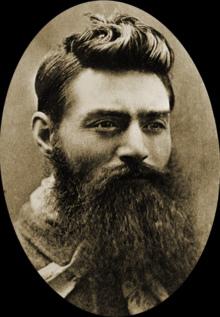
Ned Kelly the day before his execution (National Archives of Austrailia)
Locations
People
Groups
Topics
Commodoties
Subjects
Regions
Subregions
Related Events
Showing 10 events out of 11486 total
Years: 1880 - 1880
Ned Kelly the day before his execution (National Archives of Austrailia)
Locations
People
Groups
Topics
Commodoties
Subjects
Regions
Subregions