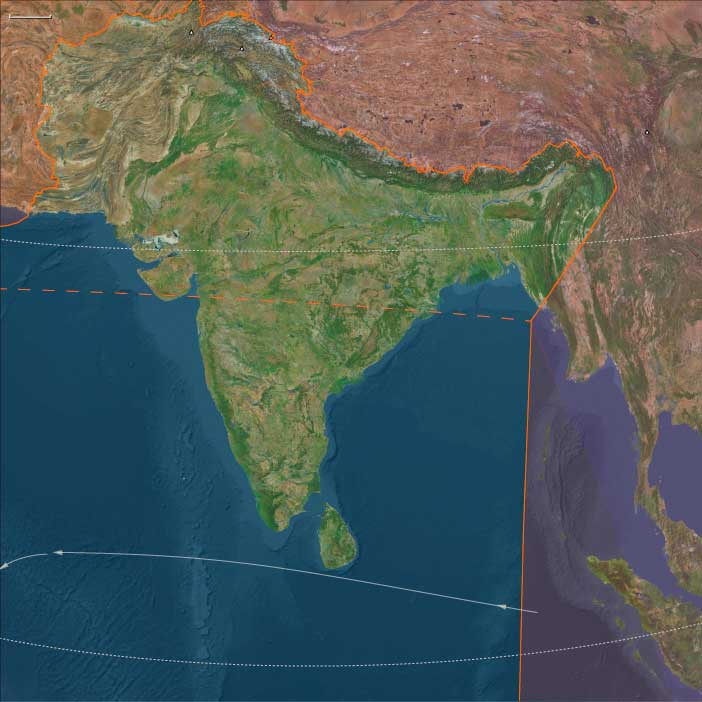
In an effort to gain support in …
Years: 1964 - 1964
In an effort to gain support in the conflict with India, Pakistan somewhat modifies its pro-Western policy after 1963.
It establishes closer relations with Communist countries, especially with China, takes a neutral position on some international issues, and joins the Regional Co-operation for Development Program of Southwest Asian nations.
Locations
Groups
Topics
Commodoties
Subjects
Regions
Related Events
Filter results
Showing 10 events out of 3355 total
Following his father's death, when he was 21, Rupert Murdoch had returned from Oxford to take charge of the family business News Limited, which had been established in 1923.
Murdoch, having turned its newspaper, Adelaide News, its main asset, into a major success, had begun to direct his attention to acquisition and expansion, buying the troubled Sunday Times in Perth, Western Australia in 1956 and over the next few years acquiring suburban and provincial newspapers in New South Wales, Queensland, Victoria and the Northern Territory, including the Sydney afternoon tabloid, The Daily Mirror, in 1960.
The Economist describes Murdoch as "inventing the modern tabloid" as he develops a pattern for his newspapers, increasing sports and scandal coverage and adopting eye-catching headlines.
Murdoch's first foray outside Australia involves the purchase of a controlling interest in the New Zealand daily The Dominion.
In January 1964, while touring New Zealand with friends in a rented Morris Minor after sailing across the Tasman Sea, Murdoch had read of a takeover bid for the Wellington paper by the British-based Canadian newspaper magnate, Lord Thomson of Fleet.
On the spur of the moment, he launched a counter-bid.
A four-way battle for control ensued in which the 32 year old Murdoch was ultimately successful.
Murdoch establishes Australia’s first national newspaper, The Australian, in 1964, based first in Canberra and later in Sydney.

By 1964, Laos has seen a succession of rightist goverments, each falling more or less annually to another CIA-sponsored coup.
The puppet government installed by the 1964 coup freezes the Pathet Lao out of the electoral process.
North Vietnam, reacting to the CIA-sponsored sabotage and assassination teams operating from Laotian territory, increases aid to the Pathet Lao.
The Chinese government explodes its first nuclear bomb in 1964.
Johnson escalates US involvement in South Vietnam’s war against the Communist nationalists backed by the North.
The American CIA collaborates with related intelligence agencies to fabricate a fraudulent attack by North Vietnam in the Tonkin Gulf.
LBJ’s adminstrtion uses the phony Tonkin Gulf Incident as a pretext for escalating what quickly becomes the Second Indochinese War.
The US, in 1964, inititates the CIA-run precursor to the Phoenix assassination program in South Vietnam, targeting for torture or death anyone with influence in the South’s parallel resistance government, including mayors, doctors, teachers and tax collectors, some of whom are dropped from helicopters after torture and interrogation.
China, in 1964, challenges Russia for leadership of the communist bloc nations.
Saudi Arabia's dissident elements support Faysal, and in March 1964 all powers are transferred to him as viceroy of the kingdom.
Finally, on November 2, 1964, King Sa'ud is formally deposed and Faysal is proclaimed king.
Four months later, ...
Omanis are generally not allowed to leave the country and those who do are seldom allowed to return.
The sultan, his only contacts with the outside world British advisers and Muscat's merchant families, permits the latter to establish enormously lucrative monopolies for the import of goods that he sees as crucial to his country's survival.
In exchange, the merchants stay out of politics and import nothing that the sultan regards as progressive or Western, including radios, books, and eyeglasses.
Aside from the few wealthy merchants whose customs receipts provide the sultan with most of the country's income, the majority of the Omanis rely upon agriculture and fishing.
Meanwhile, the oil concession provides export income that the sultan refuses to spend.
Elsewhere, the Al Bu Sa'id rule over Zanzibar ends with independence in 1964.
Indian Prime minister Jawaharwal Nehru dies in 1964; his powers pass to the five chief ministers known as the Syndicate and Lal Bahadur Shastri becomes President.
Zahir Shah asserts his power through the liberal constitution of 1964, which establishes a constitutional monarchy and prohibits royal relatives from holding public office.
The constitution also calls for the establishment of an independent Supreme Court.
The National Assembly approves the new constitution, under which the House of the People is to have 216 elected members, and the House of the Elders is to have 84 members, one-third elected by the people, one-third appointed by the king, and one-third elected indirectly by new provincial assemblies.
The Ba'thists in Syria are soon faced with a serious problem.
Although their party in Syria is led by Syrians, it also promotes Pan-Arabism and has branches in Iraq, Lebanon, and Jordan.
The continued subordination of the Syrian branch of the party to the Pan-Arab central committee gives non-Syrian Ba'thists a say in Syrian affairs.
As a result, the Syrian Ba'thists establish their own Pan-Arab central committee, thereby creating a deadly rivalry with the Iraqi Ba'thists, as each claims to be the legitimate leader of the Pan-Arab nationalist cause.
In 1964, a Soviet team led by Georgi N, Flerov at the Joint Institute for Nuclear Research in Dubna, Russia, bombards plutonium-242 with ions of neon-22.
Claiming to have obtained an isotope of element 104 that had a mass number of 260 and a half-life of 0.3 second, they announce the discovery of element 104, as 104-260, and suggest the name kurchatovium to honor Soviet nuclear physics pioneer Igor Kurchatov.
The Soviet team then performs a series of chemical experiments with the isotope to demonstrate that it behaves in a manner that had been predicted for the element.
When Dubna researchers later use a more refined measuring technique, however, they find that the half-life of the isotope is 0.1 second, not 0.3 second as originally reported.
This finding throws doubt on the previous chemical experiments, because the results of those experiments could not have been obtained with atoms having a half-life of 0.1 second.