
Atlantic Southwest Europe (388–531 CE): Transformation from …
Years: 388 - 531
Atlantic Southwest Europe (388–531 CE): Transformation from Roman Province to Early Medieval Society
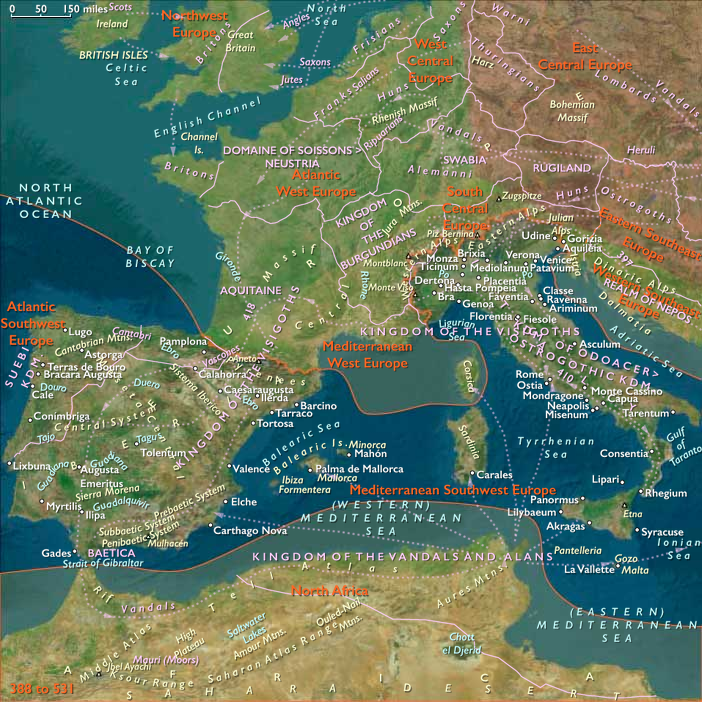
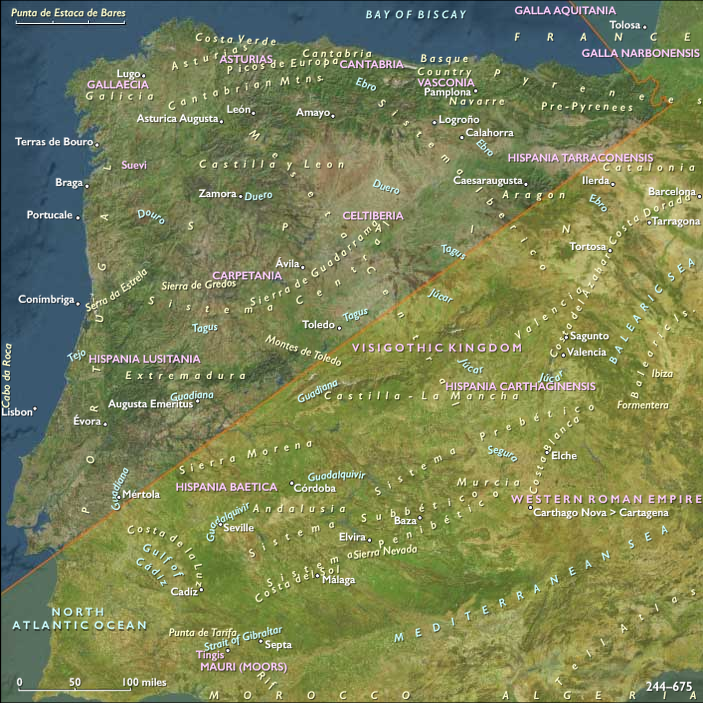
Between 388 and 531 CE, Atlantic Southwest Europe—encompassing northern and central Portugal, Galicia, Asturias, Cantabria, and northern Spain south of the Franco-Spanish border (43.05548° N, 1.22924° W)—experienced profound transformation. Beginning with the late Roman Empire's gradual decline, the region transitioned through Germanic incursions, the establishment and consolidation of the Suebic Kingdom, Visigothic influences, and finally stabilized into an early medieval society characterized by regional autonomy, localized governance, resilient economies, and institutionalized Christianity.
Political and Military Developments
Collapse of Roman Authority and Germanic Settlement (388–411 CE)
-
Roman administrative structures steadily eroded following Emperor Theodosius I’s reign (d. 395 CE).
-
From 409 CE, the arrival of Germanic tribes (Suebi, Vandals, Alans) dramatically reshaped regional politics, with the Suebi establishing permanent settlements in Gallaecia (Galicia and northern Portugal).
Consolidation and Peak of Suebic Power (412–459 CE)
-
The Suebic Kingdom expanded and consolidated under kings Hermeric, Rechila, and Rechiar, reaching peak territorial control around 450 CE.
-
After King Rechiar’s defeat by the Visigoths in 456 CE, the Suebic Kingdom fractured but soon reorganized under new leadership, maintaining autonomy in Galicia and northern Portugal.
Visigothic Influence and Suebic Stability (460–495 CE)
-
Visigothic influence in Iberia intensified following the Battle of Órbigo (456 CE), though direct control over Atlantic Southwest Europe remained indirect.
-
The Suebi regained political stability under King Remismund (r. c. 464–469 CE), and later Veremund (469–508 CE), managing effective diplomatic relations with Visigothic neighbors and maintaining political autonomy.
Post-Visigothic Realignment and Suebic Autonomy (496–531 CE)
-
Following the Visigothic defeat at the Battle of Vouillé (507 CE), Visigothic political attention shifted southward to Toledo, further enhancing Suebic independence.
-
Under Theodemund (r. c. 508–550 CE), the Suebic Kingdom enjoyed sustained political stability, marking a definitive establishment of the region’s early medieval political structures.
Economic Developments
Resilient Local Economies and Ruralization
-
Despite political shifts, regional economies remained robust, centered on agriculture (grain, olives, vineyards), mining (silver, gold), livestock, and local manufacturing (pottery, textiles, metalwork).
-
Coastal settlements such as Olissipo (Lisbon) and Bracara Augusta (Braga) maintained moderate trade networks, though increasingly localized.
Villa-Based Economy and Early Feudal Structures
-
Rural fortified estates (villae) became dominant economic units, managed by local aristocrats and ecclesiastical leaders, clearly anticipating medieval feudal economies.
-
Major urban centers (Bracara Augusta, Emerita Augusta, and Asturica Augusta) retained administrative and ecclesiastical significance, though gradually eclipsed economically by rural estates.
Cultural and Religious Developments
Institutionalization of Christianity
-
Christianity solidified its position as the region’s dominant cultural and social force, with influential bishoprics (Braga, Emerita Augusta, Asturica Augusta) guiding local governance and community life.
-
Monastic communities grew significantly, becoming central to education, social welfare, agricultural innovation, and cultural preservation.
Arianism versus Chalcedonian Christianity
-
The Germanic Suebi initially embraced Arian Christianity, a doctrine emphasizing the subordinate nature of Christ relative to God the Father, creating significant religious distinctions with the local Romanized Iberian populations who adhered predominantly to Chalcedonian (Nicene) Christianity.
-
These theological differences initially fostered cultural and political tensions. However, over time, the Suebi began to shift towards Chalcedonian orthodoxy, gradually diminishing the religious divide. This religious integration significantly facilitated the blending of Germanic and Iberian cultures and strengthened ecclesiastical authority, culminating regionally in the later widespread adoption of Chalcedonian Christianity in the late 6th century.
Cultural Integration and Syncretism
-
The region saw extensive integration between Germanic settlers and Romanized Iberian, Celtic, and indigenous populations, resulting in distinctive cultural identities marked by rich syncretism.
-
Rural communities maintained unique forms of Christianity mixed with traditional indigenous beliefs, particularly in Galicia, Asturias, and northern Portugal.
Civic Identity and Governance
-
Civic identities became deeply localized, defined by religious affiliations, tribal traditions, and local governance rather than distant Roman or royal authorities.
-
Powerful local elites, bishops, and tribal leaders governed autonomously, establishing enduring regional identities and decentralized political structures.
Notable Tribal Groups and Settlements
-
Suebi: Central to the region’s political transformation, establishing a durable medieval kingdom in Galicia and northern Portugal.
-
Lusitanians, Vettones, Vaccaei: Maintained regional autonomy through skillful local governance and strategic diplomacy.
-
Gallaeci, Astures, Cantabri: Retained resilient indigenous traditions and local governance structures, pragmatically adapting to external influences.
-
Vascones: Remained autonomous and neutral, culturally distinctive, and politically independent, largely insulated from regional upheavals.
Long-Term Significance and Legacy
Between 388 and 531 CE, Atlantic Southwest Europe:
-
Transitioned decisively from Roman provincial systems into autonomous medieval polities, particularly evident in the consolidation of the Suebic Kingdom.
-
Established resilient villa-based economies and decentralized governance structures, directly shaping medieval feudal societies.
-
Deeply entrenched Christianity’s institutional influence, including the initial Arian–Chalcedonian divide, fundamentally shaping the region’s medieval cultural and social identities.
This transformative period laid enduring foundations for medieval Atlantic Southwest Europe, setting the stage for the region’s distinct historical, cultural, and political trajectory throughout the Middle Ages.
People
Groups
- Vascones
- Lusitanians, or Lusitani
- Vettones
- Cantabri (Celtic tribe)
- Astures (Celtic tribe)
- Gallaeci
- Vaccaei
- Alans (Sarmatian tribal grouping)
- Vandals (East Germanic tribe)
- Lusitania (Roman province)
- Suebi (Suevi), Realms of the
- Gallaecia (Roman province)
- Christianity, Arian
- Christianity, Nicene
- Roman Empire, Western (Ravenna)
- Suebic Kingdom of Galicia
- Visigothic Kingdom of Toulouse
- Vandals and the Alans, Kingdom of the
- Christianity, Chalcedonian
- Visigothic Kingdom of Spain
Topics
Commodoties
Subjects
Regions
Subregions
Years: 388 - 531
People
Groups
- Vascones
- Lusitanians, or Lusitani
- Vettones
- Cantabri (Celtic tribe)
- Astures (Celtic tribe)
- Gallaeci
- Vaccaei
- Alans (Sarmatian tribal grouping)
- Vandals (East Germanic tribe)
- Lusitania (Roman province)
- Suebi (Suevi), Realms of the
- Gallaecia (Roman province)
- Christianity, Arian
- Christianity, Nicene
- Roman Empire, Western (Ravenna)
- Suebic Kingdom of Galicia
- Visigothic Kingdom of Toulouse
- Vandals and the Alans, Kingdom of the
- Christianity, Chalcedonian
- Visigothic Kingdom of Spain
Topics
Commodoties
Subjects
Regions
Subregions