Qatar joins its five Arab gulf neighbors …
Years: 1981 - 1981
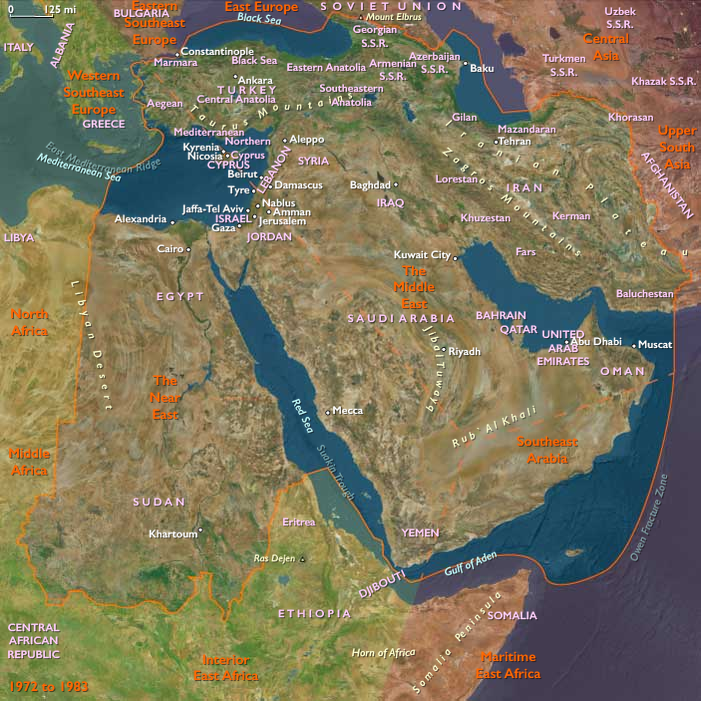
Qatar joins its five Arab gulf neighbors in 1981 in establishing the Gulf Cooperation Council, an alliance formed to promote economic cooperation and enhance both internal security and external defense against the threats generated by the Islamic revolution in Iran and the Iran-Iraq War.
Unable to support a large military establishment, Qatar relies on small but mobile force of 12,000 that can deter border incursions.
Nevertheless, the Iran-Iraq War brings attacks on shipping just beyond its territorial waters, underscoring its vulnerability to interference with oil shipments and vital imports.
Locations
Groups
Subjects
Regions
Subregions
Related Events
Filter results
Showing 10 events out of 1823 total
Bill Gates designs Microsoft DOS in 1981 as the IBM PC operating system.
In February, 1981, Brierley, AMOIL and MIM Holdings begin a joint goldmining operation.
MIM’s major shareholder is ASARCO (US) whose chairman, Barber, is also a director of Chase Manhattan Bank.
South British and New Zeanand Insurance merge.
Fletcher and UEB Chairman Papps sell their hotel operations to a Singaporian interest closely associated with the Pritzker family, owners of the Hyatt Hotel chain.
Pritzker family attorney and Hyatt Hotels Director Burton Kanter, who helps arrange the deal, is reportedly an old family friend of Paul Helliwell (the CIA paymaster for the failed bay of Pigs invasion) and has allegedly helped the Pritzker family create tax shelters using the CIA-linked Mercantile Trust and the Castle Bank, allegedly set up by Halliwell for processing funds from Onassis amnd Hughes operations.
Other alleged clients of these banks include Richard Nixon, Bebe Rebozo, Robert Vesco, and the Teamsters Union.
Brierley allegedly calls a secret March 12, 1981 meeting in Auckland including Jones, Fletcher, Hawkins, Papps and Burton Kanter to discuss transfer of the Fletcher Challenge and UEB hotel operations to the Pritzker family’s Singapore company.
On July 20, 1981, Parsky, Colny, Brierley and Seldon allegedly meet in Sydney with two new members, Kerry Packer and Alan Bond.
Chase Manhattan and Security pacific Bank are supposedly to acquire 60 percent of Packer’s company, with the stock being held in Australia, and 35 percent of Bond’s compnay, with the stock to be held in Hong Kong.
Gulf Oil, using Brierley, seemingly consolidates its hold on New Zealand’s resources in August 1981.
Cue Energy is launched, with Lawrey and Gunn as principles.
New Zealand Oil and Gas (NZOG) is launched with strategic positions held by Brierley, Jones and Renouf with licenses in PPD 38206 and 38204, both adjacent to Hunt’s Great South Basin discovery.
NZOG also reportedly controls 80 million tons of coal through the Pike River Coal Company.
Brierley-controlled Wellington Gas, Christchurch Gas, Auckland and Hawkes Bay Gas and Dual Fuel Systems (Australasia) dominates the vehicle gas conversion market.
Liquigas Limited, controlled by Shell/BP/Todd and Fletcher Challenge, is created to distribute LP gas.
In February, 1981, Brierley, AMOIL and MIM Holdings begin a joint gold mining operation.
MIM’s major shareholder is ASARCO (US) whose chairman, Barber, is also a director of Chase Manhattan Bank.
South British and New Zealand Insurance merge.
Fletcher and UEB Chairman Papps sell their hotel operations to a Singaporean interest closely associated with the Pritzker family, owners of the Hyatt Hotel chain.
Pritzker family attorney and Hyatt Hotels Director Burton Kanter, who helps arrange the deal, is reportedly an old family friend of Paul Halliwell (the CIA paymaster for the failed bay of Pigs invasion) and has allegedly helped the Pritzker family create tax shelters using the CIA-linked Mercantile Trust and the Castle Bank, allegedly set up by Halliwell for processing funds from Onassis and Hughes operations.
Other alleged clients of these banks include Richard Nixon, Bebe Rebozo, Robert Vesco, and the Teamsters Union.
Brierley allegedly calls a secret March 12, 1981 meeting in Auckland including Jones, Fletcher, Hawkins, Papps and Burton Kanter to discuss transfer of the Fletcher Challenge and UEB hotel operations to the Pritzker family’s Singapore company.
On July 20, 1981, Parsky, Colny, Brierley and Seldon allegedly meet in Sydney with two new members, Kerry Packer and Alan Bond.
Chase Manhattan and Security pacific Bank are supposedly to acquire 60 percent of Packer’s company, with the stock being held in Australia, and 35 percent of Bond’s company, with the stock to be held in Hong Kong.
Gulf Oil, using Brierley, seemingly consolidates its hold on New Zealand’s resources in August 1981.
Cue Energy is launched, with Lawrey and Gunn as principles.
New Zealand Oil and Gas (NZOG) is launched with strategic positions held by Brierley, Jones and Renouf with licenses in PPD 38206 and 38204, both adjacent to Hunt’s Great South Basin discovery.
NZOG also reportedly controls 80 million tons of coal through the Pike River Coal Company.
Brierley-controlled Wellington Gas, Christchurch Gas, Auckland and Hawkes Bay Gas and Dual Fuel Systems (Australasia) dominates the vehicle gas conversion market.
Liquigas Limited, controlled by Shell/BP/Todd and Fletcher Challenge, is created to distribute LP gas.
Australian poet and novelist Judith Wright’s 1981 novel “Cry For the Dead: treats the effects of European colonization on the Aborigines.
Australian filmmaker George Miller scores international success with 1981’s “Road Warrior,” a nightmare vision of post-apocalyptic Australia.

The United States sends a delegation to Saudi Arabia headed by Joint Chiefs of Staff General David Jones on September 28th, 1981, following Iran's initial victories over Iraq in the war that began in 1980, and the occupation of part of the Basra area by Iranian troops.
Jones reportedly conveys to the Saudis that the turn of the war has raised concerns in Washington that the House of Sa'ud may fall.
Crown Prince Fahd and his nephew Prince Bandar bin Sultan Bin Abdul Aziz, a son of Defense Minister Sultan bin Abdul Aziz and former fighter pilot educated in America and Britain, welcome the American delegation at Dhahran Airport.
The 32-year-old Bandar, whose relationship with the US begins under President Jimmy Carter's administration, during which he formed strong ties with administration officials Hamilton Jordan and Robert Strauss, is then promoted to the position of commander of a squadron of jet fighters.
Bandar is eventually able to convince the US government to supply Saudi Arabia with American-manned AWACS radar planes, after first working to assure a reluctant Congress that the planes would not in any way be used against Israel.
Promoted by the royal family to the position of ambassador to the US, Bandar reportedly acts as an intermediary between Iraq and CIA director William Casey so that Iraq can obtain highly classified troop information about Iranian troop movements during the war.
Kuwait, Bahrain, Saudi Arabia, Qatar, Oman, and the UAE form the Gulf Cooperation Council (GCC), established to promote economic, political, and security cooperation among its members in 1981, partly in response to concerns over external threats.
Fighting from the Iran-Iraq War breaks out within a few miles of the emirates' coast when Iran and Iraq begin to attack tankers in the Persian Gulf.
The intensity of such threats moves the emirates to join with Oman, Qatar, Saudi Arabia, Bahrain, and Kuwait in 1981 to form the Gulf Cooperation Council (GCC) to provide for regional defense and coordinate policy on trade and economic issues.
Sheikh Zayid ibn Sultan al-Nahyan of Abu Dhabi is elected president of the United Arab Emirates for a third successive five-year term.
On May 9, 1981, Pakistani officials estimate the number of Afghan refugees in Pakistan at 2 million.
Banner Party dominance is broadened again in June when Karmal, retaining his other offices, resigns as prime minister and is succeeded by Keshtmand.
On August 22, Egyptian President Anwar al-Sadat states in a US television interview that the US has been buying old Soviet-made arms from Egypt and sending them to rebels fighting Soviet forces in Afghanistan.
On February 6, 1981, the PPP-officially "defunct," as are the other parties-and several other parties join to form the Movement for the Restoration of Democracy.
Its demands are simple: an end to martial law and free elections, to be held under the suspended 1973 constitution.
When the Quetta High Court rules that this order is beyond the power of the martial law regime, the Provisional Constitutional Order of 1981 is issued, providing a framework for government under martial law.
This order requires all judges of the Supreme Court and high courts to take new oaths in which they swear to act in accordance with the orders.
Several judges refuse to do so and resign.
Zia's introduction of state collection of zakat has been strongly protested by the Shia, and after they demonstrate in Islamabad, the rules are modified in 1981 for Shia adherents.
The North-West Frontier Province Agricultural University is established in Peshawar in 1981.
By 1981, Pakistani laboratories, with the Sicilian Mafia as their intermediaries, supply over 60 percent of the US heroin demand, and an even greater proportion of Europe's market.
(Source: The Politics of Heroin: CIA Complicity in the Global Drug Trade; Opium)