
Abu Dhabi settles its longstanding boundary dispute …
Years: 1974 - 1974
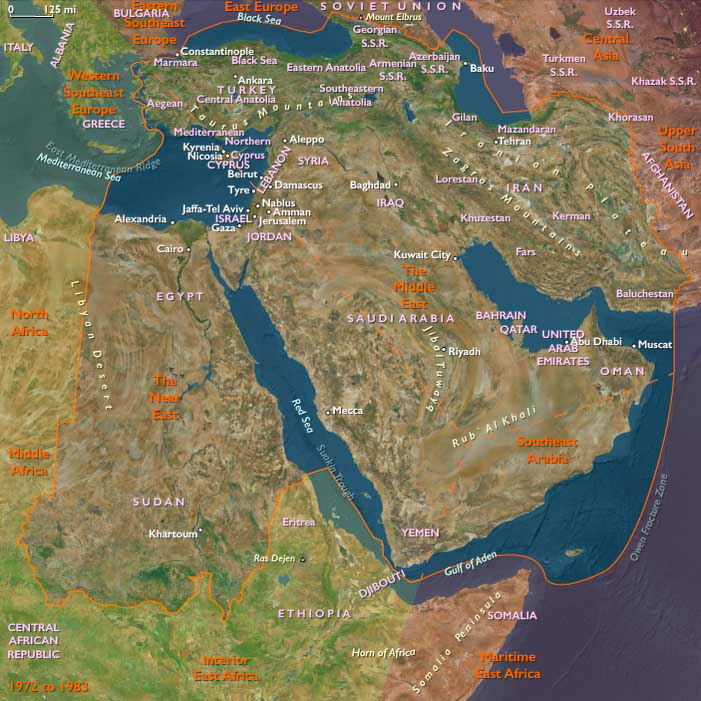
Abu Dhabi settles its longstanding boundary dispute with Saudi Arabia in 1974
Locations
Groups
Regions
Subregions
Related Events
Filter results
Showing 10 events out of 2280 total
In an alleged February 26, 1974 meeting, Michael Hand meets Bob Jones to implement plans for CIA spying operations on France, Chile, West Germany and Israel.
Jones allegedly uses Brierly/Jones to purchase a building at Willeston Street which is to be rented to France and Chile; and another at Plimmer Steps to be rented to West Germany and Israel.
The CIA is allegedly to set up eavesdropping systems inside the Willeston Street building and another at 163 The Terrace, both linked with equipment installed in the Plimmer Steps buiding and run by four CIA technicians.
In April, 1974, New Zealand Finance Minister Wallace Edward Rowling appoints Ron Trotter to the Overseas Investment Commision, whose chairman.
G. Lau, is also a member of the Todd Foundation (Shell/BP/Todd) investment board.
National party conservative Robert David Muldoon leads the opposition in New Zealand’s parliament.
Kirk begins preparation of the Petroleum Amendment Bill to give New Zealand more control over its oil resources.
Kirk has evidently discovered the secret information about the oil resources of the Great South Basin—oil reserves of at least 20 billion barrels and gas reserves estimated to be 30 times bigger than Kapuni.
Announcement of this vast new petroleum source—enough oil and gas to keep New Zealand self-sufficient for decades—would undoubtedly mean a decline in world oil prices.
As the North Sea operations are about to come on line, the world can certainly wait to exploit New Zealand’s reserves.
Kirk dies at age 51 on August 31, 1974.
Some sources attribute the cause of death to a secretly-administered lethal dose of sodium morphate.
Rowling replaces him; his first act as prime minister is to withdraw Kirk’s Anti-Monopoly Bill and the Petroleum Amendment Bill.
The New Hebrides Bank—Commercial Pacific Trust Co. (COMPAC) is established February 17, 1974.
Member banks include CBA, Europacific Finance Corporation, Trustee Executors and Agency Co., Fuji Bank, Toronto Dominion Bank, European Asian Bank and United California Bank.
In an alleged February 26, 1974 meeting, Michael Hand meets Bob Jones to implement plans for CIA spying operations on France, Chile, West Germany and Israel.
Jones allegedly uses Brierley/Jones to purchase a building at Willeston Street which is to be rented to France and Chile; and another at Plimmer Steps to be rented to West Germany and Israel.
The CIA is allegedly to set up eavesdropping systems inside the Willeston Street building and another at 163 The Terrace, both linked with equipment installed in the Plimmer Steps building and run by four CIA technicians.
In April, 1974, New Zealand Finance Minister Wallace Edward Rowling appoints Ron Trotter to the Overseas Investment Commission, whose chairman.
G. Lau, is also a member of the Todd Foundation (Shell/BP/Todd) investment board.
The British crown appoints intelligence veteran John Robert Kerr as governor general of Australia in 1974.
National party conservative Robert David Muldoon leads the opposition in New Zealand’s parliament.
Whitlam refuses to waive restrictions on overseas borrowing to finance the Alwest Aluminum Corporation owned by Rupert Murdoch, BFP and R. J. Reynolds.
Kirk begins preparation of the Petroleum Amendment Bill to give New Zealand more control over its oil resources.
Kirk has evidently discovered the secret information about the oil resources of the Great South Basin—oil reserves of at least 20 billion barrels and gas reserves estimated to be 30 times bigger than Kapuni.
Announcement of this vast new petroleum source—enough oil and gas to keep New Zealand self-sufficient for decades—would undoubtedly mean a decline in world oil prices.
As the North Sea operations are about to come on line, the world can certainly wait to exploit New Zealand’s reserves.
Kirk dies at age 51 on August 31, 1974.
Some sources attribute the cause of death to a secretly administered lethal dose of sodium morphate.
Rowling replaces him; his first act as prime minister is to withdraw Kirk’s Anti-Monopoly Bill and the Petroleum Amendment Bill.
Whitlam allegedly plans to ensure that all corporation operating in Australia are at least 50 percent Australian-owned, an act which would interfere with the putative Big Oil plan to construct three oil refineries at Cape Northumberland in South Australia to process the Great South Basin resources.
On October 6, 1974, the CIA and ASIA allegedly commence a joint bugging operation planned by William Colby and implemented by Ray Cline to oust Whitlam; the Nugan Hand Bank supposedly finances payoffs to Malcolm Fraser and other pro-US politicians while Rupert Murdoch supposedly uses his newspapers and television network to spread disinformation.
In December, 1974, Ray Cline allegedly funnels a payoff of US$200,000 to Australian Governor-General John Robert Kerr through his account number 767748 at the Singapore branch of the Nugan Hand Bank.
The Nixon administration, concerned about rising Southeast Asian heroin seizures, sends a firebreak team of 30 Drug Enforcement Administration agents to Bangkok in 1973-1974 to cut the flow.
Armed with a financial war chest that includes $12 million in narcotics assistance funds, the Bangkok DEA seconds a branch of the Thai police to its service and soon begins making substantial seizures of US-bound heroin.
(Source: The Politics of Heroin: CIA Complicity in the Global Drug Trade; Opium)
In 1974, Hong Kong Police break the Ng Sik-ho syndicate, disrupting the colony's export operations.
(Source: The Politics of Heroin: CIA Complicity in the Global Drug Trade; Opium)
The Al Buraymi oasis issue is resolved with Saudi Arabia and UAE in 1974; Oman receives three of nine villages in the region.
Increasing numbers of foreigners have come to reside in Oman, particularly in the capital, Muscat, since 1970.
These include Western businesspeople, as well as government advisers, army officers, and laborers from the Indian subcontinent, the Philippines, and other Asian countries.
Oman also develops closer relations with the United States during the 1970s.
A backer of the Camp David peace accords, Oman is one of the few Arab states that does not sever relations with Egypt after it signs a peace agreement with Israel.
Oman's offshore boundary with Iran in the Strait of Hormuz is delineated by treaty in 1974.
UNESCO names Herat as one of the first cities to be designated as a part of the world's cultural heritage.
Daud Khan attempts to introduce socioeconomic reforms, to write a new constitution, and to effect a gradual movement away from the socialist ideals his regime initially espouses; he begins to oust suspected opponents from his government.
Afghanistan broadens and intensifies its relationships with other Muslim countries, trying to move away from its dependency on the Soviet Union and the United States.
In February 1974, Afghanistan signs a trade agreement with Iran.
In May, the national flag's vertical tricolor of black, red, and green changes to a horizontal format, with the lower half a solid green, and the upper half divided into two equal bands of black and red.
The arms, in gold, feature a stylized eagle surrounded by a wreath.
Burhanuddin Rabbani, born in 1940 in Faizabad, the capital of Badakhshan province, receives his B.
A. in theology from Kabul University in 1963.
He obtains his M. A. in the same field of study from Al-Azhar University in Cairo in 1968 and, after completing his studies, begins teaching at Kabul University, where he forms a close association with the Islamic movement and its founders.
A lecturer at the sharia (Islamic law) faculty, he is active in organizing university students against the secular policies and the leftist movements.
In 1972, he succeeds Ghulam Mohammad Niazi as the leader of the Jami'at-e Islami Party, a predominately organization that develops as the dominant party in the Persian-speaking areas of northeastern and western Afghanistan.
Gulbuddin Hekmatyar, born in 1947 in Konduz province, attends the school of engineering for two years in Kabul University, becoming involved in Afghan politics while a student there.
He becomes a member of the Muslim Youth in 1970 and is imprisoned in 1972-73, having begun his political career as a student who throws acid in the faces of women who did not wear veils.
Ahmad Shah Mas'ud (also spelled Masoud, Masood, or Massoud), born in 1953 in Panjshir, attends Kabul's Polytechnic Institute for over a year.
Abdur Rab Rasool Sayyaf, born in 1946 Paghman, Kabul Province, joins the Islamic student movement and in 1971 becomes Rabbani's deputy.
Following Mohammad Daud's coup in 1973, the Afghanistan government begins cracking down on Islamic radicals.
Hekmatyar, Rabbani, Mas'ud, and others flee to Pakistan, where they seek the Pakistani government's support against Daud's regime.
The Afghanistan government imprisons Rasool Sayyaf for anti-social activities.
Bhutto recognizes Bangladesh in February 1974, before the start of a world Islamic summit conference in Lahore.
A 1974 constitutional amendment declares the Ahmadiyah community to be non-Muslims.
(The Organization of the Islamic Conference (OIC), based in Jiddah, Saudi Arabia, issues a similar declaration.)
Bhutto's program appears to be laudable but falls short in performance.
His near-monopoly of decision-making power prevents democratic institutions from taking root, and his overreaching ambitions manage in time to antagonize all but his closest friends.
His most visible success is in the international arena, where he employs his diplomatic skills.
He builds new links between Pakistan and the oil-exporting Islamic countries to the west, and generally is effective in repairing Pakistan's image in the aftermath of the war.
China's new diplomatic influence in the UN is also exerted on Pakistan's behalf, which gives Pakistan new flexibility in its international relationships.
Relations with India are, at best, strained under Bhutto.
He accomplishes the return of the prisoners of war through the Simla Agreement of 1972, but no settlement of the important problem of Kashmir is possible beyond an agreement that any settlement should be peaceful.
The nuclear issue is of critical importance to both Pakistan and India.
Bhutto reacts strongly to the detonation of a nuclear "device" by India in 1974 and says that Pakistan must develop its own "Islamic bomb," pledging that Pakistan will match India's development even if Pakistanis have to "eat grass" to cover the cost.
A series of nationalization measures instituted between 1972 and 1974 alter the balance between the public and private sectors of the economy in favor of the former.
Previously, and unlike most other developing countries, Pakistan had regarded the private sector as the leading sector of the economy.
Years: 1974 - 1974
Locations
Groups
Regions
Subregions