Abu Dhabi grants an oil concession to …
Years: 1939 - 1939
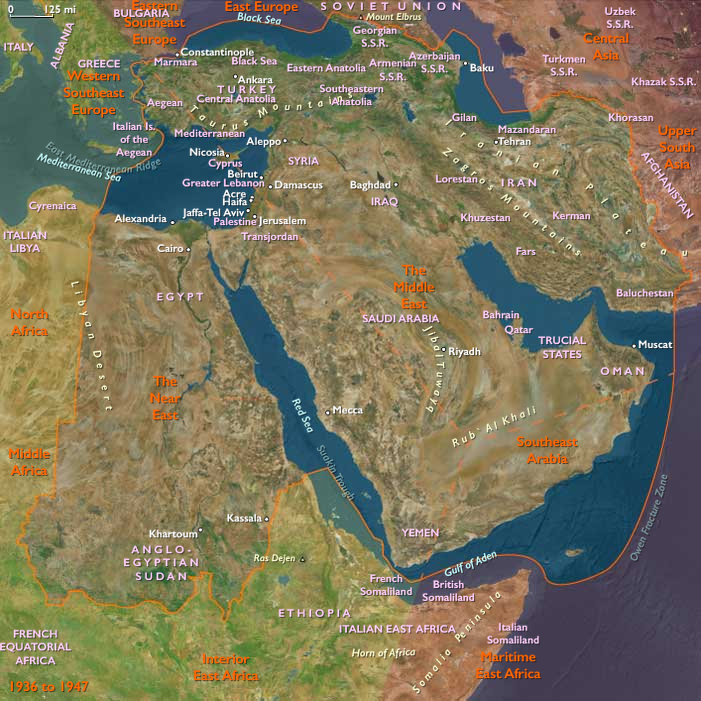
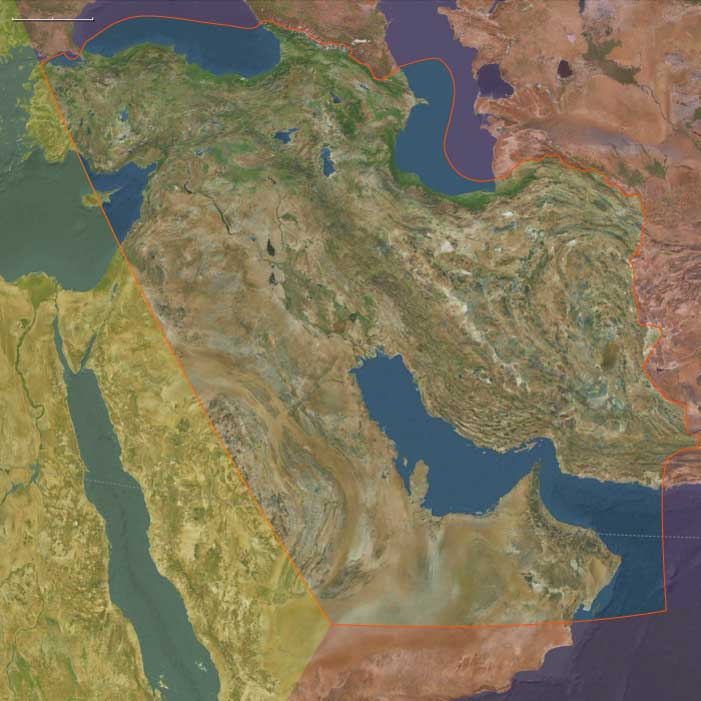
Abu Dhabi grants an oil concession to Iraq Petroleum Company in 1939 and creates the Abu Dhabi Petroleum Company as a subsidiary for development.
Locations
Groups
Subjects
Regions
Subregions
Related Events
Filter results
Showing 10 events out of 5852 total
At the outbreak of war in September 1939, Australia’s federal government offers every assistance to Britain and rapidly mobilizes.
Australian prime minister Joseph Lyons dies in office in April, 1939 and is succeeded by the Country party’s Earl Page, who is in turn succeeded by attorney general Robert Gordon Menzies.
By 1939, Japan conquers most of eastern China.
Italy and Germany expand the Axis into a military alliance in 1939.
Yugoslavia’s Sava Banovina unites with the Littoral Banovina in 1939 to form the Banovina of Croatia.
The Indian National Congress remains in power for twenty seven months.
During these months, Mohammad Ali Jinnah reorganizes the Muslim League
By the late 1930s, Jinnah, convinced of the need for a unifying issue among Muslims, believes Pakistan is the obvious answer.
The Second World War breaks out in 1939 and the British, as they did in the Great War, take India to war with them.
British priorities are driven by the expediencies of defense, and war is declared abruptly without any prior consultation with Indian politicians.
Congress ministers in the provinces resign in protest.
Consequently, Congress, with most of its leaders in jail for opposition to the Raj, loses its political advantage over the British.
The Indian Muslims had opposed the British war effort in 1914 and had also suffered heavy consequences.
The Muslim League, under the leadership of Jinnah, while choosing to remain neutral, leaves the provincial leaders free to cooperate with or help the war efforts in their individual capacities.
The League establishes a committee to examine the partition proposals that are coming in from many provinces.
The committee includes Jinnah as chairperson, Abdul Mateen Chaudhry, Khawaja Nazimuddin, Liaquat Ali Khan, Nawab Ismail Khan, and Syed Abdul Aziz.
They submit a detailed report highlighting the possibilities of a separate homeland for the Muslims of India.
The Muslim League branches of Uttar Pradesh and Sindh independently pass resolutions demanding a separate homeland for the Muslims of India.
All these reports are dispatched to the central office of the Muslim League, where they are compiled to support the demand for a separate homeland in the next annual meeting.
German troops complete the dismemberment of Czechoslovakia in March 1939.
1939 marks the first attempted assassination of Hitler.
Hitler, in 1939, names Rudolf Hess second in succession after Herman Goering.
Hitler and Stalin sign the Nazi-Soviet Pact, officially merely a ten-year non-aggression agreement but secretly including a protocol to divide Poland between them, on August 23, 1939.
On September 1, Germany invades Poland in a blitzkrieg that starts the Second World War.
Hitler’s threats to take Poland’s free port of Danzig prompts Anglo-French intervention.
France and the British Commonwealth, sans Ireland, declare war on Sept. 3, 1939, two days after Germany’s invasion of Poland.
The Blitzkrieg crushes Polish resistance.
Soviet troops invade Poland from the East, and Hitler and Stalin divide the country between them.
Three million Polish Jews suffer a Blitzpogrom of murder and rape.
Himmler aide Reinhard Heydrich issues a ghetto decree to progressively isolate Jews from the rest of the Polish population.
The USSR invades Finland two days after its November 29, 1939 denunciation of its nonaggression pact with that country, initiating the Russo-Finnish War, or Winter War.
The League of Nations condemns the USSR for its Finnish adventure and expels it.
Hitler dissolves Czechoslovakia later in the year, makes Bohemia and Moravia protectorates, and encourages the formation of an independent Slovakia.
Interpol, grouped with the Gestapo in 1939, is either exiled or taken over by the Nazis.

Peter Abrahams (a future novelist) finds conditions in the South Africa of 1939 so repressive that he leaves for Jamaica at age 20.
South Africa’s Nationalist party reunites in opposition to the nation’s entry into the Second World War.
Hertzog, opposed to South Africa’s entry into the war, resigns as prime minister in September 1939 following the defeat in Parliament of his motion of neutrality.
Jan Smuts, who succeeds Hertzog, favors South Africa’s entry into the war on the side of the allies; former Stellenbosch University professor Hendrik F. Verwoerd opposes it.
South Africa declares war on Germany.
Population transfers in Palestine have already begun.
Ramla, though an Arab city, had contained a Jewish community until the Arab-Jewish disturbances of 1936 to 39.