The British government invites all the Arab …
Years: 1923 - 1923
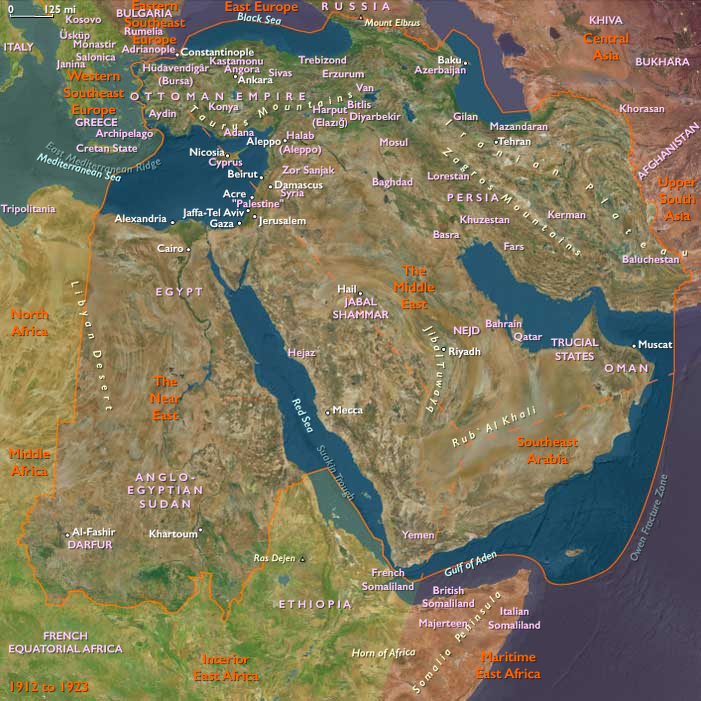
The British government invites all the Arab rulers concerned in the sporadic hostilities to attend a conference at Kuwait in 1923 and, if possible, to agree on a settlement of their differences.
The British also make it clear that the £60,000 annual subsidies paid since 1915 to Ibn Sa'ud and Sharif Husayn will be terminated.
The conference ends in complete disagreement.
Related Events
Filter results
Showing 10 events out of 7098 total
Although there is no indication of any decline in overall level of addiction in China, opium smoking has declined and heroin use has increased rapidly.
By 1923, Shanghai syndicates are importing 10.25 tons of heroin from Japan and Europe annually to meet consumer demand.
The fundamental political issue in Romania is the struggle between parliamentary government and authoritarianism.
The prospects for democracy seem bright, for the two strongest parties support representative institutions.
The Liberal Party, the dominant political force, sponsors a revision of the constitution in 1923 that protects middle-class political and economic values.
The new constitution provides for a highly centralized state.
A chamber of deputies and a senate make up the national legislature, and the king holds the power to appoint prime ministers.
The constitution grants males suffrage and equal political rights, eliminates the Romanian Orthodox Church's legal supremacy, gives Jews citizenship rights, prohibits foreigners from owning rural land, and provides for expropriation of rural property and nationalization of the country's oil and mineral wealth.
The constitution's liberal civil rights guarantees carry dubious force, however, and election laws allow political bosses to manipulate vote tallies easily.
The constitution enables Bucharest to dominate Transylvania's affairs, …
Belgrade’s foreign policy in the 1920s seeks to counter threats from Italy, Hungary, and Bulgaria, and to secure regional peace through a series of Balkan alliances.
The young kingdom is a charter member of the League of Nations.
In 1921 and 1922, Yugoslavia, Romania, and Czechoslovakia had signed mutual defense and political treaties aimed at blocking a Habsburg restoration and blocking the ambitions of revisionist Hungary.
This alignment, later known as the Little Entente, wins support from France, which hopes to block Soviet expansion and contain Germany.
France backs the agreement because it hems in Germany along its eastern frontiers.
…which further fuels resentment in the region.
Polish firms begin in 1923 to dismiss Jewish factory workers.
The Einstein Tower (German: Einsteinturm), an astrophysical observatory in the Albert Einstein Science Park in Potsdam, built by Erich Mendelsohn, is built on the summit of the Potsdam Telegraphenberg to house a solar telescope designed by the astronomer Erwin Finlay-Freundlich.
The telescope supports experiments and observations to validate (or disprove) Albert Einstein's relativity theory.
The building was first conceived around 1917, built from 1919 to 1921 after a fund-raising drive, and becomes operational in 1924.
Although Einstein never works here, he supports the construction and operation of the telescope.
(It is still a working solar observatory today as part of the Leibniz Institute for Astrophysics Potsdam.)
Light from the telescope is directed down through the shaft to the basement where the instruments and laboratory are located.
There were more than half a dozen telescopes in the laboratory.
This is one of Mendelsohn's first major projects, completed when a young Richard Neutra is on his staff, and his best-known building.
A handful of high school students in Riga, Latvia, under the influence of Vladimir Jabotinsky in 1923 establish the Betar, an activist Zionist youth movement dedicated to the establishment of a Jewish state on both sides of the Jordan River.
Jabotinsky is a hero to the Yishuv because of his role in the defense of the Jews of Jerusalem during the riots of April 1920.
The name "Betar" is an acronym for "Brith Yosef Trumpeldor"—Association of [Joseph] Trumpeldor, the hero of the Zion Mule Corps and of Tel Hay—and, as Bethar, the name of final redoubt of the Jewish revolutionary Bar Kochba during the anti-Roman revolt of CE 135.
Its industrial centers occupied by France from January, 1923, Germany suffers massive inflation.
The Dawes Plan restructures German war reparation payments in Germany’s favor.
Iran’s civil war ends in 1923 with Reza Pahlavi installed as prime minister.
In a Munich beer hall on the night of November 8, 1923, Hitler and General Erich Ludendorff announce the “National Revolution” against the alleged government of Jews and Marxists that Hitler views as destroying Germany; the next day, they launch an attempted coup, or putsch, in an attempt at bringing the Bavarian government under control of the National Socialist (Nazi) party.
Marching on the Bavarian War Ministry, the Nazis are beset by other right wing elements.
Hitler deputy Hess escapes to Austria.
Hitler is captured and tried for high treason.
The International Police Organization (Interpol) is founded in Vienna in 1923.
Ataturk begins the modernization of the new, truncated Turkish republic.
French physicist Maurice, duc de Broglie, has observed faint spectral lines which almost correspond to those predicted by Niels Bohr for element 72, but his attempts to increase the concentration to verify this are thwarted as he is working with rare earth residues.
Bohr predicts that element 72 will not be a member of the rare earths, or lanthanides, but will instead be related to zirconium.
Dutch physicist Dirk Coster and Hungarian-Swedish chemist György Charles de Hevesy, investigating zirconium minerals in 1923 at Bohr's suggestion, discover a new element in Norwegian and Greenland zircons by analyzing their X-ray spectra.
They name the new element hafnium, after Hafnia, the name, in New Latin, for Copenhagen, the city in which it is discovered.
Years: 1923 - 1923
Locations
Groups
- Britain (United Kingdom of Great Britain and Ireland)
- Kuwait, British protectorate of
- Hejaz, Kingdom of
- Russian Soviet Federated Socialist Republic