The eighteen-year-long Panthay Rebellion in central Yunnan …
Years: 1873 - 1873
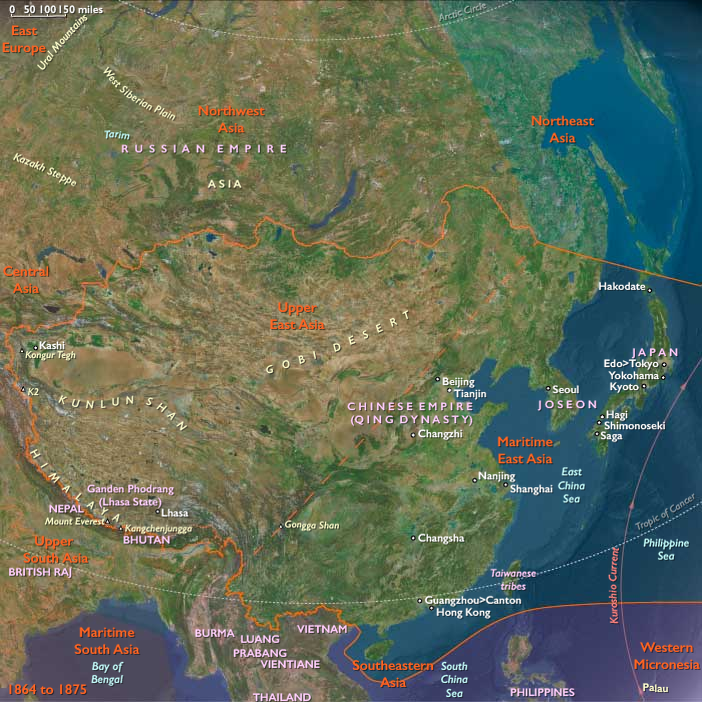
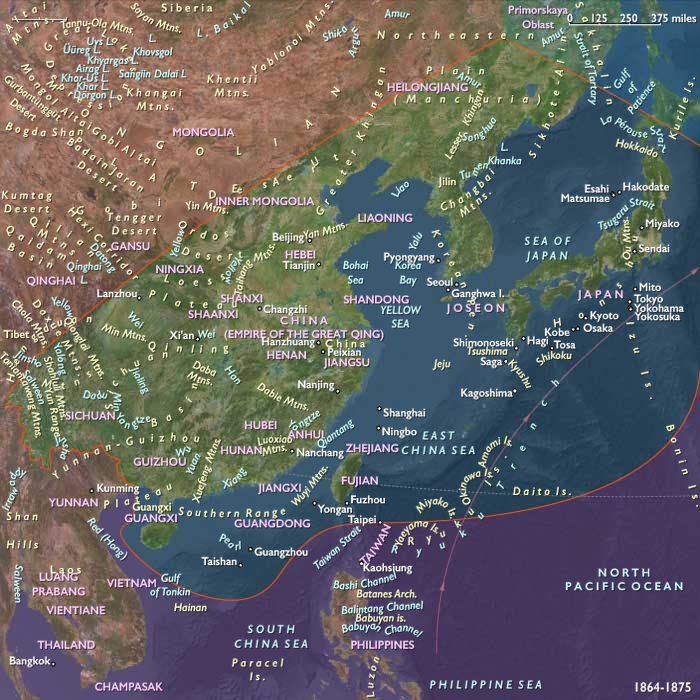
The eighteen-year-long Panthay Rebellion in central Yunnan is finally crushed in 1873 with great cruelty by the Chinese Imperial troops, aided by arms from the French authorities in Tonkin.
Locations
Groups
Topics
- Panthay Rebellion
- Dungan Revolt, Hui Minorities' War, or Muslim Rebellion in China
- Chinese Rebellion & Reaction 1864-75
Subjects
Regions
Subregions
Related Events
Filter results
Showing 10 events out of 12581 total
Kamehameha V's cousin William Charles Lunalilo wins the election and assumes the Hawaiian throne on January 8, 1873.
The other candidate is David Kalākaua; Lunalilo is the more popular of the two.
When Lunalilo assumes the duties of the king, a major change in the government's policy begins to form.
His predecessor, Kamehameha V, had spent his reign increasing the powers of his office and trying to restore the absolute monarchy of his grandfather, Kamehameha I.
Lunalilo, however, will spend his reign trying to make the Hawaiian government more democratic.
Wishing to undo some of the changes that his predecessor had made when he enacted the 1864 Constitution, he starts by writing to the legislature, recommending that the constitution be amended.
For example, the Kingdom legislature prior to 1864 had met in two houses: The House of Nobles and the House of Representatives.
The members of the House of Nobles were appointed by the King and the Representatives were elected by popular vote.
Lunalilo had served in the House of Nobles from 1863 through 1872.
Under King Kamehameha V, the two houses of legislature had been combined into one.
Lunalilo wishes to restore the bicameral legislature.
He also wants to add a provision to the constitution that would require the king to include a written explanation to accompany any veto by the king.
He wants cabinet ministers to be heard in the House of Representatives.
The King also wants to improve Hawaii's economic situation.
The Kingdom is in an economic depression, with the whaling industry rapidly declining.
Commercial groups ask the king to look at sugarcane cultivation to improve the economy and recommend that a treaty be drawn with the United States to allow Hawaiian sugar to enter the nation tax-free.
To make such a treaty, many think that the Kingdom will have to offer the Pearl Harbor area to the United States in exchange.
There is much controversy over this, with both the public and in the legislature.
When Lunalilo sees this opposition, he drops the proposal.
During Lunalilo's reign, a mutiny takes place in the small Hawaiian army when some members of the army revolt against the drillmaster and the adjutant general.
The king interviews the troops involved in the mutiny and persuades them to lay down their arms.
Following this, the king disbands the army.
From this point on, the Kingdom will have no armed forces until King Kalākaua restores them.

Uluru and Kata Tjuta had been first mapped by Europeans in 1872 during the expeditionary period made possible by the construction of the Australian Overland Telegraph Line.
In separate expeditions, Giles and Gosse are the first European explorers to this area.
While exploring the area in 1872, Giles had sighted Kata Tjuta from a location near Kings Canyon and called it Mount Olga, while the following year Gosse observes Uluru and nameda it Ayers Rock, in honor of the Chief Secretary of South Australia, Sir Henry Ayers.
These barren desert lands of Central Australia disappoint the Europeans as unpromising for pastoral expansion, but will later come to be appreciated as emblematic of Australia.
Rama V is the first Siamese king to have a full western education, having been taught by a British governess, Anna Leonowens—whose place in Siamese history has been fictionalized as The King and I.
At first, Rama V's reign had been dominated by the conservative regent, Chaophraya Si Suriyawongse, but when the king comes of age in 1873, he soon takes control.
He creates a Privy Council and a Council of State, a formal court system and budget office.
He announces that slavery will be abolished gradually and debt-bondage restricted.
Sir Harry Ord, now perceived as incompetent by the Colonial Office in London, is replaced in 1873 by Sir Andrew Clarke, who is ordered to get a complete picture of what is happening in the Malay states and recommend how to streamline British administration in Malaya.
London is increasingly aware that the Straits Settlements are increasingly dependent on the economy of the Malay states, including Perak.
After Clarke's arrival in Singapore, many British traders, including Read, became close to the governor.
Through Read, Clarke learns of Raja Abdullah's problem and his willingness to accept a British representative in his court if the British assist the once heir-apparent.
Zuo Zongtang slowly and systematically defeats the Muslim rebels in Shensi and ..
...Kansu, using a combination of effective taxation, encouragement of economic production, and Western technology.
In 1873, Zuo finally succeeds in suppressing the rebellion, which has affected more than ten million people.
The Muslim Panthay rebellion in Yunnan lasts until 1873.
Lack of a unified policy has weakened the Muslims, and the rebellion is brought to an end partly through the pacifiers' policy of playing the rebel leaders off against one another.
The Russians subdue Bokhara and Khiva in 1873 but allow them to survive as vassal-states; both khanates became Russian protectorates.
Vasil Levski, captured by the Turks, becomes a Bulgarian national hero when he is hanged in 1873, but his death temporarily shatters the Bulgarian Revolutionary Central Committee.
Omani Sultan Turki ibn Said signs a major agreement with Britain to suppress the slave trade in 1873.
However, the deteriorating economy resulting from the suppression of the slave trade renders the sultan's secular rule susceptible to opposition from the devout Ibadi population of the interior.
For a brief period, Turki appeases his opposition with cash payments and British backing.
His authority extends from the Al Batinah coast to Suhar, but the rest of the country operates autonomously.
Whereas other gulf rulers use the British to protect them from their more powerful neighbors, the sultan needs the British to protect him from his subjects.
Years: 1873 - 1873
Locations
Groups
Topics
- Panthay Rebellion
- Dungan Revolt, Hui Minorities' War, or Muslim Rebellion in China
- Chinese Rebellion & Reaction 1864-75