
Hongi Hika attacks Ngāti Whātua again in …
Years: 1825 - 1825
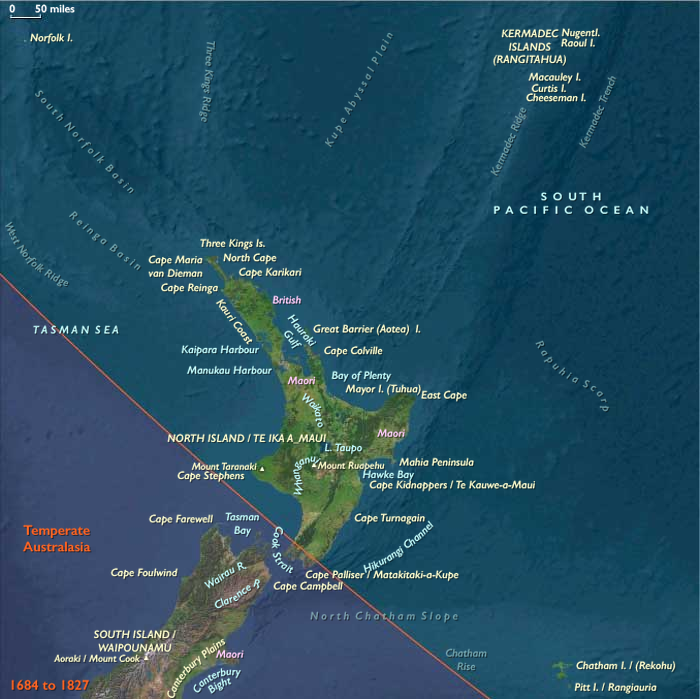
Hongi Hika attacks Ngāti Whātua again in 1824–25, losing seventy men, including his eldest son Hare Hongi, in the battle of Te Ika a Ranganui.
According to some accounts, Ngāti Whātua lost one thousand men—although Hongi Hika himself, downplaying the tragedy, put the number at one hundred.
In any event, the defeat is a catastrophe for Ngāti Whātua—the survivors retreat south, leaving behind the fertile region of Tāmaki Makaurau (the Auckland isthmus) with its vast natural harbors at Waitemata and Manukau—land which had belonged to Ngāti Whātua since they won it by conquest over a hundred years before.
Hongi Hika leaves Tāmaki Makaurau almost uninhabited as a southern buffer zone.
Fifteen years later, when Lieutenant Governor William Hobson wishes to remove his fledgling colonial administration from settler and Ngāpuhi influence in the Bay of Islands, he will be able to purchase this land cheaply from Ngāti Whātua, to build Auckland, a settlement that has become New Zealand’s principal city.
Although the Māori population has always been, to some extent, mobile in the face of conquests of land, during the Musket Wars, Hongi Hika alters the balance of power not only in the Waitemata but also the Bay of Plenty, Tauranga, Coromandel, Rotorua and Waikato to an extent which seems unprecedented within the memory of his contemporaries.
Although he does not usually occupy conquered territory, his campaigns and those of other musket warriors trigger a series of migrations, claims and counter claims which in the late twentieth century will add to the disputes over land sales in the Waitangi Tribunal—not least Ngāti Whātua's occupation of Bastion Point.
Locations
People
Groups
Topics
Commodoties
Subjects
Regions
Subregions
Related Events
Showing 10 events out of 20063 total
Years: 1825 - 1825
Locations
People
Groups
Topics
Commodoties
Subjects
Regions
Subregions