
The world's first modern railway, the Stockton …
Years: 1825 - 1825
September
The world's first modern railway, the Stockton and Darlington Railway, opens in England on September 27, 1825.
A parliamentary bill had been passed in 1821 to allow the building of the Stockton and Darlington Railway (S&DR).
The twenty-five-mile (forty kilometer) railway is intended to connect various collieries situated near Bishop Auckland to the River Tees at Stockton, passing through Darlington on the way.
The original plan was to use horses to draw coal carts on metal rails, but after company director Edward Pease met Stephenson he had agreed to change the plans.
George Stephenson surveyed the line in 1821, assisted by his eighteen-year-old son Robert.
Construction of the line began the same year.
A manufacturer was now needed to provide the locomotives for the new line.
As it turned out, Pease and Stephenson jointly established a company in Newcastle to manufacture locomotives.
The company was set up as Robert Stephenson and Company, and George's son Robert was the managing director.
A fourth partner is Michael Longridge of Bedlington Ironworks.
An early trade card describes Robert Stephenson & Co as "Engineers, Millwrights & Machinists, Brass & Iron Founders".
In September 1825, the works at Forth Street, Newcastle complete the first locomotive for the new railway: originally named Active, it is soon renamed Locomotion.
It will be followed by Hope, Diligence, and Black Diamond.
Locomotion, driven by Stephenson, haul an eighty-ton load of coal and flour nine miles (fifteen kilometers) in two hours, reaching a speed of twenty-four miles per hour (thirty-nine kilometers per hour) on one stretch.
The first purpose-built passenger car, dubbed Experiment, is attached, and carries dignitaries on the opening journey.
It is the first time passenger traffic has been run on a steam locomotive railway, representing a revolution in land transportation.
The rails used for the new line are wrought-iron ones, produced by John Birkinshaw at the Bedlington Ironworks.
Wrought-iron rails can be produced in much longer lengths than the cast-iron ones and are much less liable to crack under the weight of heavy locomotives.
William Losh of Walker Ironworks had thought that he had an agreement with Stephenson to use his cast-iron rails, and Stephenson's decision causes a permanent rift between the two men.
The gauge that Stephenson has chosen for the line is 4 feet 8½ inches (1,435 millimeters), and this will subsequently come to be adopted as the standard gauge for railways, not only in Britain, but also throughout the world.
Stephenson moves to the Liverpool and Manchester Railway the same year.
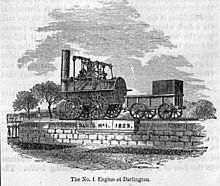
The No. 1 engine, called Locomotion, for the Stockton & Darlington Railway (Smiles, Samuel. Lives of the Engineers, 1862, digitized by Project Gutenberg 27710)
Locations
People
Groups
- Britain (United Kingdom of Great Britain and Ireland)
- Liverpool and Manchester Railway (L&MR)
- Stockton and Darlington Railway
Topics
Commodoties
Subjects
Regions
Subregions
Related Events
Showing 10 events out of 20063 total
Years: 1825 - 1825
September
The No. 1 engine, called Locomotion, for the Stockton & Darlington Railway (Smiles, Samuel. Lives of the Engineers, 1862, digitized by Project Gutenberg 27710)
Locations
People
Groups
- Britain (United Kingdom of Great Britain and Ireland)
- Liverpool and Manchester Railway (L&MR)
- Stockton and Darlington Railway
Topics
Commodoties
Subjects
Regions
Subregions