The Wahhabis capture and sack the Shi'ite …
Years: 1801 - 1801
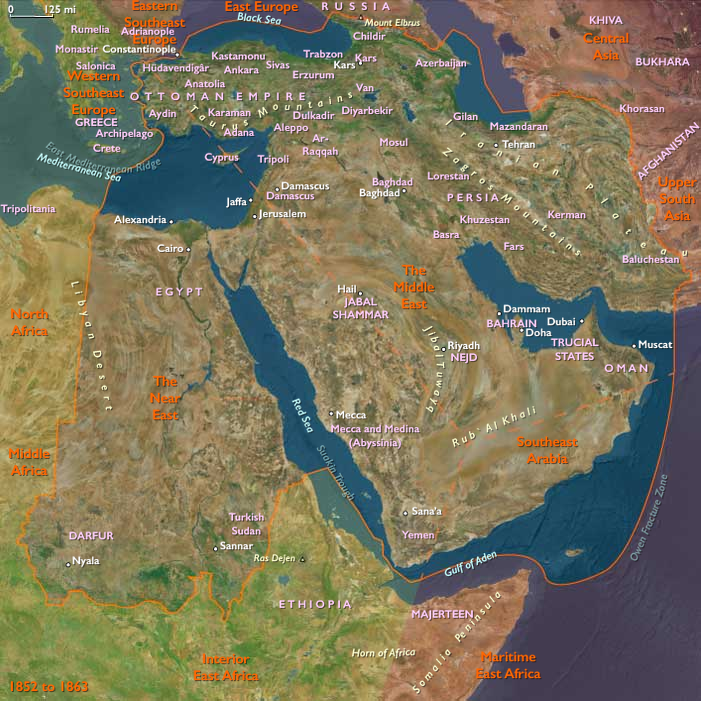
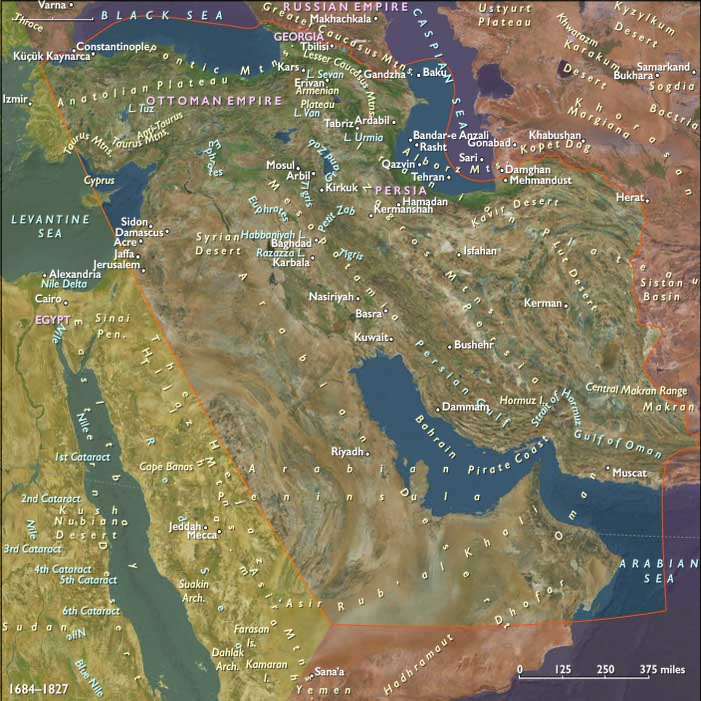
The Wahhabis capture and sack the Shi'ite holy city of Karbala' in the central region of Ottoman Iraq in 1801.
Locations
Groups
Commodoties
Subjects
Regions
Subregions
Related Events
Filter results
Showing 10 events out of 22720 total
Many Yankee merchants had become involved in the continuous trade of pelts to China within a few years of the Columbia Expedition’s voyages, and by 1801 sixteen American vessels are engaged in this triangular route.
These mercantile activities encroach upon territorial claims by other nations to this disputed region, notably those of Spain and of Russia, and in the coming years they will be used in support of American claims to the Oregon Country, and will contribute to the limiting to California and to Alaska, respectively, of the Spanish and Russian claims.
George Bass had married Elizabeth Waterhouse at St. James Church, Westminster, on October 8, 1800.
She was the sister of Henry Waterhouse, Bass's former shipmate, and captain of the Reliance.
He had set sail again within three months, and though he writes her affectionate letters, such is his fate that he will not return.
Bass and a syndicate of friends have invested some ten thousand pounds in the copper-sheathed brig Venus, and a cargo of general goods to transport and sell in Port Jackson.
Bass, as the owner-manager, had set sail in early 1801. (Among his influential friends and key business associates in the Antipodes is the principal surgeon of the satellite British colony on Norfolk Island, Thomas Jamison, who will subsequently be appointed Surgeon-General of New South Wales.)
On passing through Bass Strait on his 1801 voyage he recorded it simply as Bass Strait, like any other geographical feature.
It seems, as Flinders' biographer Ernest Scott observed, that Bass's natural modesty meant he felt no need to say "discovered by me" or "named after me".
On arrival, Bass finds the colony awash with goods and he is unable to sell his cargo.
Governor King is operating on a strict program of economy and will not take the goods into the government store, even at a 50% discount.
What King does, though, is contract with Bass to ship salt pork from Tahiti.
Food is scarce in Sydney at this time and prices are being driven up, yet pigs are plentiful in the Society Islands and King can contract with Bass at six pence a pound, where he'd been paying a shilling (twelve pence) previously.
The arrangement suits King's thrift, and is profitable for Bass.
King meanwhile continues to face military arrogance and disobedience from the New South Wales Corps.
He fails to receive support in England when he sends an accused officer, John Macarthur, back to face a court-martial in November 1801.

As late as July 1800, there is no evidence of any 'prophetic word' from Macarthur about the future of Spanish wool: at that time he was considering selling his entire flock.
Sir Walter becomes an important patron and friend to Macarthur.
For example, when William Davidson, later Macarthur's business partner in New South Wales, applies for land next to Macarthur's holdings at Parramatta, he will carry with him a letter of introduction announcing his Royal connections as nephew to Sir Walter Farquhar.
The Year 1801 – A Turning Point in the Napoleonic Wars
The year 1801 saw major geopolitical shifts and military campaigns across Europe, the Middle East, and the Atlantic world, as Britain expanded its war effort, France sought to consolidate its victories, and conflicts raged in Portugal, Egypt, and the Caribbean.
Formation of the United Kingdom (January 1, 1801)
On January 1, 1801, the Acts of Union officially merged the Kingdom of Great Britain and the Kingdom of Ireland, creating the United Kingdom of Great Britain and Ireland.
- This political union unified the British Isles under a single government, strengthening Britain’s war effort against France.
- Ireland, long under British rule, was now fully integrated into the United Kingdom, though Irish resentment and unrest remained.
- The war against revolutionary and Napoleonic France was now a national struggle for the entire British Isles.
The Treaty of Lunéville – France Strengthens Its Dominance (February 9, 1801)
After French military successes in Italy and Germany, Austria signed the Treaty of Lunéville, effectively confirming the terms of the earlier Treaty of Campo Formio (1797).
- Austria formally ceded the left bank of the Rhine to France, consolidating French control over Western Germany.
- The Holy Roman Empire’s influence was further weakened, marking a step toward its eventual dissolution in 1806.
- The treaty left Britain as France’s only major opponent on the continent, setting the stage for naval and colonial warfare.
The French Surrender in Egypt (August–September 1801)
Napoleon’s Egyptian expedition, launched in 1798, was doomed by British naval supremacy and Ottoman resistance.
- In 1801, British and Ottoman forces launched a joint invasion, overwhelming the French garrisons in Egypt.
- After the fall of Cairo (June 1801) and Alexandria (September 1801), the French were forced to surrender, marking the end of Napoleon’s Eastern ambitions.
- The loss of Egypt weakened French prestige and influence in the Middle East, while Britain solidified its naval dominance in the Mediterranean.
Britain’s Naval War – The Battle of Copenhagen (April 2, 1801)
To counter Britain’s powerful naval blockade, a coalition of neutral countries—Prussia, Russia, Denmark, and Sweden—formed the League of Armed Neutrality, aiming to protect neutral shipping from British interference.
- Britain, viewing this as a threat to its maritime dominance, responded with a preemptive strike on Denmark.
- At the Battle of Copenhagen (April 2, 1801), Admiral Horatio Nelson launched a surprise attack, destroying much of the Danish fleet in harbor.
- The League of Armed Neutrality collapsed, ensuring that Britain’s naval blockade would continue unchecked.
The War of the Oranges – France and Spain Attack Portugal (May–June 1801)
As part of Napoleon’s pressure campaign against Britain’s allies, France and Spain invaded Portugal, launching the War of the Oranges (May 1801).
- The Spanish army, backed by French forces, quickly occupied Olivença and parts of the Alentejo region.
- Portugal, militarily weak and diplomatically isolated, was forced to sign the Treaty of Badajoz (June 1801), agreeing to:
- Close its ports to British shipping.
- Grant commercial concessions to France.
- Cede Olivença to Spain (a territorial loss that remains a source of dispute today).
While Portugal remained independent, the treaty temporarily weakened its ties with Britain—though Portugal would secretly maintain contacts with its old ally.
The Saint-Domingue Expedition – France’s Failed Attempt to Crush the Haitian Revolution (December 1801–1803)
Napoleon, determined to restore French control over Saint-Domingue (Haiti), sent a massive expedition under General Charles Leclerc in December 1801 to crush the slave-led revolution that had begun in 1791.
- Leclerc’s forces initially gained ground, but faced fierce resistance from Toussaint Louverture and his army.
- However, the British Royal Navy blockaded the Caribbean, preventing France from sending reinforcements.
- Over time, the French army suffered heavy losses from guerrilla warfare, disease (yellow fever), and lack of supplies.
- The campaign would ultimately fail, leading to Haiti’s declaration of independence in 1804, making it the first independent Black republic in history.
Conclusion – The War in 1801
The year 1801 was a pivotal moment in the Napoleonic Wars:
- Britain strengthened its control of the British Isles, solidifying Ireland’s incorporation into the UK.
- France consolidated its dominance in Europe with the Treaty of Lunéville, forcing Austria out of the war.
- The French surrender in Egypt ended Napoleon’s dreams of an Eastern empire, while Britain cemented its naval supremacy at the Battle of Copenhagen.
- The War of the Oranges weakened Portugal, forcing it into temporary submission to France and Spain.
- The French expedition to Saint-Domingue would ultimately fail, marking the beginning of the end of French colonial rule in the Caribbean.
As 1802 approached, both Britain and France were exhausted, leading to negotiations for peace—but this truce would be short-lived, as Napoleon’s ambitions would soon lead to renewed conflict across Europe.
Achard opens the first sugar beet refinery at Gut Kunern near Steinau in Silesia, at this time a part of Prussia, in 1801, with the support of King Friedrich Wilhelm III.
Achard had planted various sugar-bearing plants on his manor in Kaulsdorf near Berlin in 1789.
He soon preferred sugar beets because of their efficiency.
In the following year he had studied different varieties of beets and the influence of fertilizers.
The research had been interrupted when Kaulsdorf manor burnt down and had to be sold.
Achard later continued on the manor Französisch Buchholz.
Johann Ritter, a German physicist, discovers the ultraviolet end of the spectrum in 1801.
A blood libel in Bucharest leads to the death or wounding of one hundred and twenty-eight Jews in 1801.
A threefold invasion of Egypt begins in 1801.
British troops are landed at Abu Qir in March, while the Ottomans advance from Syria.
British forces destroy Bonaparte’s Egyptian army at Alexandria in August.
The first census is held in France in 1801.