
Georges Cuvier had in 1800 been the …
Years: 1811 - 1811
Georges Cuvier had in 1800 been the first to correctly identify in print, working only from a drawing, a fossil found in Bavaria as a small flying reptile, which he named the Ptero-Dactyle in 1809 (later Latinized as Pterodactylus antiquus)—the first known member of the diverse order of pterosaurs.
In 1808, Cuvier had identified a fossil found in Maastricht as a giant marine lizard, which he named Mosasaurus, the first known mosasaur.
Cuvier speculated that there had been a time when reptiles rather than mammals had been the dominant fauna.
This speculation will be confirmed over the next two decades by a series of spectacular finds.
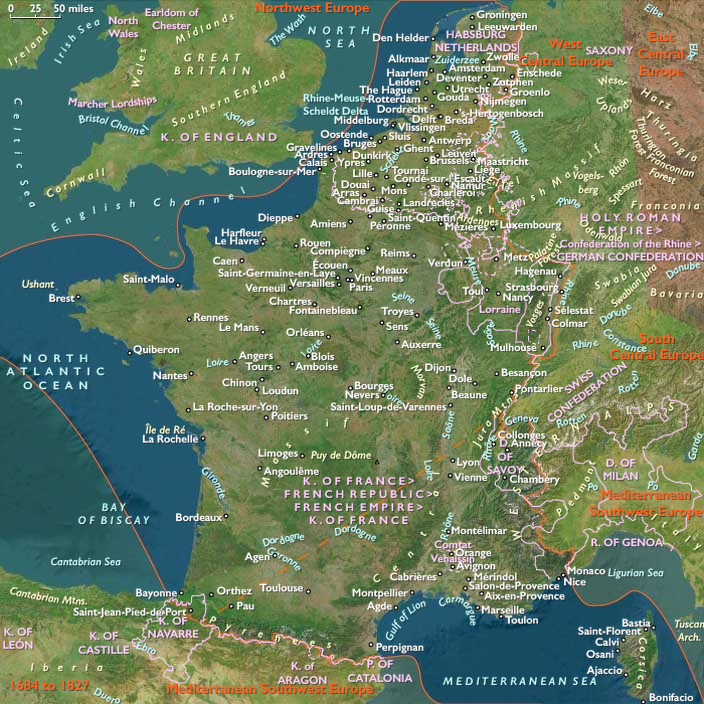
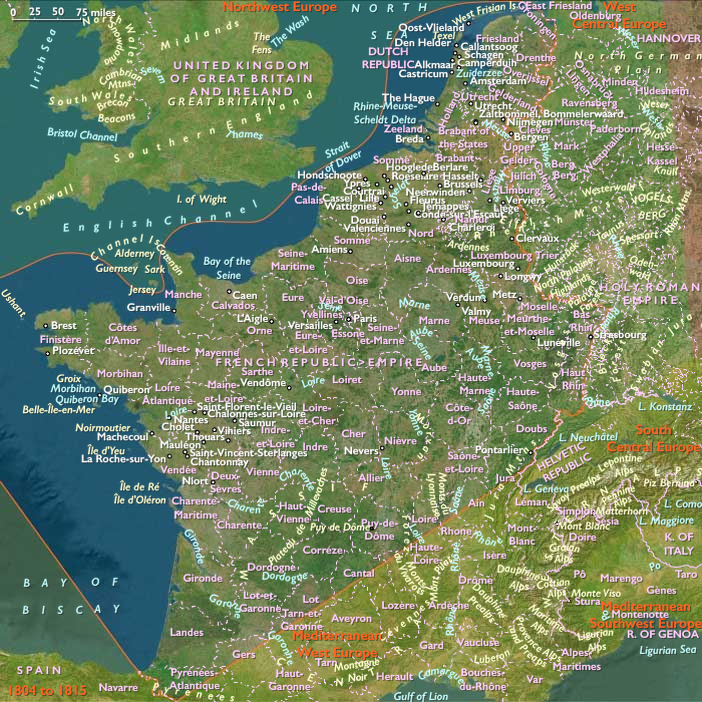
Cuvier has collaborated for several years with Alexandre Brongniart, an instructor at the École de Mines (Mining School) in Paris, to produce a monograph on the geology of the region around Paris.
They had published a preliminary version in 1808 and the final version is published in 1811.
In this monograph, they identify characteristic fossils of different rock layers that they use to analyze the geological column, the ordered layers of sedimentary rock, of the Paris basin.
They conclude that the layers had been laid down over an extended period during which there clearly had been faunal succession and that the area had been submerged under sea water at times and at other times under fresh water.
Along with William Smith's work during the same period on a geological map of England, which also used characteristic fossils and the principle of faunal succession to correlate layers of sedimentary rock, the monograph helps establish the scientific discipline of stratigraphy.
It is a major development in the history of paleontology and the history of geology.
Cuvier has come to believe that most if not all the animal fossils he has examined are remains of species that were now extinct.
Near the end of his 1796 paper on living and fossil elephants, he wrote: All of these facts, consistent among themselves, and not opposed by any report, seem to me to prove the existence of a world previous to ours, destroyed by some kind of catastrophe.
This has led Cuvier to become an active proponent of the geological school of thought called catastrophism, which maintains that many of the geological features of the earth and the history of life could be explained by catastrophic events that had caused the extinction of many species of animals.
Over the course of his career, Cuvier will come to believe that there had not been a single catastrophe but several, resulting in a succession of different faunas.
He writes about these ideas many times; in particular, he discusses them in great detail in the preliminary discourse (introduction) to a collection of his papers, Recherches sur les ossements fossiles de quadrupèdes (Researches on quadruped fossil bones), on quadruped fossils published in 1812.
The 'Preliminary Discourse' becomes very well known, and unauthorized (and in the case of English not entirely accurate) translations are made into English, German and Italian.
Apart from his own original investigations in zoology and paleontology Cuvier has carried out a vast amount of work as perpetual secretary of the National Institute, and as an official connected with public education generally; and much of this work appears ultimately in a published form.
Thus, in 1808 he had been placed by Napoleon upon the council of the Imperial University, and in this capacity he presides (in the years 1809, 1811 and 1813) over commissions charged to examine the state of the higher educational establishments in the districts beyond the Alps and the Rhine which had been annexed to France, and to report upon the means by which these could be affiliated with the central university.
Three separate reports on this subject are published by him.
In his capacity, again, of perpetual secretary of the Institute, he not only prepares a number of éloges historiques on deceased members of the Academy of Sciences, but he is the author of a number of reports on the history of the physical and natural sciences, the most important of these being the Rapport historique sur le progrès des sciences physiques depuis 1789, published in 1810.
Locations
People
Groups
Subjects
Regions
Subregions
Years: 1811 - 1811
Locations
People
Groups
Subjects
Regions
Subregions