Abdul Aziz musters a large army of …
Years: 1788 - 1788
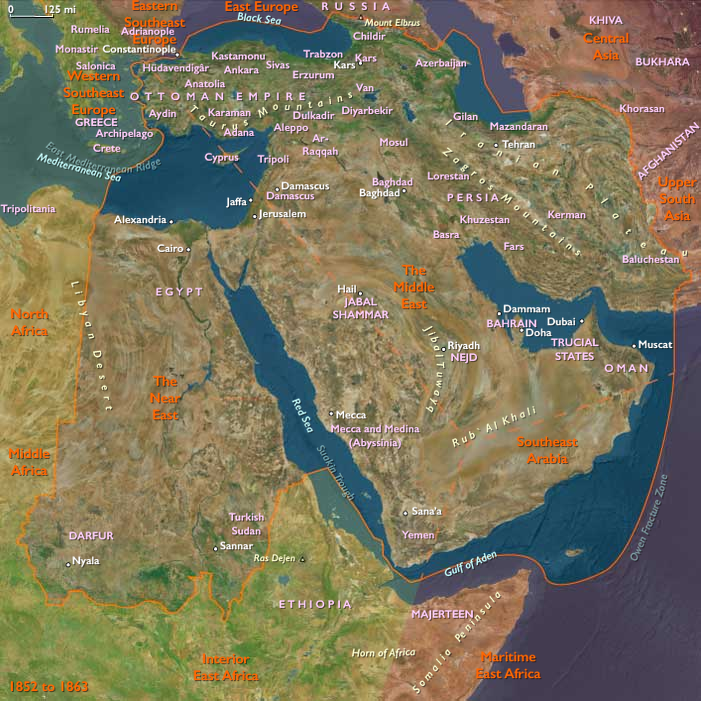
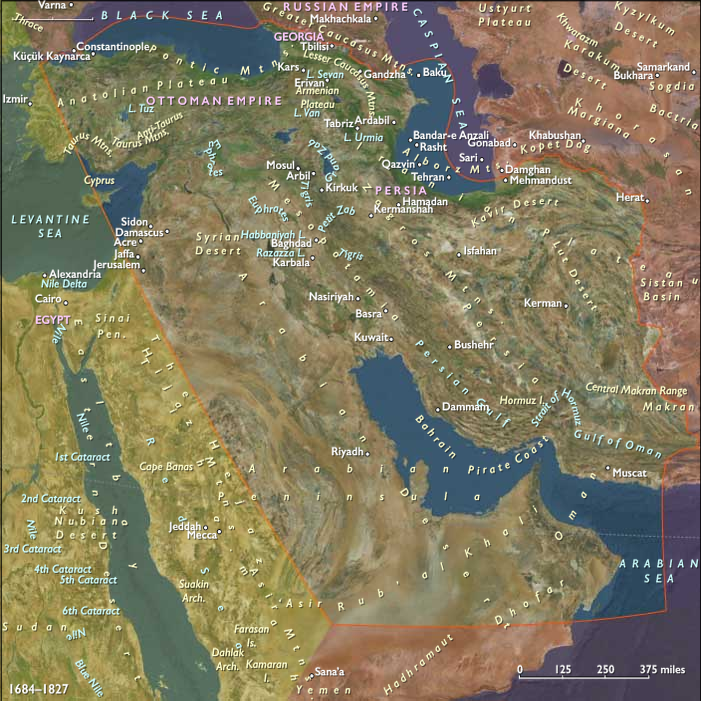
Abdul Aziz musters a large army of Wahhabis with British forces in 1788, attacks Kuwait and occupies it, then offers Kuwait as a gift to Britain who had failed in their 1755 and 1767 attempts to wrest Kuwait from Ottoman control.
Locations
People
Groups
Commodoties
Subjects
Regions
Subregions
Related Events
Filter results
Showing 10 events out of 24474 total
Alexander Mackenzie, born at Luskentyre House in Stornoway on the Isle of Lewis, was the third of the four children born to Kenneth 'Corc' Mackenzie (1731–1780) and his wife Isabella MacIver, from another prominent mercantile family in Stornoway.
When only fourteen years old, Mackenzie's father served as an ensign to protect Stornoway during the Jacobite rising of 1745.
He later became a merchant and held the tack of Melbost; his grandfather being a younger brother of Murdoch Mackenzie, 6th Laird of Fairburn.
Educated at the same school as Colin Mackenzie, Alexander had sailed to New York City with his father to join an uncle, John Mackenzie, in 1774, after his mother died in Scotland.
In 1776, during the American War of Independence, his father and uncle had resumed their military duties and joined the King's Royal Regiment of New York as lieutenants.
By 1778, for his safety as a son of loyalists, young Mackenzie had either been sent, or was accompanied by two aunts, to Montreal.
By 1779 (a year before his father's death at Carleton Island), Mackenzie had secured an apprenticeship with Finlay, Gregory & Co., one of the most influential fur trading companies at Montreal, which is later administered by Archibald Norman McLeod.
The North West Company had expanded in 1787 to include Gregory, McLeod and Company, and in 1788 sends Alexander Mackenzie to Alberta, where he is one of the founders of Fort Chipewyan on Lake Athabasca.
On behalf of the North West Company Mackenzie travelled to Lake Athabasca where, in 1788, he was one of the founders of Fort Chipewyan.
Shelikhov seeks exclusive control of the fur trade, and Empress Catherine II decides in 1788 to grant his company a monopoly only over the area it already occupies.
Other traders are free to compete elsewhere.
Catherine's decision is issued as the imperial ukase (proclamation) of September 28, 1788.
The Russians have spent over forty years establishing and expanding their maritime operations in North America by the time of Catherine's ukase of 1788, just as other nations are entering the maritime fur trade.
A number of colonies are being established over a large region stretching from the Aleutian Islands to Cook Inlet and Prince William Sound.
Many ships sail from Kamchatka to Alaska each year.
The Russians not only have an early start, but they control the habitats of the most valuable sea otters.
The Kurilian, Kamchatkan, and Aleutian sea otters have fur that is thicker, glossier, and blacker than those on the Northwest Coast and California.
There are four grades of fur based on color, texture, and thickness.
The most prized furs are those of Kurilian and Kamchatkan sea otters, Aleutian furs are second grade, those of the Northwest Coast third, and the poorest grade is that of Californian sea otters.
Russia also controls the sources of sable furs, the most valuable fur-bearing land mammal.
The Russian system differs from the British and American systems in its relationship with indigenous peoples.
Using the same method they had used in Siberia the Russians have employed or enserfed Aleut and Alutiiq people, the latter being a subgroup of the Yupik Eskimo people.
The Aleut and Alutiiq people are expert sea otter hunters, noted for their use of kayaks and baidarkas.
Russian ships are mainly used for transporting and assisting native hunting parties.
This differs from the British and American system, where the natives hunt sea otters and prepare the furs on their own, and are essentially independent agents of the fur trade.
The Russians do not trade freely with the native Alaskans, rather they impose a fur tribute known as yasak.
The yasak system, which is widely used in Siberia, essentially enslaves the natives.
It is banned in Russian America in 1788, only to be replaced by compulsory labor.

The Iphigenia arrives in December 1788 in Kealakekua Bay with Chief Kaʻiana, who had already traveled to China.
The first American ship is probably the Lady Washington around this time, under Captain John Kendrick.
Sir John Call, MP for Callington in 1784 and a partner in the Pybus and Son banking house, had argued the advantages of Norfolk Island in that it is uninhabited and that flax grows there.
The British government includes Norfolk Island as an auxiliary settlement, as proposed by Call, in its plan for colonization of New South Wales in 1786.
The decision to settle Norfolk Island is taken due to the decision by Empress Catherine of Russia to restrict sales of hemp.
Practically all the hemp and flax required by the Royal Navy for cordage and sailcloth is imported from Russia.
Philip Gidley King was born at Launceston, Cornwall, England on April 23, 1758.
Joining the Royal Navy at the age of twelve as captain's servant, he had been commissioned as a lieutenant in 1778.
King had served under Arthur Phillip, who had chose him as second lieutenant on HMS Sirius for the expedition to establish a convict settlement in New South Wales.
On arrival, in January 1788, King had been selected to lead a small party of fifteen convicts and seven free men to set up a settlement at Norfolk Island, nearly a thousand miles (sixteen hundred kilometers) distant, and prepare for its commercial development as a second station for transported convicts.
King and his party land on March 6, 1788, with difficulty, owing to the lack of a suitable harbor, and set about building huts, clearing the land, planting crops, and resisting the ravages of grubs, salt air and hurricanes.
More convicts and soldiers are sent to the island from New South Wales during the first year of the settlement, which is also called "Sydney" like its parent.
The first Swedish theater had opened in Bollhuset and Lejonkulan in 1667 and employed only foreign companies.
While the plays were sometimes open to the public, it remained more or less a court theater.
The first Swedish play, Den Svenska Sprätthöken, was performed in 1737 by the first Swedish theater company.
The Swedish theater had been turned out of their playhouse by Queen Louisa Ulrika of Prussia after the 1753-54 season, and the playhouse had been given to a French company.
In 1773, King Gustav III had fired the French company and encouraged Swedish talents, and thus, the Royal Swedish Opera is founded in Bollhuset.
A theater of spoken drama had been founded in the same building in 1787, but was not to last long.
In 1788 the director flees the country to escape his creditors, so the actors form a company and asked for the king's protection, which leads to the establishment of the national stage for dramatic art (spoken drama).
It was now that the Royal Theater (Kungliga Teatern) in Sweden is officially split in two, and the Royal Theater (today known as the Royal Swedish Opera) becomes hereafter solely an opera stage.
For spoken drama a new theater is built specifically, called Kungliga Dramatiska Teatern—the Royal Dramatic Theater, to distinguish it from the Royal Theater (the opera stage).
The king becomes the formal director and places the theater under Royal protection, to be ruled by the actors themselves by votes every fourteenth day under the supervision of the Royal Swedish Academy of Arts.
This rule is quite chaotic, and the voting is described as capricious and temperamental.
In 1803, the actors themselves will ask for the system to be replaced by a director.
Austria offers to recognize Kara Mahmud as the ruler of all Albania if he will ally himself with Vienna against the Sublime Porte.
Seizing an opportunity, Kara Mahmud sends the sultan the heads of an Austrian delegation in 1788, and the Turks appoint him governor of Shkodër.
He is first buried in the Frascati Cathedral, where his brother Henry Benedict Stuart is bishop.
Henry thus becomes the new Stuart claimant to the throne of Great Britain, as King Henry IX and the figurehead of Jacobitism.
The duc’ d’Orleans continues his outspoken opposition to Louis XVI’s authoritarianism, increasing his stock among the people through his promotion of the union of the liberal nobles with the commoners.