
Iloilo, the second Spanish settlement in the …
Years: 1571 - 1571
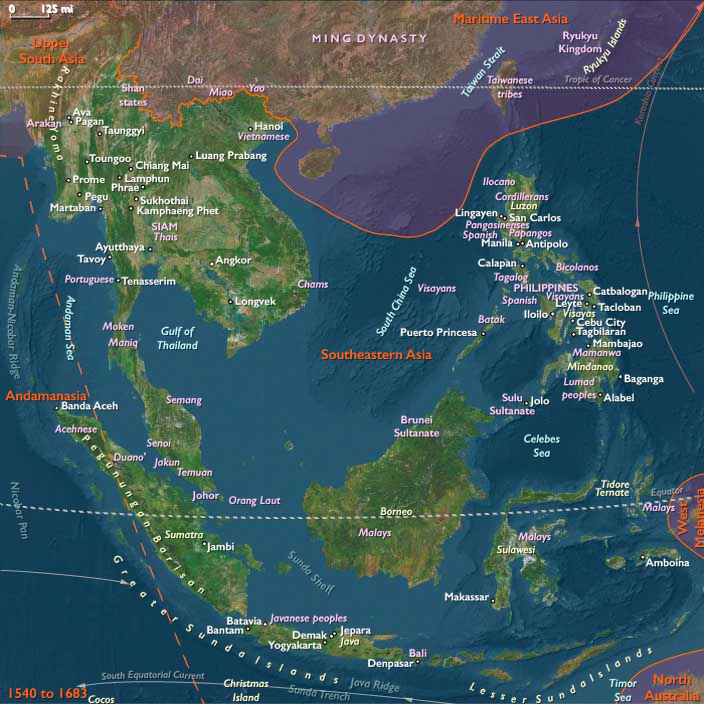
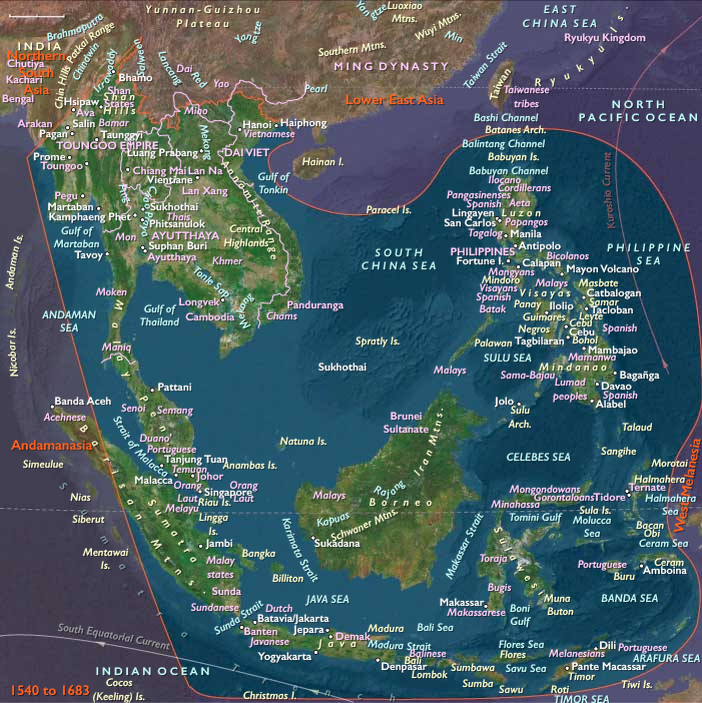
Iloilo, the second Spanish settlement in the Philippines, is established in 1571 on Panay Island.
Locations
People
Groups
Topics
Commodoties
Subjects
Regions
Subregions
Related Events
Filter results
Showing 10 events out of 35378 total
López de Legazpi, after hearing that Manila has been conquered, follows Goiti and Salcedo to the city in 1571.
Here, he forms a peace pact with the native Muslim councils, Rajahs Suliman, Matanda, and Lakandula.
Both groups agree to organize a city council, consisting of two mayors, twelve councilors and a secretary.
López de Legazpi finally establishes a permanent settlement here on June 24, 1571, and orders the construction of the walled city of Intramuros.
He proclaims the town as the island's capital and permanent seat of the Spanish colonial government in the western Pacific Ocean.
With the help of Augustinian and Franciscan friars, he establishes a government on the islands, becoming the first Spanish governor of the Philippines, and works to convert the natives to the Catholic religion.
Those who oppose his rule are tortured and executed, while those who supported him are awarded with encomiendas.
Setthathirat, ruler of the Laotian kingdom of Lan Xang, and often allied to the Siamese and the Shan states of Upper Burma in their defensive wars against Lower Burma’s expansionist King Bayinnaung, dies in 1571 at the age of thirty-seven.
Bayinnaung again invades Lan Xang.
Nobunaga, now master of Kyoto, crushes all opposition, including the powerful Tendai Buddhist establishment in the Hiyesian hills above Kyoto, whose Enryakuji monastery on Mt.
Hiei, with its warrior monks, is a particular thorn in his side, residing as it does so close to his residence at Kyoto.
The sect has been a traditional power in politics and religion since the beginning of the Heian period in the eighth century.
Nobunaga, in retaliation for their aid to his enemies, attacks Enryakuji, admired by contemporaries as a significant cultural symbol, and in 1571 burns it to the ground, killing between twenty thousand and thirty thousand men, women, and children in the process.
He then shatters, albeit with less severity, the Buddhist monasteries in the province under his control.
Nobunaga also encourages the Jesuit missionaries in Japan as a means of weakening his traditionalist opposition.
What had once been Russia's best and most fertile areas have been devastated and have fallen well below the rest of the country.
Those that have not been killed by the Oprichniks have often fled into other areas of Russia.
Tax revenues, instead of increasing (as Ivan had hoped), have fallen, and Russia is badly prepared when the Crimean Tatars attack.
Devlet I Giray, the khan of the Crimean Tatars, has mounted several attacks on Moscow during Ivan’s long war against Poland-Lithuania, Livonia, and Sweden, his main purpose being the annexations of Kazan and Astrakhan, lost by the Muslim world to the Russians in the previous years.
Having seen an opportunity in Ivan’s involvement in the Russo-Turkish War of 1568-69, he sets out with a body of cavalry and advances northward to Moscow, ravaging the countryside.
Reaching Moscow’s walls in 1571, they capture and burn the city, save for the fortified Kremlin, and supposedly carry off some one hundred thousand captives before being driven off.
The Roman Catholic István Báthory, a thirty-seven-year-old member of the prominent Hungarian family, succeeds János II (János Sigismund Zápolya) as prince of Transylvania following the death of the latter on March 14, 1571.
The death of Sigismund and the accession of Stephen Báthory further contribute to the decline of Unitarianism, although Blandrata allies himself to Báthory to maintain a semblance of the earlier toleration.
Dávid meanwhile begins to advocate the view that Christ should not be worshipped at all.
The Transylvanian Diet in 1571 gives constitutional recognition to all four of the received religions.
Akbar transfers his capital from Agra to his new city of Fatehpur Sikri in 1570.
A remarkable achievement in both planning and execution, the design for the new city includes magnificent palace buildings and halls of state together with several architectural conceits, such as a courtyard transformed by its paving into a gigantic functional chessboard, and the Diwan-i-Am, a five-storied pavilion the stepped tiers of which diminish in scale as they rise toward a kiosk on top.
He personally directs the building of the Jami Masjid (Great Mosque) in 1571, which stretches some five hundred and forty feet (one hundred and sixty-five meters) in length and contains an ornate tomb for Chishti.
The Great Mosque complex contains the elaborate marble tomb of Salim and a triumphal gateway memorializing Akbar's military triumphs.
Bijapur and Ahmadnagar are drawn into a series of conflicts over the forts in the Maratha region and the Konkan coast.
A treaty between the two in 1571 reveals their interest in restoring a balance in the political situation.
Biijapur recognizes the right of Ahmadnagar to annex Berar and Bidar in return for recognition of Bijapur's right to occupy extensive territories in the south, particularly portions of Vijayanagar.
The Moriscos, after two years of ferocious campaigning, with dreadful atrocities committed by both sides, are removed en masse from Granada.
Only the few Moriscos who had collaborated with the royal forces are permitted to remain in the city and territory of Granada.
To eliminate the possibility of further revolts in Granada, Philip disperses its Morisco population in small groups among the Old Christian towns and villages of the Castilian hinterland, particularly to Valencia and Murcia, and hopes for their assimilation into Spanish society as well as true observance of Christianity.
They are replaced by colonists from Extremadura and Galicia.
In the absence of systematic education and in the face of the hostility of the Christian population, this attempt is also doomed to failure: the Moriscos will continue their particular Muslim ways.
Philip III will eventually order the expulsion of all Moriscos from Spain in 1609.
Cosimo I de' Medici', in exchange for his receipt of the title of Grand Duke of Tuscany from the Pope in 1569, had bowed to Church pressure and in the following year established the ghetto in Florence, locking in eighty-six Jews at night.
The ghetto swells to five hundred in 1571, as Jews from all over Tuscany are compelled to live within the ghetto walls.
