
Illus and Verina attempt to overthrow emperor …
Years: 483 - 483
Illus and Verina attempt to overthrow emperor Zeno and place another general named Leontius on the throne.
Locations
People
Groups
- Goths (East Germanic tribe)
- East, or Oriens, Praetorian prefecture of
- Ostrogoths, Realms of the
- Roman Empire, Eastern: Leonid dynasty
Topics
Subjects
Regions
Subregions
Related Events
Filter results
Showing 10 events out of 58473 total
Pope Simplicius dies in 483; Felix III, a widower with two children, succeeds him.
The Vandals tolerate Jews, who flourish under their rule, but persecutions of the Roman Catholic church in Africa have at times been fierce, particularly during the last years of the reign of Genseric's successor, Huneric.
The Alemannic Expansion and the Germanization of Eastern Gaul
As the Western Roman Empire collapses, the Alemanni, a confederation of Germanic tribes, continue their westward migration, establishing permanent settlements in eastern Gaul.
Settlement in Alsace and Northern Switzerland
- The Alemanni settle in Alsace, securing control over the Upper Rhine region, which will later become a permanent Germanic-speaking area.
- They also occupy northern Switzerland, where Alemannic dialects take root, forming the linguistic basis of Swiss German.
- Unlike the Franks, who integrate heavily with Gallo-Roman culture, the Alemanni retain their Germanic traditions, reinforcing their distinct identity.
Westward Expansion and Conflict
- The Alemanni push further west, moving into the territory between the Franks and the Burgundians.
- This migration creates new tensions, as they encroach upon lands contested by the Franks, particularly during the reign of Clovis I.
- Their expansion threatens Frankish-controlled territories, leading to the Battle of Tolbiac (496 CE), where Clovis decisively defeats the Alemanni.
- Following this defeat, Alemannic autonomy is reduced, and they gradually become tributary to the Franks, though they maintain a strong cultural presence in Alsace and Switzerland.
The Lasting Impact of Alemannic Migration
- The Alemannic settlements permanently shape the linguistic and cultural landscape of the Upper Rhine.
- Alsace and northern Switzerland remain German-speaking regions, even as they come under Frankish rule.
- Over time, Alemannic identity adapts to Frankish dominance, but their distinct laws, customs, and dialects survive into the medieval period.
This migration marks the end of Roman control in eastern Gaul and further cements the Germanization of the region, setting the stage for future divisions between Germanic and Romance-speaking Europe.
The Romano-British Migration to Armorica and the Birth of Brittany
As the Western Roman Empire collapses, waves of Romano-British immigrants flee Britain, crossing the English Channel to settle in Armorica (modern-day Brittany). This migration, which had begun earlier in the fifth century, accelerates dramatically in response to the increasing pressure of:
- Anglo-Saxon raids and settlements in eastern and southern Britain, displacing native Britons.
- Scoti (Irish) incursions into western Britain, including Wales and Cornwall.
- The general breakdown of Roman authority in Britain following the withdrawal of Roman legions (c. 410 CE).
The Formation of a British Identity in Armorica
- The Romano-British immigrants, known as Britons or Bretons, settle primarily on the Armorican Peninsula, where they establish permanent communities.
- These migrants bring with them their language (a Brythonic Celtic dialect), Christianity, and Romano-British traditions, heavily influencing local culture.
- Over time, the Armorican Peninsula becomes known as "Brittany" (Bretagne in French), a reflection of its British origins.
Evidence of Cultural and Linguistic Ties
The connection between Britain and Brittany is evident in:
- Place names – Many regions in Brittany bear names linked to Cornwall and Devon, such as Domnonée (related to Dumnonia in Britain) and Cornouaille (Cornwall).
- Language – The Breton language, still spoken today, remains closely related to Cornish and Welsh.
- Religious and monastic ties – Many early Christian saints venerated in Brittany (e.g., Saint Samson, Saint Malo, and Saint Gildas) were originally from Britain, reinforcing the region’s shared heritage.
Armorica Transformed into Brittany
By the end of the fifth century, the influx of Britons has permanently reshaped Armorica, turning it into a distinct Celtic region within post-Roman Gaul. While surrounded by Frankish and Gallo-Roman territories, Brittany retains its cultural and political independence, developing alongside, but separate from, the Frankish Kingdom.
This migration is one of the most significant cultural shifts of the period, ensuring that Celtic Britain continues to influence the continent, even as much of Britain itself falls under Anglo-Saxon control.
Illus has broken off his relationship with Emperor Zeno, who sends Leontius with an army against Illus, but Illus manages to persuade Leontius to go over to his side.
Zeno remains unpopular with the people of Constantinople, a crucial part of Eastern Roman politics, because he is an Isaurian and as such he is considered a barbarian (which is why he had suffered an usurpation in 475/476 by Basiliscus); Illus, who also is an Isaurian, decides not to take the throne for himself but to raise Leontius to the purple.
Leontius's coronation takes place in Tarsus on July 19, 484—the day had been chosen, following the advice of some astrologers, as a favorable day—at the hands of the empress dowager Verina, who then sends a letter to the Governors of the Diocese of the East and of the Diocese of Egypt suggesting they accept the usurper as Emperor.
Leontius is recognized in Antioch, where he enters July 27, and in some other places; he even has time to nominate officers and to mint coins, before facing the reaction of Zeno.
Illus and Leontius are both Chalcedonians and thus gain the backing of Callandion, Patriarch of Antioch, but otherwise have little support.
Also some pagans support the revolt, among whom is the poet, philosopher, and soothsayer Pamprepius.
Zeno's army, composed of Roman and Ostrogothic troops under the command of Theodoric the Amal and John the Scythian, defeats the rebel army near Antioch on August 8.
Illus and Leontius are forced to take refuge inside the fortress of Papurius, where the insurgents will hold out for four years.
East Central Europe (484–495 CE): Theodoric’s Migration to Italy and Gepid Ascendancy
Between 484 and 495 CE, East Central Europe—including Poland, Czechia, Slovakia, Hungary, and those portions of Germany and Austria lying east of 10°E and north of a line stretching from roughly 48.2°N at 10°E southeastward to the Austro-Slovenian border near 46.7°N, 15.4°E—underwent significant geopolitical shifts following the departure of Theodoric the Great and his Ostrogothic followers for Italy in 488 CE. This migration reshaped regional power dynamics, leading to increased dominance by the Gepids, who rapidly expanded into territories vacated by the Ostrogoths. Amid these transitions, the Rugii maintained their diplomatic neutrality and autonomy along the upper Tisza, while the region's proto-Slavic communities continued their enduring cultural stability and careful adaptation to shifting power balances.
Political and Military Developments
Theodoric the Great’s Departure (488 CE)
-
In 488 CE, Theodoric the Great, encouraged by the Eastern Roman Empire, led his Ostrogothic followers from East Central Europe to Italy, drastically altering regional power structures and leaving a substantial political and territorial vacuum behind.
Gepid Expansion and Dominance
-
Following the Ostrogothic exodus, the Gepids, already influential in modern Hungary and the Carpathian Basin, swiftly moved to consolidate control over the newly vacated territories, greatly expanding their sphere of influence and firmly establishing regional dominance.
Continued Autonomy of the Rugii
-
The Rugii adeptly navigated these shifting alliances and regional changes, preserving their autonomy and regional stability through continued diplomatic engagement with the Gepids and other neighboring powers.
Economic and Technological Developments
Economic Reorientation and Stability
-
The Gepid ascendency provided stability in previously Ostrogoth-controlled territories, allowing a modest economic revival through renewed trade networks, particularly along routes linking major settlements like Augusta Vindelicorum (Augsburg) and the former Roman frontier towns.
Infrastructure and Settlement Maintenance
-
Existing infrastructure, including roads, bridges, and settlements, saw modest maintenance efforts, reflecting the Gepids' intent to sustain trade and military mobility throughout the region.
Cultural and Artistic Developments
Gepid Cultural Flourishing
-
With Gepid consolidation came renewed expressions of cultural identity, as evident in refined metalwork, decorative jewelry, pottery, and weaponry. These cultural artifacts displayed distinctively Gepid motifs blended with remnants of Roman, Ostrogothic, and Hunnic artistic influences.
Proto-Slavic Cultural Continuity
-
Proto-Slavic communities maintained traditional cultural and social practices, carefully integrating limited external influences without compromising their core communal and cultural identities.
Settlement and Urban Development
Strengthened Regional Settlements
-
Strategic settlements such as Augusta Vindelicorum (Augsburg) continued to flourish as essential regional centers, benefiting from increased stability and restored trade under Gepid authority.
-
Former Roman towns, notably Carnuntum, Vindobona, and Aquincum, persisted as fortified centers and administrative hubs within Gepid-dominated regions, albeit on a smaller scale.
Stability and Prosperity of Rugian Settlements
-
Rugian communities along the upper Tisza remained economically and politically stable, anchoring local prosperity and providing continuity during regional realignments.
Social and Religious Developments
Gepid Tribal Consolidation
-
Gepid society became increasingly organized around strong warrior elites and chieftains, consolidating their regional authority by emphasizing traditional Germanic cultural practices, rituals, and governance structures.
Continued Rugian Diplomatic Success
-
Rugian leaders preserved their autonomy through careful diplomatic interactions, ensuring their continued regional independence despite the changing geopolitical landscape.
Proto-Slavic Social Resilience
-
Proto-Slavic communities continued their stable social structures and religious traditions, facilitating strong internal cohesion amid external shifts in political control.
Long-Term Consequences and Historical Significance
The era 484–495 CE represented a critical period of transition following the departure of Theodoric and the Ostrogoths, significantly reshaping East Central Europe's geopolitical landscape. The rapid Gepid expansion filled the resulting power vacuum, stabilizing parts of the region and laying the groundwork for subsequent tribal and political arrangements. Concurrently, the continued autonomy of the Rugii and the enduring resilience of proto-Slavic communities provided crucial continuity, profoundly influencing East Central Europe's historical trajectory toward early medieval configurations.
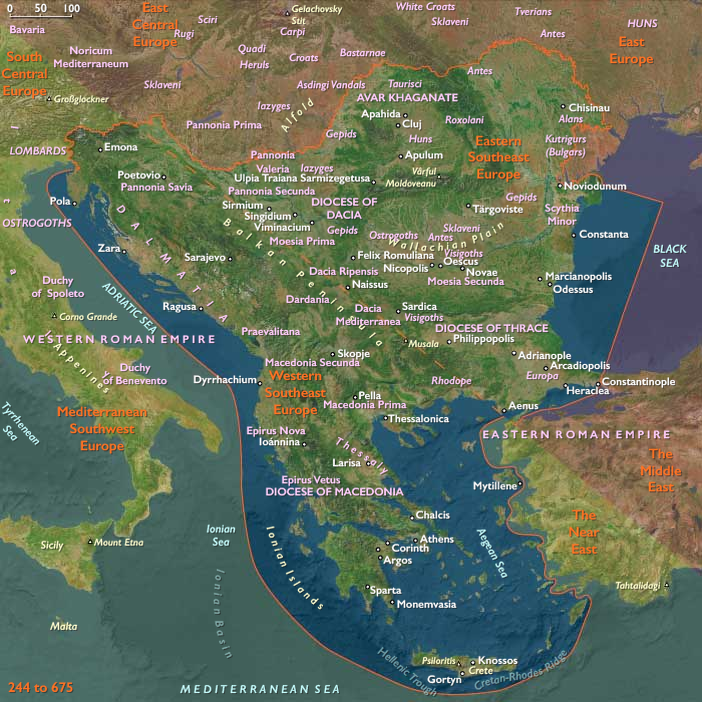
Eastern Southeast Europe (484–495 CE): Strengthening Foundations and Emerging Challenges
Settlement and Migration Patterns
Continued Regional Stability
Between 484 and 495 CE, Eastern Southeast Europe continued enjoying relative stability, allowing settlements to consolidate further after earlier migrations, particularly among expanding Slavic populations settling the Balkans. Moderate population growth reinforced urban expansion and bolstered rural communities, gradually reshaping demographic and social structures.
Strategic Fortifications
Urban centers such as Constantinople and Philippopolis continued enhancing defensive fortifications. Strategic expansions and infrastructure improvements reinforced urban security, ensuring resilience against ongoing threats and facilitating continued regional stability.
Economic and Technological Developments
Sustained Economic Activity
The region’s economy displayed sustained growth and resilience, driven by stable agricultural production, active trade routes, and consistent urban commerce. Constantinople maintained its pivotal role as the regional economic hub, facilitating trade throughout Eastern Southeast Europe and beyond.
Military and Defensive Innovations
Advancements in military technology further refined fortifications, weaponry, and logistical capabilities. These ongoing developments ensured sustained military preparedness, bolstered regional defenses, and safeguarded economic activities amid evolving challenges.
Cultural and Artistic Developments
Flourishing Artistic Traditions
Cultural vitality remained robust, with continued artistic production blending classical heritage with Christian themes. Public monuments, religious architecture, and decorative arts flourished, reinforcing regional cultural identity and societal cohesion.
Intellectual Vitality
Educational institutions and scholarly communities actively preserved and expanded classical and theological knowledge. Scholarly activities adapted effectively to contemporary socio-political contexts, sustaining cultural continuity and maintaining intellectual vibrancy.
Social and Religious Developments
Efficient Governance and Administration
Provincial administration further strengthened, improving local governance, civic oversight, and administrative efficiency. These enhancements supported ongoing regional stability, ensuring coherent responses to external pressures and internal developments.
Deepened Christian Integration
Christianity’s integration intensified, increasingly shaping social, cultural, and political dynamics. Continued establishment and expansion of religious institutions, such as churches and monasteries, reinforced societal cohesion and provided moral continuity amid change.
Long-Term Consequences and Historical Significance
The period from 484 to 495 CE was marked by strengthened regional foundations, sustained economic resilience, and robust cultural and administrative frameworks. These developments significantly influenced Eastern Southeast Europe's historical trajectory, laying essential groundwork for ongoing regional stability and cultural prominence in the emerging Byzantine era.
The Survival of the Eastern Empire and the Acacian Schism (484–519 CE)
While imperial rule collapses in the West, the Eastern Roman Empire, centered in Constantinople ("New Rome"), continues to thrive. As the last remnants of Western Roman authority disappear, "Old Rome" transforms into a primarily ecclesiastical center, maintaining its spiritual prestige while losing many of its former imperial characteristics.
The Acacian Schism and the Struggle for Religious Unity
In 484 CE, the Acacian Schism erupts between the Eastern and Western Christian Churches, reflecting a deepening theological and political rift between the two halves of the former Roman Empire.
The dispute originates from tensions over the Council of Chalcedon (451 CE), which had defined Christ as possessing two natures (divine and human)—a doctrine rejected by many in the Eastern Christian world, particularly in Egypt and Syria, where Monophysitism gained influence.
Emperor Zeno’s Henotikon: A Failed Attempt at Reconciliation
- In 482 CE, Emperor Zeno issues the Henotikon, an imperial decree attempting to bridge the divide between:
- Chalcedonian Christians, who accepted the Council of Chalcedon’s ruling, and
- Monophysite Christians, who insisted on Christ’s single, unified nature.
- The Henotikon avoids explicitly endorsing Chalcedonian Christology, instead attempting to create a compromise formula.
Excommunication and Schism (484 CE)
- The compromise satisfies neither side. Chalcedonian Christians view it as a betrayal of orthodoxy, while Monophysites see it as insufficient.
- Pope Felix III in Rome rejects the Henotikon, excommunicating Patriarch Acacius of Constantinople, the leading proponent of the policy.
- In response, Acacius retaliates, severing ties with the Roman Papacy, thus beginning the Acacian Schism.
Thirty-Five Years of Religious Division (484–519 CE)
The schism endures for thirty-five years, symbolizing:
- The widening rift between Eastern and Western Christendom, a precursor to later divisions.
- The growing autonomy of the Eastern Roman Church, as emperors in Constantinople take an increasingly active role in theological disputes.
- The political and religious isolation of Rome, which now exists in a world dominated by Germanic rulers in the West and Byzantine emperors in the East.
Resolution Under Emperor Justin I (519 CE)
The schism finally ends in 519 CE, when Emperor Justin I—a staunch Chalcedonian—seeks to restore unity with Rome. The Henotikon is abandoned, and Patriarch John II of Constantinople formally reconciles with Pope Hormisdas, restoring communion between East and West.
Legacy of the Acacian Schism
Although the schism is healed, it highlights:
- The growing theological tensions that will later culminate in the Great Schism of 1054.
- The increasing political divergence between Rome and Constantinople, as the Eastern Roman (Byzantine) emperors continue to shape Christian doctrine through imperial intervention.
- The consolidation of Constantinople as the true center of Roman imperial power, as Old Rome declines into a city defined by religious, rather than political, authority.
This period marks a turning point in Christian history, reinforcing the notion that the Western and Eastern Churches are evolving along increasingly separate paths, despite their shared Roman heritage.
Years: 483 - 483
Locations
People
Groups
- Goths (East Germanic tribe)
- East, or Oriens, Praetorian prefecture of
- Ostrogoths, Realms of the
- Roman Empire, Eastern: Leonid dynasty
Topics
Subjects
Regions
Subregions