Successes in a foreign war are necessary …
Years: 35BCE - 35BCE
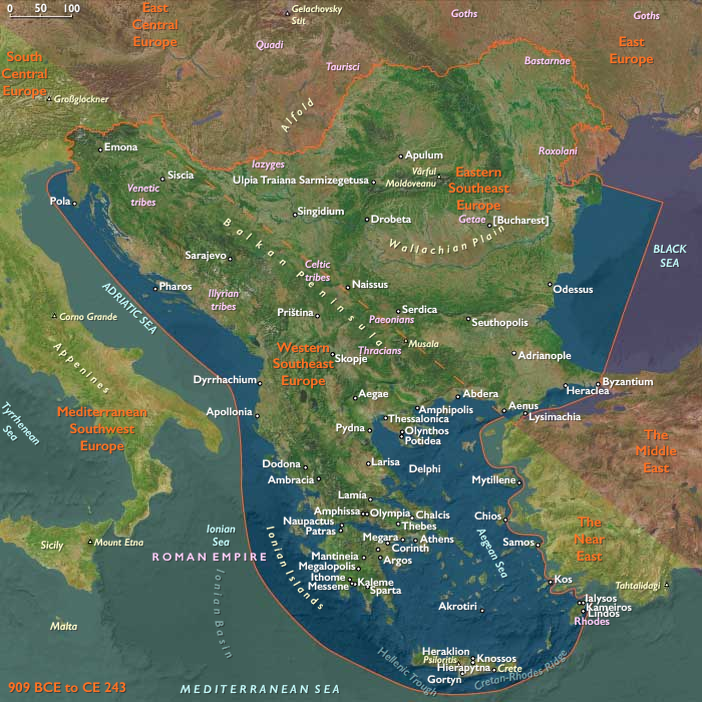
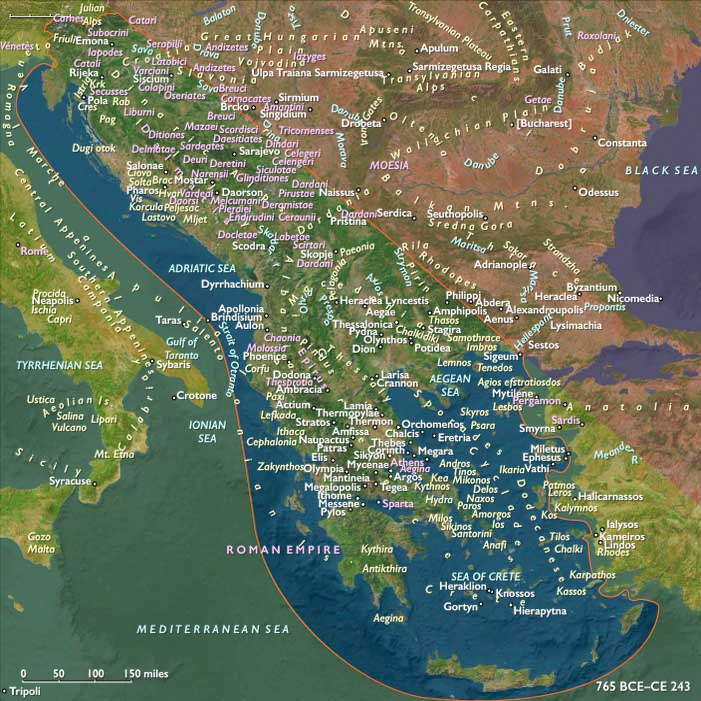
Successes in a foreign war are necessary if Octavian is to compete with Antony's military seniority; thus, Octavian in 35 initiates the Roman conquest of Pannonia, an area corresponding to present western Hungary and parts of eastern Austria, Slovenia, and northern Yugoslavia (Vojvodina).
Octavian conquers the coastal region and seizes inland Celtic and Illyrian strongholds, fighting three successive campaigns in Illyricum and Dalmatia (parts of modern Slovenia and Croatia) in order to protect the northeastern approaches of Italy.
In these, Agrippa has a distinguished military role.
Octavian eventually conquers and occupies Siscia (Sisak) in present Croatia.
Locations
People
Groups
Topics
Commodoties
Subjects
Regions
Subregions
Related Events
Filter results
Showing 10 events out of 62261 total
Cleopatra meets Antony with money and supplies on his return to Syria.
Octavian, exploiting the occasion and the contrast of Antony's failure with the decisive victory he himself—or rather his admiral Agrippa—has won against Sextus Pompeius, sends Octavia to Antony along with troops and provisions.
However, the soldiers fall far short of the numbers Antony expects (and are owed by his fellow-triumvir), and he now makes a future breach between the two leaders almost inevitable by ordering Octavia to return to Rome.
Octavian, his power thus increased, enters Rome in triumph.
Agrippa receives the unprecedented honor of a naval crown decorated with the beaks of ships; as Dio remarks, this was "a decoration given to nobody before or since".
With the help of Agrippa, Octavian also lavishes large sums on the adornment of Rome.
When Octavian foments public clamor against Antony's territorial gifts to Cleopatra, it is clear that a clash between the two men is imminent.
Gaius Sallustius Crispus, generally known simply as Sallust, had entered public life after an ill-spent youth and won election as one of the tribunes of the people in 52 BCE, the year in which the followers of Milo had killed Clodius in a street brawl.
Sallust had opposed Milo, Pompey's party and the old aristocracy of Rome.
From the beginning of his public career, Sallust had operated as a decided partisan of Caesar, to whom he owed such political advancement as he attained.
In 50, the censor Appius Claudius Pulcher had removed him from the Senate on the grounds of gross immorality (probably really because of his friendship for Caesar).
In the following year, no doubt through Caesar's influence, he had been reinstated and appointed quaestor.
In 46 he had served as a praetor and accompanied Caesar in his African campaign, which had ended in the decisive defeat of the remains of the Pompeian war party at Thapsus.
As a reward for his services, Sallust gained appointment as governor of the province of Africa Nova, the newly conquered Numidia, in which capacity he had committed such oppression and extortion that only the influence of Caesar enabled him to escape condemnation.
On his return to Rome he had purchased and begun laying out in great splendor the famous gardens on the Quirinal known as the Horti Sallustiani or Gardens of Sallust.
Retiring from public life, he has since devoted himself to historical literature, and further developing his Gardens of Sallust, upon which he has spent much of his accumulated wealth.
He recounts in his first work, Conspiracy of Catiline, the suppression of Catiline's 63 plot to seize power against the background of political and moral decline in Rome.
A master of political invective, Sallust attacks the corruption, greed, and degeneration of the Roman ruling class.
Sallust employs his powerful, somewhat archaic style in his War of Jugurtha, published in 40, assailing the incompetence and venality of the Roman aristocracy between 111 and 105, during the war against the Numidian king.
His final work, the “Histories” (which survives only in fragments, some discovered in 1886) sketches the history of Rome from 78 to 67.
Historians regret the loss of the work, as it must have thrown much light on a very eventful period, embracing the war against Sertorius (died 72 BCE), the campaigns of Lucullus against Mithridates VI of Pontus (75 - 66 BCE), and the victories of Pompey in the East (66 - 62 BCE).
Sallust struck out for himself practically a new line in literature, his predecessors having functioned as little better than mere chroniclers, whereas he has endeavored to explain the connection and meaning of events and successfully delineated character.
He dies in 34 at around fifty-two.
The gardens will eventually be acquired by the emperor Tiberius and maintained for several centuries by the Roman Emperors as a public amenity.
The Emperor Nerva will die of a fever in a villa in the gardens in 98, and they willl remain an imperial resort until their sack by the Goths in 410.
In the early seventeenth century, Ludovico Cardinal Ludovisi, nephew of Pope Gregory XV, will purchase the site and constructs the Villa Ludovisi, in the course of which several important Roman sculptures will be rediscovered.
Much of the area occupied by the gardens will be divided into building lots and filled following the breakup of Villa Ludovisi after 1894, as Rome expanded as the capital city of Italy after the unification of Italy.

Only fragments survive of the works of Roman poet Publius Terentius Varro Atacinus, more polished than the more famous and learned Varro Reatinus, his contemporary.
His first known works are Bellum Sequanicum, a poem on Julius Caesar's campaign against Ariovistus, and Satires.
He has translated the Alexandrian poet Apollonius Rhodius' Argonautica into Latin.
He dies in about 35.
Marcus Terentius Varro anticipates microbiology and epidemiology in Rerum rusticarum libri III (or Agricultural Topics in Three Books), warning his contemporaries to avoid swamps and marshland, since such areas "breed certain minute creatures which cannot be seen by the eyes, but which float in the air and enter the body through the mouth and nose and cause serious diseases."
The Roman scholar and writer, also known as Varro Reatinus to distinguish him from his contemporary Varro Atacinus, was born in 116 in or near Reate (now Rieti) to a family thought to be of equestrian rank, has always remained close to his roots in the area, owning a large farm in the Reatine plain, probably near Lago di Ripa Sottile, until his old age.
He had studied under the Roman philologist Lucius Aelius Stilo, and later at Athens under the Academic philosopher Antiochus of Ascalon.
Politically, he had supported Pompey, reaching the office of praetor, after having been tribune of the people, quaestor and curule aedile.
He had escaped the penalties of being on the losing side in the civil war through two pardons granted by Julius Caesar, before and after the Battle of Pharsalus.
He had been one of the commission of twenty that carried out the great agrarian scheme of Caesar for the resettlement of Capua and Campania in 59 BCE.
Caesar had later appointed him to oversee the public library of Rome in 47 BCE, but following Caesar's death Mark Antony had proscribed him, resulting in the loss of much of his property, including his library.
Restored to favor by Octavian, Varro devotes himself fully to research and writing.
Among his many works, one that stands out for historians is his compilation of the Varronian chronology, an attempt to determine an exact year-by-year timeline of Roman history up to his time.
It is based on the traditional sequence of the consuls of the Roman Republic, eked out, where that did not fit, by inserting dictatorial and anarchic years.
It has been demonstrated to be somewhat erroneous but has become the widely accepted standard chronology, in large part because it was inscribed on the arch of Augustus in Rome; though that arch no longer stands, a large portion of the chronology has survived under the name of Fasti Capitolini.
Antony, again with Egyptian money, and believing himself betrayed by Artavasdes II of Armenia, has concluded a treaty of alliance with Artavasdes I of Media Atropatene, who had maintained his ground against the Romans but his domain had been severely ravaged.
In addition, his stronger ally Phraates IV had treated him with condescension and given him very little booty.
To deepen this friendship Alexander Helios, the son of Antony and Cleopatra VII of Egypt, is betrothed in 34 BCE to Artavasdes’ daughter Iotapa, although both are infants.
Antony now invades the Armenian kingdom and takes Artavasdes II prisoner.
A Roman Triumph is celebrated in the streets of Alexandria upon Antony’s return from his successful expedition to Armenia.
The parade through the city, a proceeding regarded by Romans as an impious parody of their traditional Triumph, is a pastiche of Rome's most important military celebration.
For the finale, the whole city is summoned a few days later to hear a very important political statement.
Antony, surrounded by Cleopatra and her children, is about to put an end to his alliance with Octavian.
He distributes kingdoms between his children by Cleopatra, giving them imposing royal titles: Alexander Helios is named king of Armenia, Media, and Parthia (which was never conquered by Rome), his twin Cleopatra Selene receives Cyrenaica and Libya, and the young Ptolemy Philadelphus is awarded Phoenicia, Syria and Cilicia.
As for Cleopatra, she is proclaimed Queen of Kings and Queen of Egypt, to rule with Caesarion (Ptolemy XV Caesar, son of Julius Caesar), King of Kings and King of Egypt.
Most important of all, Caesarion is declared the legitimate son and heir of Caesar, for Cleopatra, and now Antony, claim that Julius Caesar had fathered the boy).
These proclamations, known as the Donations of Alexandria, cause a fatal breach in Antony's relations with Rome.
The exact significance and substantiality of these Donations are disputable, but critics interpret them as involving the transfer of Roman territories into alien, Greek, hands.
Distributing insignificant lands among the children of Cleopatra is not a peace move, but neither is it a serious problem.
The serious threat to Octavian's political position, however, is the acknowledgment of Caesarion as legitimate and heir to Caesar's name.
Octavian's base of power is his link with Caesar through adoption, which grants him much-needed popularity and loyalty of the legions.
To see this convenient situation attacked by a child borne by the richest woman in the world is something Octavian cannot accept.
Quintus Horatius Flaccus (anglicized as Horace), the son of a former slave who had moved from Venusia in southern Italy to Rome to secure a better education for his son, had responded to Brutus’ speech to the Romans in Athens by enlisting, at twenty, in the republican army, in which he had fought as a staff officer (tribunus militum) under Brutus in the Battle of Philippi.
Alluding to such famous literary models as Archilochus, he will later claim that he had saved himself by throwing away his shield and fleeing.
When an amnesty was declared for those who had fought against the victorious Octavian, Horace, his military career and political aspirations shattered, had made an abject return to Rome to find his father dead and his estate confiscated.
Though later claiming that he was reduced to poverty, he nevertheless had had the means to purchase a profitable lifetime appointment as a scriba quaestorius, an official of the Treasury, which will allow him to get by comfortably and practice his poetic art.
Eventually finding employment as an ill-paid public clerk, Horace has spent his free time writing poetry and haunting literary circles.
His literary endeavors had attracted the attention of Virgil, who, in early 38, had introduced him to Gaius Maecenas, a man of letters from Etruria, a patron of the arts, and a powerful councilor to Octavian.
Maecenas has formed a friendship with Horace, granting him a country villa in the Sabine Hills (near modern Tivoli) that finally affords Horace the financial freedom to concentrate on his poetry.
Horace produces a collection of ten satirical poems written in hexameter verse, Sermonum Liber primus (also known as Satires I).
The Satires reflect Horace's adhesion to Octavian's attempts to deal with the contemporary challenges of restoring traditional morality, defending small landowners from large estates (latifundia), combating debt and usury, and encouraging novi homines (“new men”) to take their place next to the traditional republican aristocracy.
The Satires often exalt the new man, who is the creator of his own fortune and does not owe it to noble lineage.
Horace develops his vision with principles taken from Hellenistic philosophy: metriotes (the just mean) and autarkeia (the wise man's self-sufficiency).
The ideal of the just mean allows Horace, who is philosophically an Epicurean, to reconcile traditional morality with hedonism.
Self-sufficiency is the basis for his aspiration for a quiet life, far from political passions and unrestrained ambition.
Published probably in 35 and at the latest by 33, this first book of Satires represents Horace's first published work and establishes him as one of the great poetic talents of what will be known to history as the Augustan Age.
The Rise of Augustus and the Birth of the Roman Empire (27 BCE)
After nearly a century of internal conflict, Octavian successfully ended the Roman civil wars, restoring peace and stability to a state that had been plagued by power struggles, assassinations, and civil unrest.
In 27 BCE, the Senate formally granted Octavian the title of Augustus, marking his transformation into the most powerful figure in the Roman world. This moment signified:
- The end of the Roman Republic and the transition to the autocratic Roman Empire.
- The concentration of power under a single ruler, while maintaining a facade of Republican institutions.
Augustus and the Foundations of the Roman Empire
- As Augustus Caesar, he carefully reshaped Rome’s political system, ensuring his dominance while preserving Senate authority in name only.
- His rule stabilized the empire, bringing an end to the chaotic struggles of the late Republic.
- He enacted economic, legal, and military reforms, securing Rome’s dominance over its vast territories.
The Pax Romana: The Longest Period of Stability in European History
The conclusion of Rome’s final civil war ushered in the Pax Romana ("Roman Peace"), an era of:
- Relative peace and stability across the empire, lasting for over 200 years (27 BCE – 180 CE).
- Expansion and prosperity, as Rome strengthened infrastructure, trade, and governance.
- Cultural flourishing, with advancements in literature, architecture, and engineering.
Significance of Augustus’ Rule
- His reign laid the political and institutional foundations of the Roman Empire, shaping the governance of Europe for centuries.
- He became the model for future emperors, setting a precedent for imperial rule.
- The Pax Romana, which he initiated, provided stability and unity to a vast, diverse empire stretching from Britain to the Middle East.
Augustus' ascension in 27 BCE was a turning point in world history, marking the end of the Republic and the beginning of an empire that would last for nearly 500 years in the West and over 1,400 years in the East.
The Middle East: 33–22 BCE
Parthian Civil War and Roman Diplomacy
In 32 BCE, the Parthian Empire descends into civil war as Tiridates rebels against the rule of Phraates IV, who had previously alienated the nobility through harsh persecutions. Tiridates initially seizes power with considerable support from the Parthian elite, driving Phraates from the throne. However, Phraates soon returns with the backing of Scythian allies, regaining control and forcing Tiridates to flee.
Seeking refuge, Tiridates travels to Roman-held Syria, appealing to the Roman ruler Augustus for assistance. Augustus, unwilling to directly intervene against Parthia at this juncture, allows Tiridates safe haven but withholds active support. Undeterred, Tiridates launches another invasion into Parthian territory around 26 BCE, briefly minting coins under the royal title "Arsaces Philoromaios"—emphasizing his pro-Roman stance with symbolic imagery of Tyche, the goddess of fortune, offering him victory.
Despite this symbolic proclamation of legitimacy, Tiridates is swiftly expelled once more by Phraates. In an attempt to strengthen his political position, Tiridates captures one of Phraates' sons and delivers him to Augustus in Spain, intending to leverage the prince as a bargaining chip. Augustus returns the boy to his father, a gesture of diplomatic goodwill aimed at preserving peace. However, Augustus pointedly refuses to surrender Tiridates himself, further complicating Roman-Parthian relations.
Thus, this era underscores the intricate balance of power in the Middle East, with Rome cautiously navigating internal Parthian conflicts to extend its diplomatic influence without committing to direct military confrontation.
Civil war breaks out in Parthia around 32 BCE, when a certain Tiridates rebels against Phraates IV, probably with the support of the nobility that Phraates had previously persecuted.
Tiridates is expelled when Phraates returns with the help of the Scythians.
He flees to Syria, where Augustus allows him to stay, but refuses to support him.
During the next few years Tiridates invades Parthia again; some coins dated from March and May, 26 BCE, with the name of a king "Arsaces Philoromaios," belong to him; on the reverse they show the king seated on the throne, with Tyche stretching out a palm branch towards him.
He is soon expelled again, and brings a son of Phraates into Spain to Augustus.
Augustus gives the boy back to his father, but declines to surrender "the fugitive slave Tiridates."